Portuguese
  Spanish


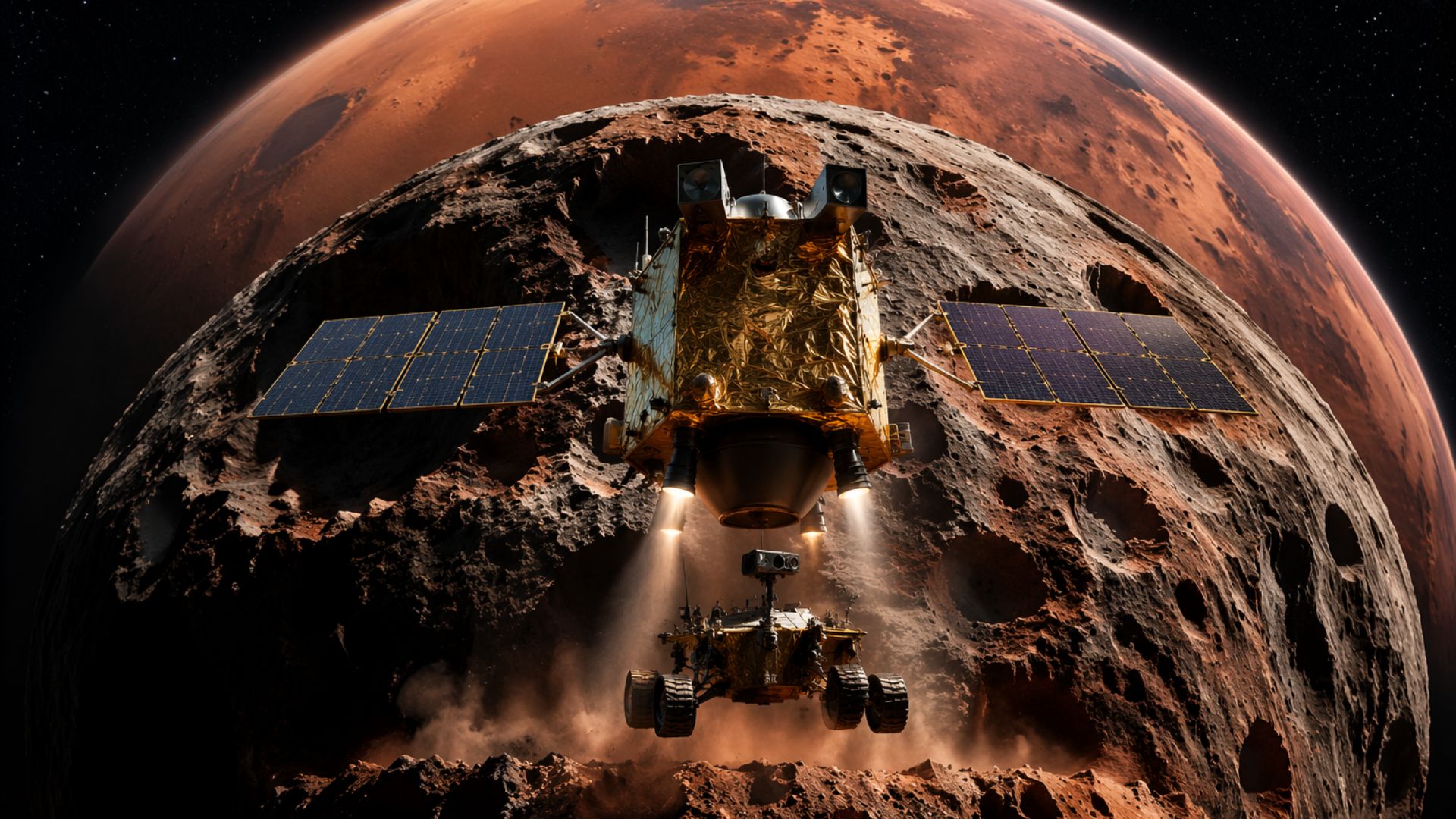

Japanese mission bets on unprecedented landing, sample collection, and return to Earth to investigate the origin of the moons of Mars, uniting planetary science and technological advancement in one of the most complex operations ever planned for deep space.
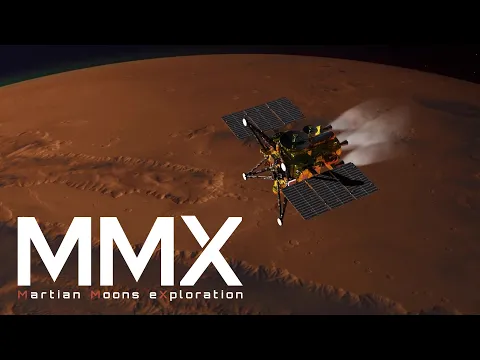
The Japanese space agency JAXA is preparing a mission that aims to elevate the exploration of the Martian system to an unprecedented level by combining prolonged observation, landing on Phobos, sample collection, and returning the material to Earth.
Named MMX, short for Martian Moons eXploration, the spacecraft is designed to study Mars’ two moons and execute, on Phobos, the first sample return mission ever planned for the Martian neighborhood.
Origin of Phobos and Deimos is the center of the mission
The project focuses efforts on one of the oldest questions in planetary science: the origin of Phobos and Deimos.
-
DNA Analysis Reveals How Five Cattle Survived Over 130 Years on a Deserted Brazilian Island

-
Private Spacecraft Intercepts Another for First Time in History During U.S. Space Force Mission Completed 11 Hours Early with Rocket Launched in Record 16 Hours

-
Scientists Predict Earth’s Habitable Lifespan: 1.8 Billion Years Before Oceans Evaporate and Sun Forces Planet Out of Life Zone
-
LG Unveils XBOOM Stage 501 Portable Speaker with 25-Hour Battery, AI Karaoke, and Sound by will.i.am in Brazil


There is still no consensus on whether the two moons were born from debris thrown around Mars after a major impact or if they were bodies formed in another region of the Solar System and later captured by Martian gravity.
JAXA treats this investigation as a central piece to understand the evolution of the Mars system and the transport of materials such as water and organic compounds between the inner and outer regions of the Solar System.
Mission to Phobos with collection and return to Earth
Unlike probes limited to flybys or remote observations, MMX was designed as a complete round-trip operation.

The architecture combines an exploration module, a sampling system, and a reentry capsule, allowing the spacecraft to travel to Mars, operate near Phobos for an extended period, collect material from the surface, and bring this content back for analysis in terrestrial laboratories.
According to the official mission, the goal is to return with more than 10 grams of samples.
This objective gives the return capsule a decisive role in the program.
Instead of relying solely on images, spectral measurements, and indirect estimates, researchers hope to confront hypotheses about the origin of the Martian moons with physical fragments of rock and regolith.
The mission also aims to gather data on the topography, internal structure, composition, and gravitational field of Phobos, while conducting observations of Deimos and the environment near Mars.
The most recent schedule released by JAXA indicates a launch in the Japanese fiscal year of 2026 aboard the H3 rocket, from the Tanegashima Space Center.
Arrival at the Martian system is expected to occur about a year later, followed by an approximately three-year phase of scientific operations in the Martian region.
After that, the spacecraft will begin its return, with the separation of the reentry capsule expected in the fiscal year of 2031 and recovery planned in Australia.
European rover IDEFIX acts before the main landing
Among the most relevant components of the mission is the IDEFIX rover, developed in partnership between the French space agency CNES and the German aerospace center DLR.
The function of this vehicle is to land on Phobos before the main sampling stage to examine the terrain, analyze surface properties, and help identify safer conditions for the operation of the mother ship.
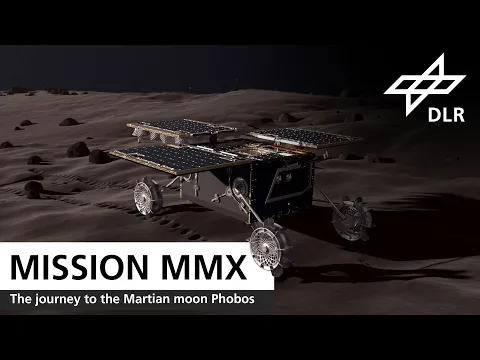

The presence of the rover transforms local exploration into a practical risk reduction step, rather than just a scientific complement.
The choice of Phobos makes the mission especially delicate from an operational standpoint.
On a small body with very low gravity, each approach, trajectory correction, and contact with the surface requires strict control.
The MMX will need to operate in a nearly stationary orbit around the Martian moon, accumulate remote observations, deploy the IDEFIX, and only then proceed to the landing and collection sequence.
This reduces the simplified image of a direct landing and shows that sampling depends on long preparation, with decisions based on the data gathered throughout the campaign.
In addition to the environmental challenge, the mission carries strategic weight for Japanese space engineering.
JAXA itself presents the MMX as a platform to develop techniques for round trips to the Martian system, access to planetary moons, operational permanence near small bodies, and advanced sampling methods.
This package also includes the enhancement of deep space communications and the consolidation of capabilities that could support future robotic missions to more distant destinations.
What the MMX can reveal about Mars and its moons
The scientific payload reflects this hybrid nature between planetary research and technological demonstration.
JAXA reports that the spacecraft will carry eleven scientific instruments used to observe Phobos, Deimos, the Martian atmosphere, and the space environment near Mars.
The definition of the collection point will depend precisely on these remote observations, which should guide the choice of the location with the highest scientific value and the best operational safety margin.
The scientific value of the material from Phobos may extend beyond the study of the two moons.
If the samples reveal signs consistent with a captured body, this will reinforce the idea that Mars retains objects coming from more distant regions of the Solar System.
If, on the contrary, the composition points to an origin in debris resulting from a large impact, the result will help reconstruct a violent phase of Martian formation.
In both scenarios, the analyses could provide clues about the circulation of matter, the history of impacts, and the conditions that shaped rocky planets.
The mission also stands out for its international reach.
Although led by JAXA, MMX brings together contributions from partners in Europe and the United States, including CNES, DLR, ESA, and NASA.
This cooperation includes the European rover, scientific instruments, and support in technologies related to deep space exploration, enhancing the project’s significance in the global landscape of planetary missions.
In practice, MMX shifts some of the traditional attention dedicated to the surface of Mars to a territory that is still little known but strategically valuable.
Instead of only targeting the red planet, the probe will seek to understand how its moons formed, how they interact with the Martian environment, and what records they hold of very ancient processes in the Solar System.
By combining detailed observation, reconnaissance rover, sample collection, and return capsule, the Japanese program aims to turn Phobos into a concrete key to answer questions that, until now, have remained largely supported by models and inferences.