Portuguese
  Spanish


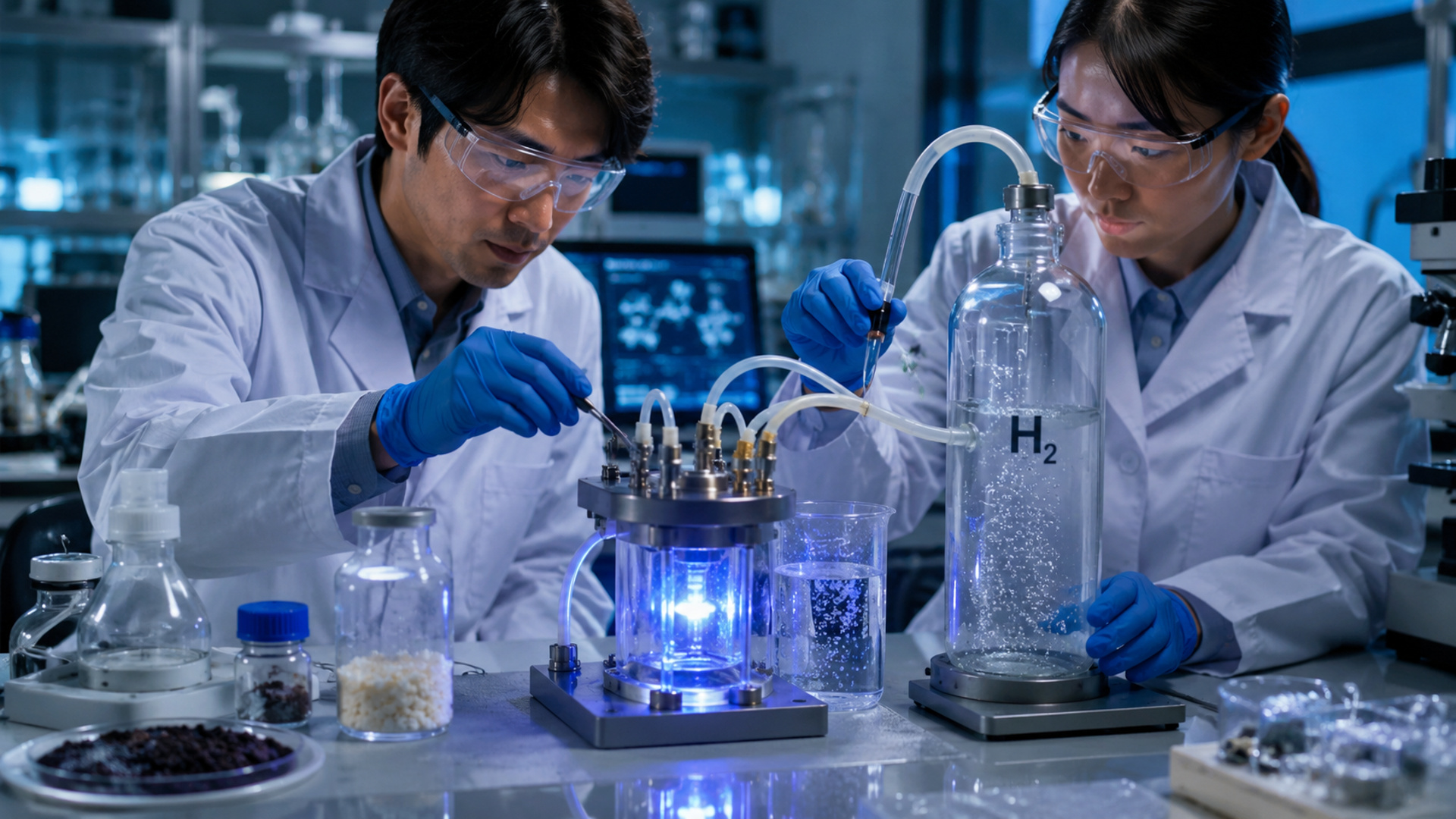


Japanese scientists create new technology to produce cheap hydrogen with iron and alcohol, driving advances in sustainable and renewable energy.
A discovery made by Japanese scientists could help accelerate low-cost hydrogen production and expand the advancement of sustainable energy in different parts of the planet. Researchers from Kyushu University announced the development of a new technology capable of generating hydrogen using iron ions, alcohol, and ultraviolet light in a process considered simple, efficient, and economically more accessible.
The study was published in the international scientific journal Communications Chemistry on April 17th and quickly drew the attention of the energy sector for using abundant and cheap materials, especially iron, one of the most common metals on Earth. Currently, most industrial hydrogen production still relies on fossil fuels, such as natural gas and petroleum, which limits some of the environmental benefits linked to renewable energy.
In addition to low cost, the researchers highlighted that the new technology also offers great versatility. The method can be adapted for different types of alcohol and even organic waste, expanding future possibilities for large-scale hydrogen production.
-
A newly discovered caterpillar in Hawaii wears the remains of its prey that it devoured as a macabre armor, stitching bones and insect shells to its own back for camouflage.

-
She heard for decades that space was not a place for women, became a pioneer in aviation, was part of the Mercury 13, and at 82, finally traveled with Jeff Bezos before dying at 87.
-
Scientists investigate microplastics in the airways of patients with sleep apnea and reveal a new focus for research on environmental pollution, human exposure, and possible impacts on breathing quality.
-
For the first time, scientists have seen the ocean floor open up in real-time—plates moving apart by two meters in a few days and 160 million cubic meters of lava emerging on the seafloor.




Japanese scientists bet on a simple solution to expand hydrogen production
The Japanese scientists responsible for the research focused their studies on the catalytic activity of metal ions. During the tests, the team mixed trivalent iron ions with methanol and sodium hydroxide. When the solution was subjected to ultraviolet light irradiation, the so-called dehydrogenation of methanol occurred, releasing hydrogen during the chemical process.
According to the results released by the Kyushu University team, the system managed to produce 20.6 liters of hydrogen per gram of catalyst every hour. Even though it is still a developing research, the number drew attention due to the performance achieved using low-cost materials.
Associate Professor Takahiro Matsumoto, one of the names involved in the study, explained that the catalyst’s activity demonstrated efficiency comparable to conventional methods currently used in hydrogen production from alcohol.
The main difference lies precisely in the cost. Many modern systems rely on rare and expensive metals, such as iridium, a factor that hinders the commercial expansion of these technologies. Iron, on the other hand, has wide availability in the global market, in addition to having a much lower price.
New technology can reduce reliance on fossil fuels
The search for cleaner energy alternatives has become a priority in several countries. Today, much of industrial hydrogen is still produced through natural gas reforming, a process that generates significant carbon dioxide emissions.
Therefore, experts consider it essential to find more sustainable ways to produce hydrogen without excessively increasing industrial costs. In this scenario, the new technology developed by Japanese scientists emerges as a promising alternative.
The use of accessible and abundant materials can help make hydrogen more competitive within the global energy matrix. This is especially important for accelerating projects related to sustainable energy and expanding investments in renewable energy.
Among the main differentials of the method presented by the Japanese team are:
- Use of iron as a catalyst
- Relatively simple chemical process
- Potential for low operational cost
- Adaptability to different alcohols
- Future possibility of utilizing organic waste
The advance also reinforces Japan’s role as one of the most active countries in research focused on energy transition and the development of sustainable solutions.
Hydrogen gains strategic space in global sustainable energy
Hydrogen is considered one of the most promising fuels for the coming decades. This is because it can be used for electricity generation without direct emission of polluting gases when applied in fuel cells.
Various governments and companies are already investing billions of dollars in the development of hydrogen-related technologies. Countries such as Japan, Germany, the United States, China, and South Korea lead some of these investments.
The growth of this market is directly linked to the need to reduce carbon emissions and expand the use of renewable energy in industrial and heavy transport sectors.
Currently, hydrogen is being studied for applications in areas such as:
- Industrial production
- Heavy road transport
- Maritime navigation
- Aviation
- Energy storage
- Electricity generation
According to analyses by the International Energy Agency, internationally known as IEA, hydrogen will play an important role in helping countries achieve climate neutrality targets by 2050.
However, one of the biggest obstacles is still the high cost of clean production. For this reason, research such as that developed by Japanese scientists is receiving worldwide attention.
Japanese scientists study the use of waste to generate renewable energy
Another point that drew attention in the study was the possibility of using waste as raw material for hydrogen production. The Japanese team reported that the new technology can be adapted for different types of alcohol derived from urban and industrial waste.
Among the materials cited by the researchers are:
- Food waste
- Sewage sludge
- Industrial organic compounds
This potential significantly expands the environmental benefits of the discovery. In addition to generating hydrogen, the method can contribute to the reuse of waste that normally causes significant environmental impacts.
In practice, this means that cities and industries could transform part of their waste into clean fuel in the future. The concept also connects directly to the principles of the circular economy and sustainable energy.
Experts believe that integrated solutions of this type tend to gain traction in the coming years, especially in countries seeking to reduce emissions without compromising economic growth.
New Japanese technology could accelerate investments in renewable energy
The development of cheaper solutions for hydrogen production can directly influence global investments in renewable energy. This is because hydrogen is seen as a strategic alternative for storing energy produced by solar and wind sources.
In many cases, one of the challenges of renewable energy lies precisely in storage capacity. Hydrogen appears as an option to solve part of this problem, allowing energy to be accumulated and used later in different sectors.
In recent years, automotive companies have also expanded research involving hydrogen-powered fuel cells. Japanese automakers such as Toyota and Honda are among the pioneers in this segment.
At the same time, European and Asian governments have announced multi-billion dollar programs to stimulate hydrogen transport and production infrastructure. With new, lower-cost technology, the scenario could become even more favorable for the global expansion of this market.
Kyushu University research still seeks to increase system efficiency
Despite the positive results presented so far, the Japanese scientists themselves acknowledge that significant challenges still remain before large-scale commercial application.
Researchers at Kyushu University reported that future studies will focus on a detailed understanding of the chemical reaction mechanism and on increasing the efficiency of hydrogen production.
Among the points that still need to be analyzed are:
- Industrial scalability
- Energy consumption of the process
- Catalyst durability
- Integration with industrial systems
- Large-scale economic viability
Nevertheless, energy sector specialists consider the discovery quite relevant precisely due to its operational simplicity and the use of abundant materials.
The global trend is for research focused on renewable energy and hydrogen to continue growing in the coming years, driven by international pressure to reduce carbon emissions.
Japanese discovery strengthens global race for cleaner energy solutions
Research led by Japanese scientists shows how scientific innovation can play a decisive role in building a more sustainable energy system. By using iron, alcohol, and ultraviolet light in a relatively simple process, the new technology has the potential to reduce costs and expand access to hydrogen.
Although further testing and efficiency improvements are still needed, the results released by Kyushu University are already attracting international interest in the energy sector.
The combination of low cost, the possibility of waste reuse, and industrial application potential makes the method seen as a promising alternative to strengthen sustainable energy and expand the use of renewable energy in different parts of the world.
With growing investments in clean technologies and increasingly stringent global decarbonization targets, solutions like this can help transform the energy future in the coming decades.
With information from Kyushu University.