






 Portuguese
  Spanish


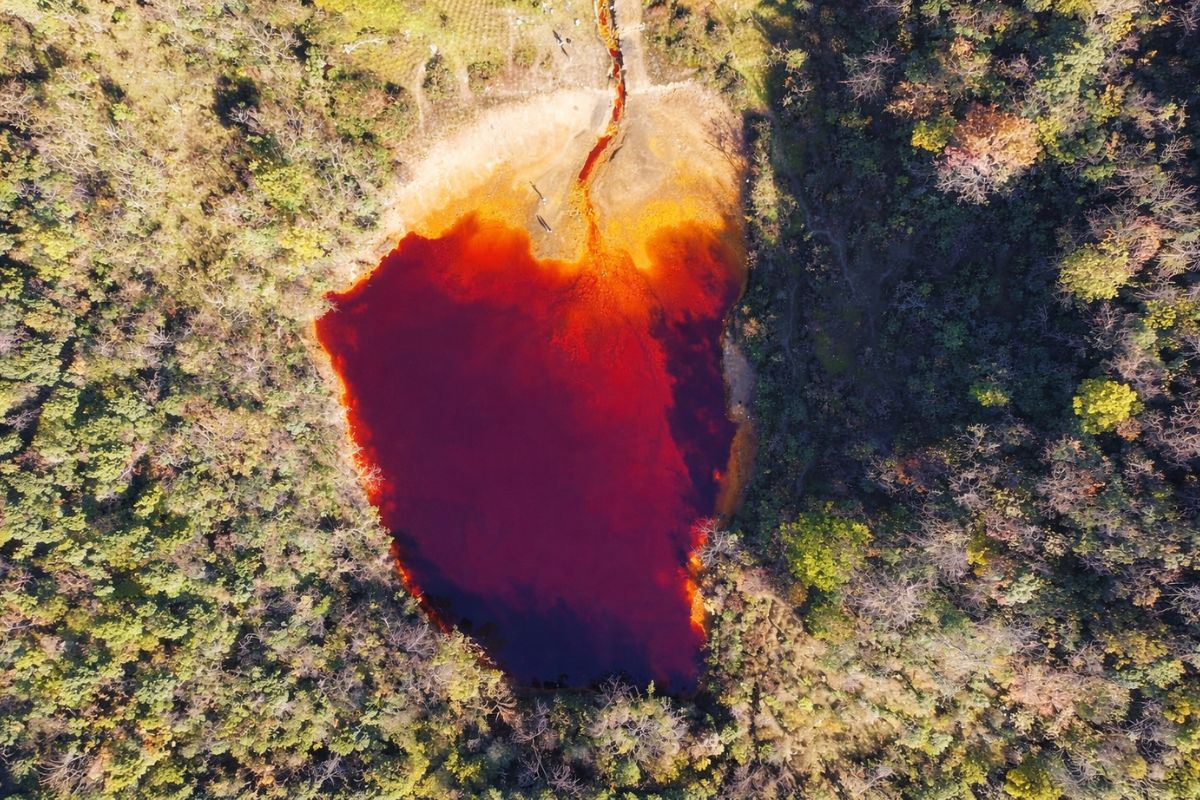


A Small Blood-Red Lake Hidden In The Mountains Of Guizhou, Formed By Mineral Oxidation In An Old Mining Area, Looks Like A Heart Seen From Above And Transforms A Difficult Trail Into One Of The Most Surreal Landscapes In China.
At first glance, it seems exaggerated to call a lake the “heart of the Earth.” But in the Mountains of Guizhou, in Longli, there is a water mirror as red as blood, surrounded by rocks and vegetation, which seen from a drone takes the form of a perfect heart, with paths and channels resembling arteries and blood vessels. The impression is that the planet has an exposed heart on the surface, silently pulsing in the middle of the forest.
Guiding the adventure is Tina, a content creator who decides to take the audience into the mountains of Guizhou in search of this strange lake. The trail begins on a simple road, passes through an old mining tunnel, follows narrow paths, slippery bamboo groves, red ribbons tied to trees to avoid getting lost, and ends in front of water so red it seems unreal. It is a mix of nature exploration, remnants of human activity and an impressive geological phenomenon.
The Blood-Red Heart In The Mountains Of Guizhou
The lake is not large, but it is hypnotic. Up close, the water is red as blood, deep in some spots, shining under the sun.
-
Bruno Guimarães, 28, Misses Crucial Penalty Against Norway in World Cup After Replacing Vinicius Jr.

-
Inspired by a school lesson on Africa’s water crisis, a young boy raised money through chores to fund a well that transformed a Ugandan community.

-
Brazilian Construction Worker Moves to France, Earns Up to €2,500 Monthly with Home Renovations, Gains Social Media Attention

-
US Navy Sinks USS Oriskany with 230 kg of C-4, Creating World’s Largest Artificial Reef in 37 Minutes





From above, through drone images, the heart shape becomes clear, surrounded by small trails, channels and streams that look like arteries and capillaries feeding this “organ” of water.
There, in the middle of the Mountains of Guizhou, the scenery escapes from any “normal” lake. The intense red contrasts with the green of the forest and the yellow of the stained rocks, creating a color palette that seems digitally assembled, but is all there, live.
The surface of the lake sparkles under the sun as if it were alive, reinforcing the metaphor of the “heart of the forest” or “heart of the Earth.”
It is no wonder that these images spread. The place gathers everything that draws attention in an extreme landscape, the still little-explored mountains of Guizhou by mass tourism, a rare phenomenon of water coloration, and a context of ancient mining that left visible chemical marks.
The Narrow Trail To The “Heart Of The Forest”
Reaching the lake is not simply parking the car and walking on a comfortable walkway. The trail to the blood-red heart is narrow, slippery, and almost nonexistent in some sections.
Tina shows the way step by step, following the ribbons tied to the trees, which serve as improvised guides not to get lost in the middle of the vegetation.
At first, the walk passes through an old mining area, where water once flowed more strongly. Today, the ground is dry in several spots, a sign that part of the flow has gone underground.
As the group delves deeper into the Mountains of Guizhou, the path narrows, covered by a type of bamboo that hinders passage and requires balance, caution with slips, and heightened attention.
In the middle of the trail, curious details appear, such as wild fruits red as blood, as strange as the water yet to come.
Tina even tries one, discovers that it is extremely sour, and decides not to insist. The message is clear, even in a light tone, nature there is beautiful, but it demands respect.
When The Water Changes Color: From Yellow To Blood Red

In certain stretches of the path, the transformation of the water begins discreetly. Small puddles and trickles of water appear over the soil with a soft reddish hue.
As you advance, the color intensifies, until the first stretches of truly red water appear.
Another detail grabs attention, the contrast between the red water and the yellow ground through which it flows. Tina shows how the flow of water leaves intense colored trails on the ground, as if drawing the chemical path it takes between the rocks. It is a visual cue that something different is happening deep within the earth.
After about twenty to thirty minutes of walking along this difficult trail, the group finally reaches the main lake. Up close, the water looks like a liquid mirror of living rust, both beautiful and unsettling.
From above, through drone images, the lake takes on the shape that made the place famous, the shape of a red heart amidst the Mountains of Guizhou.
The Science Behind The Color In The Mountains Of Guizhou
Despite the poetic nickname of “heart of the Earth,” the lake’s coloration is not magical, it is chemical. According to information gathered by Tina, the region of the Mountains of Guizhou where the lake is located was a coal mining area in the past.
The mining activities altered the underground and exposed iron-rich minerals, which ended up dissolving in the groundwater.
When this water, loaded with iron compounds, infiltrated and emerged to the surface, it came into contact with air. In this process, substances like ferrous sulfate oxidized, similarly to what happens when an old nail rusts.
Oxidized iron, or iron oxide, is precisely what causes the intense red color that stains the lake’s water.
In other words, it is as if the Mountains of Guizhou had inadvertently created a large open-air laboratory experiment.
The combination of old mining, iron-rich groundwater, and oxidation upon contact with air painted the lake with what Tina calls the “blood of the Earth,” a red so strong it is almost impossible to ignore.
Dangerous Beauty: The Blood-Red Lake Is Not For Touching

As fascinating as it is, this red “heart” is not an inviting natural pool. Tina clearly warns that the water is not safe to touch, much less to drink.
Since the color comes from the oxidation of minerals and the presence of iron compounds and possible pollutants linked to ancient mining, direct contact can irritate the skin, cause redness, itching, and other unwanted effects.
She reinforces that when visiting this type of place in the Mountains of Guizhou, the ideal is to keep a respectful distance from the lake, admire the landscape, record images and videos, but not enter, not dive, and not play with the water. The lake is beautiful because it is extreme, and exactly because it is extreme, it poses invisible risks.
Moreover, the terrain around is slippery, with stones, cliffs, and areas where it is necessary to “use four limbs,” in her words, supporting oneself with hands and feet to avoid falling.
The adventure is for those willing to tackle a difficult trail, but not for those looking for a tranquil bath.
The Message From The “Heart Of The Earth” In Guizhou
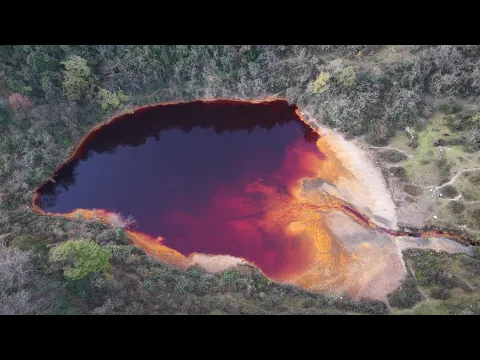

At the end of the exploration, after showing the lake, the trails, the red water, and the drone view, Tina reflects on everything we have seen.
She suggests that this “heart of the forest” is also a reminder that nature has its own heartbeat, its own rhythm, its own way of responding to what we do to the soil and the underground.
The Mountains of Guizhou, marked by mining, produced a spectacular lake through chemical reaction, but also a symbol of how our actions leave lasting marks on the landscape.
The beauty of the blood-red lake coexists with the silent warning of oxidized minerals and the water that no one should touch.
On the way back, the drone still captures the scenery at sunset, with the red heart highlighted among the shadows of the Mountains of Guizhou, in a moment that blends contemplation, awe, and respect. It is the kind of place that impresses with its aesthetics, but also provokes questions about human impact on the planet.
And you, would you tackle a narrow trail in the Mountains of Guizhou to see up close this blood-red lake that looks like the heart of the Earth, or would you prefer to admire such a “heart” only from images and afar?





