






 Portuguese
  Spanish
  5 min of reading
  0 comments


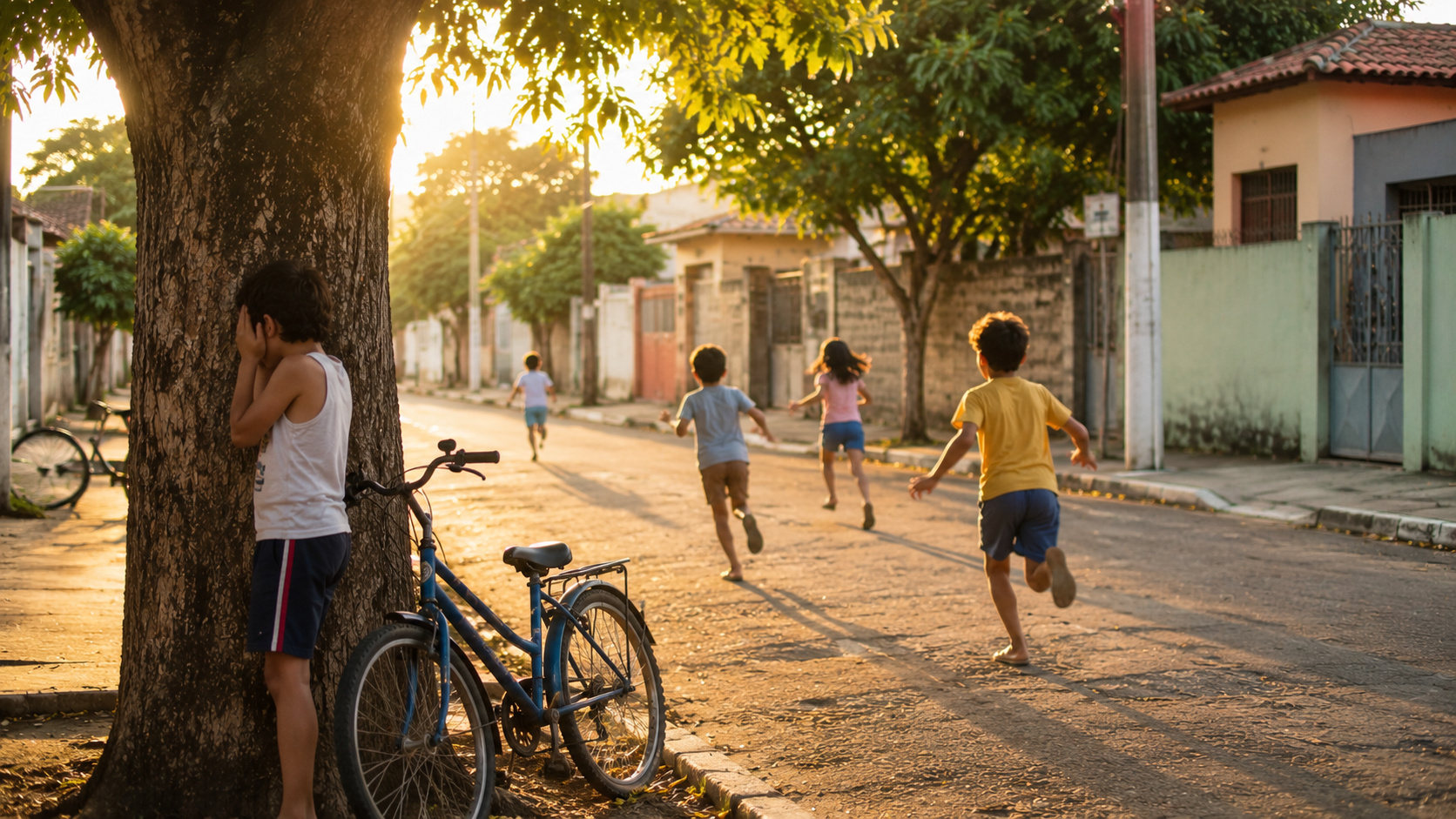
While spending entire afternoons running, creating routes, and exploring streets and yards without realizing it, children of the 1980s and 1990s were training complex cognitive skills that today are studied by developmental psychology and taught in specialized courses focused on spatial intelligence, creativity, and logical reasoning
For a long time, the scene seemed just part of the routine: children disappearing from home after lunch and returning only when the sky began to darken. However, what profoundly marked the childhood of the 1980s and 1990s went far beyond fun. According to studies in developmental psychology and modern cognitive theories, free outdoor play helped develop a mental skill that is highly valued today: spatial intelligence.
The information gained strength after several studies on child cognitive development revisited the impact of the reduction of free play in contemporary childhood. As pointed out by research published on academic platforms like PePSIC and analyses based on the Theory of Multiple Intelligences by psychologist Howard Gardner, spontaneous bodily experiences shape cognitive abilities that remain present in adult life.
In practice, this means that running through the streets, climbing trees, improvising hideouts, and memorizing paths functioned as intense brain training. The most curious thing is that, decades later, many of these skills began to be taught in paid courses, cognitive development apps, and structured learning methods.
-
Pato Merlin becomes a phenomenon at the 2026 World Cup by wearing a Mexican jersey, garnering millions of views, and even challenging FIFA’s official mascots in popularity.

-
‘Capital do Diamante’ is in Brazil and surprises by recording only 12.7 °C, the lowest temperature in the Northeast, surpassing cities from three states in the official Inmet ranking and revealing a little-known side of Chapada Diamantina.

-
At 75 years old, Mr. Izidro planted 400,000 trees over decades in Paraná, transformed a 2.42 million m² property into a green refuge in the Guartelá Canyon, and leaves a legacy with over 100,000 endangered araucarias.

-
11-year-old girl sees that the family didn’t have money for her father’s headstone, sets up a lemonade stand and raises almost $3,000 with the help of the community.



Psychology explains why playing in the street naturally developed spatial intelligence
Spatial intelligence is one of the pillars of the Theory of Multiple Intelligences, created by cognitive psychologist Howard Gardner. It is related to the ability to understand spaces, interpret distances, visualize objects mentally, and find practical solutions using spatial perception.
According to developmental psychology, this skill does not emerge ready-made. It is primarily built through the physical and sensory experiences lived during childhood. This is precisely where street play, so common among children of the 1980s and 1990s, comes in.
While participating in endless games of tag, hide-and-seek, improvised soccer, or adventures in vacant lots, children constantly trained their brains. Each run required distance calculation. Each escape involved quick decision-making. Each mentally created route strengthened neural connections related to spatial orientation and planning.
Moreover, the child’s brain learns with enormous intensity when the body is in motion. Interaction with real obstacles, changes in direction, depth perception, and adaptation to the environment create stimuli that no screen can fully reproduce.
In this sense, free play functioned as a spontaneous cognitive laboratory. Without formal classes, without workbooks, and without rigid methods, thousands of children developed skills that are now considered essential in fields such as architecture, engineering, design, surgery, visual programming, and even urban navigation.
What seemed like just fun continues to influence adult life decades later

Many adults who grew up in the 1980s and 1990s still report ease in memorizing routes, assembling furniture, organizing spaces, and visualizing practical solutions in daily life. Although these may seem like simple skills, psychology shows that they have a direct connection to experiences lived in childhood.
Those who played in the street often needed to create strategies in real-time. It was necessary to improvise rules, identify shortcuts, calculate risks, and adapt movements quickly. All of this strengthened sophisticated cognitive abilities related to spatial reasoning and problem-solving.
According to child development experts, the freedom to explore physical environments helps build cognitive autonomy. This explains why many people from that generation developed keen spatial perception without ever having any formal training.
Another important point involves creativity. The absence of technological toys forced children to invent narratives, characters, and scenarios using only simple everyday objects. A piece of wood became a sword. A sidewalk became a racetrack. An entire backyard transformed into an imaginary universe.
Child psychology highlights that this type of play simultaneously activates brain areas linked to creativity, language, motor coordination, and spatial intelligence. In other words, the brain learned through play in an integrated and extremely efficient way.
The reduction of outdoor play has changed the development of new generations
In recent decades, the scenario has changed drastically. Issues related to urban safety, excessive school activities, increased screen time, and increasingly controlled routines have significantly reduced the space for free play.
Meanwhile, specialized courses in cognitive development have started to gain ground. Today there are trainings exclusively focused on spatial reasoning, child creativity, motor coordination, and problem-solving — skills that were once naturally developed in streets, squares, and backyards.
Developmental psychology observes this phenomenon with growing attention. Recent research investigates how the excess of digital stimuli can affect cognitive skills related to spatial perception, creativity, and emotional autonomy.
According to information released in academic studies on child learning, the balance between digital experiences and concrete physical experiences has become one of the greatest challenges of contemporary childhood. This is because the child’s brain still needs movement, sensory exploration, and real interaction with the environment to develop certain cognitive skills solidly.
Even so, specialists emphasize that it is not about demonizing technology. The focus is on understanding that certain bodily experiences remain irreplaceable for the full development of the child’s mind.
The backyard became a luxury and spontaneous childhood began to be seen as a cognitive tool
Perhaps the most curious aspect of this discussion is realizing that what seemed like just “unimportant play” is now analyzed as a powerful cognitive stimulus. What was once a spontaneous routine has become studied in scientific research and replicated in structured child development programs.
For many families, understanding this completely changes the way they view childhood. Allowing a child to explore spaces, invent games, and have moments of unsupervised play can represent much more than leisure. It can be one of the foundations of healthy cognitive development.
Moreover, the reflection also provokes a more empathetic view of adults. Many facilities — or difficulties — present today may have direct roots in experiences lived during childhood. Psychology does not use this information to create guilt, but to broaden the understanding of how the environment shapes cognitive skills throughout life.
While researchers continue to investigate the impacts of the digital world on the child’s brain, one conclusion seems increasingly evident: running in the street until dark may have taught much more than any generation imagined.
And you, do you think the games of your childhood helped shape the skills you still use today without even realizing it?





-

-

-

-

-

-

25 people reacted to this.