






 Portuguese
  Spanish


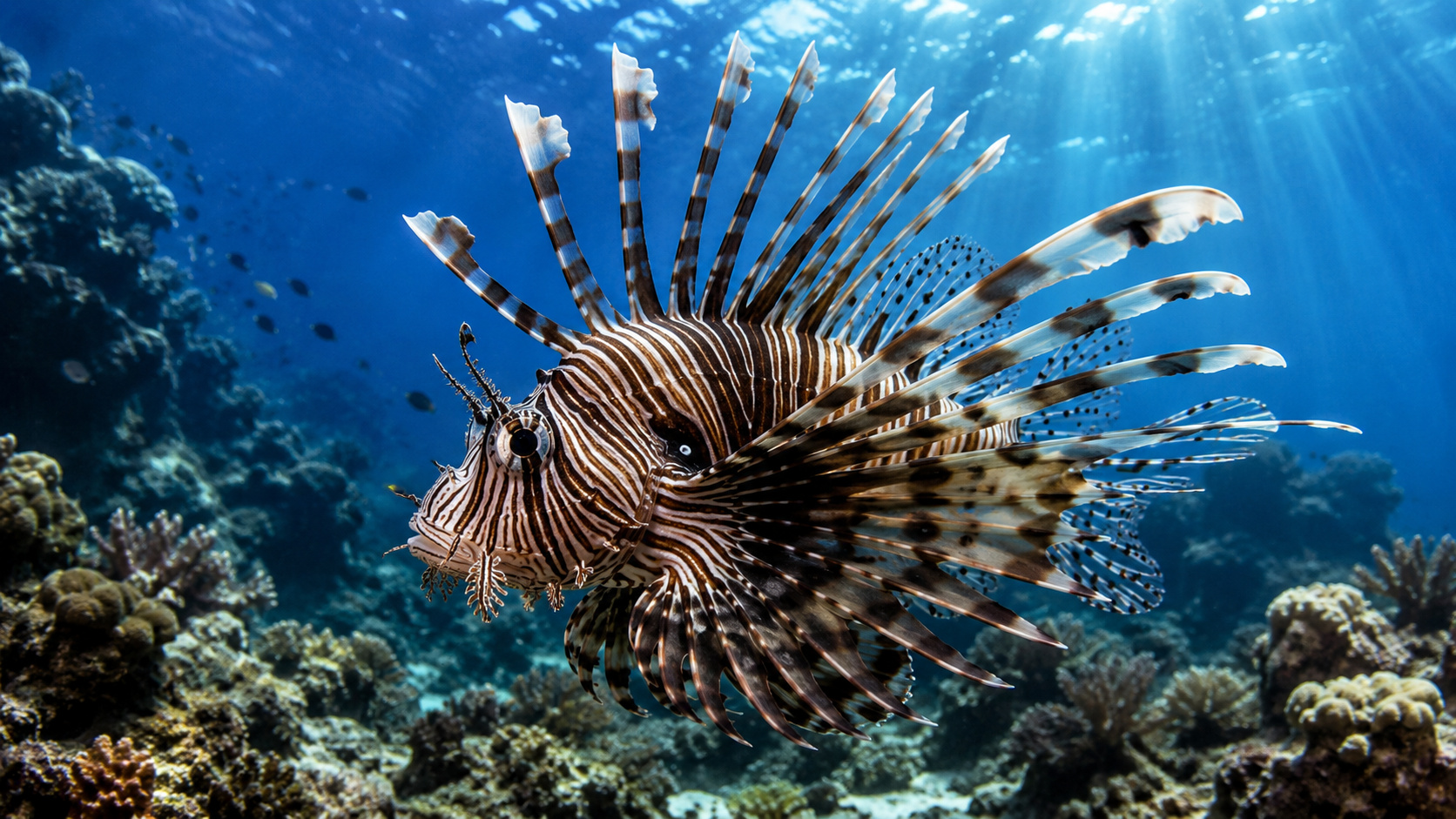

Venomous lionfish invades reefs, mangroves, and protected areas of the Brazilian coast since 2020 and concerns researchers.
The Brazilian coast faces a marine invasion that researchers classify as one of the most concerning ecological threats in recent years. The lionfish, a venomous exotic species originating from the Indo-Pacific, has been rapidly spreading along the country’s coastline since 2020, occupying reefs, mangroves, seagrass beds, shipwrecks, and protected areas. The information was released by CNN Brasil on 05/25/26.
The advance concerns scientists, fishermen, and environmental agencies because the fish has characteristics considered highly dangerous for marine ecosystems: accelerated reproduction, extremely aggressive feeding, absence of natural predators in much of the Atlantic, and venomous spines capable of causing painful accidents in humans.
Lionfish left the Indo-Pacific and advanced rapidly through the Atlantic until reaching Brazil
The lionfish mainly belongs to the species Pterois volitans and Pterois miles, venomous fish of the Scorpaenidae family native to the Indo-Pacific. The animal became known worldwide after invading the Caribbean, the Gulf of Mexico, and parts of the western Atlantic in recent decades.
-
China Develops Custom 140-Ton Electric Mining Truck with 770 kWh Swappable Battery, Deploys 290 Units in Xinjiang’s Largest Zinc Mine

-
Meta to Launch Arena, a New Prediction App Targeting 3.56 Billion Users, Competing with Polymarket and Kalshi

-
Scientist Challenges Famous Human Evolution Theory, Argues Homo Sapiens Evolved Gradually Over Thousands of Years
-
15-Year-Old American Builds Ocean Generator with PVC Pipe and 3D-Printed Propeller for $12, Wins National Prize, Presents at White House, and Makes Forbes 30 Under 30 List





In Brazil, isolated records began to appear as early as 2014 on the coast of Rio de Janeiro. But it was from 2020, especially after records in Fernando de Noronha and the North/Northeast coast, that researchers began to treat the advance as an effective colonization process of the Brazilian coast.
Recent research shows that the species has rapidly spread along the national coast, reaching areas from Amapá to the south of Bahia, as well as regions of Ceará, Rio Grande do Norte, Pará, and reef systems linked to the Brazilian Blue Amazon.
Venomous species has already invaded reefs, mangroves, and Brazilian environmental protection areas
The problem is no longer just an isolated biological record. Studies and reports indicate that the lionfish already occupies different Brazilian marine environments, including shallow reefs, mangroves, seagrass beds, artificial shipwrecks, and environmental conservation units.
According to research highlighted by CNN Brasil, the species has managed to invade even protected marine areas of the Southwest Atlantic. Researchers state that the fish has spread to oceanic islands, reefs, and habitats essential for the reproduction and feeding of native species.
The situation is especially delicate in reef environments because the lionfish acts as an extremely efficient predator, consuming small fish, crustaceans, and young species essential for the ecological balance of the reefs.
Lionfish have venomous spines and can cause painful accidents in humans
Besides the environmental impact, the lionfish also poses a risk to divers, fishermen, and artisanal fishing workers. The animal has long venomous spines mainly distributed in the dorsal, anal, and pelvic fins.

According to Brasil Escola, the species has 18 venomous spines, capable of causing intense pain, nausea, convulsions, and other symptoms after accidents. Although there are no confirmed records of death from the venom, contact can cause severe suffering and require medical attention.
Researchers and environmental agencies warn that handling requires extreme care. ICMBio has already conducted specific training for the capture and handling of the lionfish precisely because of the risk associated with the venomous spines.
Invasive species find no natural predators and threaten Brazilian fish
The advance of the lionfish is aggravated by another critical factor: the absence of efficient natural predators in much of the Brazilian coast. This allows for rapid population growth and makes it difficult to control the species.
Researchers point out that the lionfish is an opportunistic and generalist predator, capable of consuming a wide variety of native species. The invasion is particularly concerning in areas with endemic reef fish, found only in Brazil or specific archipelagos.
The research cited by CNN identified at least 29 species of endemic fish vulnerable to predation by the invasive lionfish.
Fernando de Noronha has become one of the areas of greatest concern in Brazil
Fernando de Noronha has become one of the main focuses of monitoring the invasion. Since the first sighting of the species in the archipelago in 2020, ICMBio teams have been developing capture and monitoring programs for the invasive population.
A report released in 2023 indicated that more than 100 individuals had been captured since the start of the local management program.

The advance is concerning because Noronha hosts extremely sensitive ecosystems and exclusive species of the South Atlantic, in addition to having strategic importance for Brazilian marine biodiversity.
Lionfish can live in different depths and marine environments
Another factor that makes the invader so difficult to control is its adaptability. The lionfish can live in varied environments, from shallow waters to depths close to 300 meters, according to Revista Pesquisa FAPESP.
This means that the species can occupy coastal areas, deep reefs, mangroves, artificial structures, and reef systems far from the coast.
Wide adaptation reduces the efficiency of simple eradication strategies because the fish does not depend on a single specific habitat to survive.
ICMBio created management and monitoring plans to try to contain the invasion
The advance of the lionfish led ICMBio and environmental agencies to develop emergency plans and specific materials for monitoring, capture, and management.

Official documents highlight the need for quick identification of the species, communication of sightings, and training of divers and fishermen for safe capture.
The problem is that the Brazilian coast has thousands of kilometers, which makes constant monitoring and quick response in all affected areas difficult.
Silent invasion could alter entire food chains on the Brazilian coast
Researchers warn that the impact of the lionfish goes beyond the visual presence of the species. The greater risk lies in the alteration of the marine food chain.
By consuming large quantities of small and juvenile fish, the invader can reduce populations important for the maintenance of reefs, mangroves, and coastal areas, affecting everything from biodiversity to artisanal fishing.
In Caribbean regions, the lionfish has already been associated with local collapses of reef fish populations. The fear of Brazilian researchers is that the same pattern will begin to repeat in parts of the national coast.
Brazil could face one of the largest marine invasions ever recorded in the South Atlantic
The advance of the lionfish shows how invasive species can cross oceans and transform entire ecosystems in just a few years.
The animal quietly arrived on the Brazilian coast, found a favorable environment, few natural predators, and an enormous availability of food. Now, researchers are trying to prevent the invasion from advancing further over reefs and protected areas.
The problem is that the lionfish does not depend on borders, states, or municipalities. Once established in the ocean, it transforms the entire sea into an expansion route.







