






 Portuguese
  Spanish


The sheet identified as page 123 of the Archimedes Palimpsest preserves parts of propositions 39 to 41 of “On the Sphere and Cylinder”. Found in Blois, the document may undergo multispectral examinations and synchrotron X-ray analyses to recover currently inaccessible content.
Archimedes returns to the center of an investigation after researchers identified, in France, a missing sheet of his palimpsest. The page may recover calculations hidden for centuries and expand understanding of an important work from Antiquity.
The discovery occurred at the Museum of Fine Arts of Blois. Preliminary analyses confirmed that the document corresponds to page 123 of the Archimedes Palimpsest, considered lost during the manuscript’s passage through private collections.
The study was published on March 6, 2026, in the journal Zeitschrift für Papyrologie und Epigraphik. The sheet preserves excerpts from On the Sphere and Cylinder, Book I, in propositions 39, 40, and 41.
-
Brazilian Education Ministry Announces Tech Benefits for Teachers, Providing Smartphones, Notebooks, and Tablets to Enhance Digital Learning and Professional Development

-
Woman Stranded for Six Months in Brazilian Airport After Losing Passport and Ticket, Faces Agonizing Wait to Reunite with 15-Year-Old Son at Age 56.

-
Brazilian Man Amputates Own Foot in Attempt to Claim $300,000 Insurance Payout, But Key Evidence Found Nearby Exposes the Fraud.
-
Brazilian Delivery Worker Goes Viral in China for Using Measuring Tape to Report Over 1,000 Street Issues, Leading to Fixes by Authorities




Archimedes reappears under medieval texts
The Archimedes Palimpsest is a Greek manuscript produced in the 10th century. It gathers works attributed to the mathematician from Syracuse, but part of the original writing was erased during the Middle Ages to reuse the parchment.
During that period, the support made of animal skin was costly. It was common to remove ancient texts and write new content on the same material, creating layers that today require special techniques.
The manuscript initially remained in Jerusalem and then in Constantinople. In 1906, Johan Ludvig Heiberg arranged for its photography before the volume entered a private collection in France.
In 1996, the French Ministry of Culture authorized the export and sale of the document at auction. The palimpsest was acquired by a private collector, who remains its owner.
Currently, the work is located at the Walters Art Museum in Baltimore, United States. For decades, researchers relied on photographs taken by Heiberg to examine pages and compare known fragments.
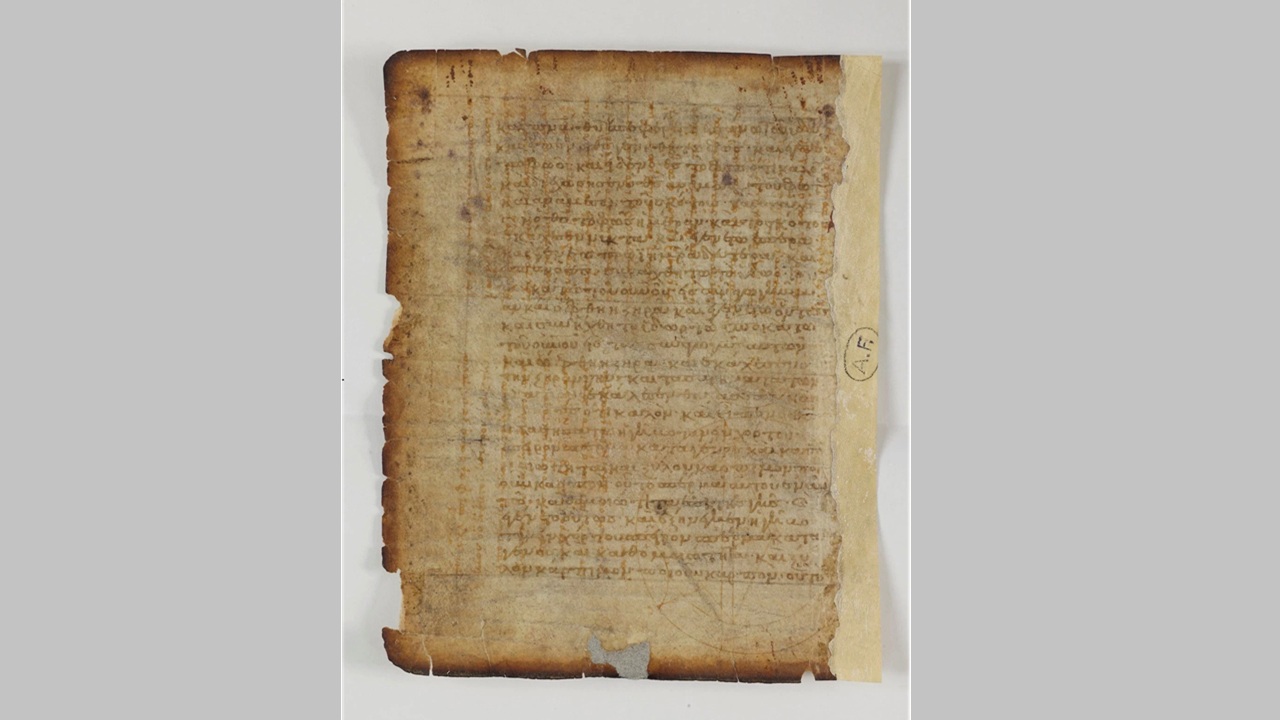
Comparison confirmed the missing page
Victor Gysembergh, a CNRS researcher at the Léon Robin Center for Research on Ancient Thought, affiliated with CNRS and the Sorbonne University, identified the sheet preserved in Blois.
The confirmation occurred after comparison with the 1906 images, now kept at the Royal Danish Library. The records allowed clear recognition of the piece as sheet number 123 of the set.
One side features a prayer partially overlaid with geometric diagrams and the mathematical passage of Archimedes. Much of the older writing remains visible and can be directly examined by specialists.
On the reverse, an illumination added in the 20th century shows the prophet Daniel surrounded by two lions. The painting covers the ancient writing and prevents its reading by conventional methods.
New images may reveal hidden calculations
If the necessary authorizations are granted, the expectation is to start the first imaging campaigns within a year. The work should combine multispectral imaging and synchrotron X-ray fluorescence analyses.
These techniques can reveal the content preserved under the illumination without removing the added layer. The goal is to recover passages currently inaccessible and better understand the calculations recorded on the page.
In the early 2000s, multispectral imaging had already revealed important texts by Archimedes, as well as unknown fragments of ancient literary and philosophical works.
Before reaching the current owner, however, the manuscript passed through several hands. Three sheets recorded in Heiberg’s photographs disappeared during this journey and were long considered lost.
The location of one of them also renewed interest in examining the entire palimpsest with more advanced resources. A new campaign could allow the rereading of pages that remained illegible during the first digitization.
The discovery shows how historical collections and modern technologies can complement each other in the recovery of ancient knowledge.
For you, which aspect is most striking: the reappearance of the leaf, the preservation of Archimedes’ calculations, or the use of X-rays to uncover hidden texts? Share your opinion in the comments and join the conversation.
Source: “A Rediscovered Leaf of the Archimedes Palimpsest in Blois” by Victor Gysembergh, published on March 6, 2026, in the journal Zeitschrift für Papyrologie und Epigraphik.


Be the first to react!