






 Portuguese
  Spanish


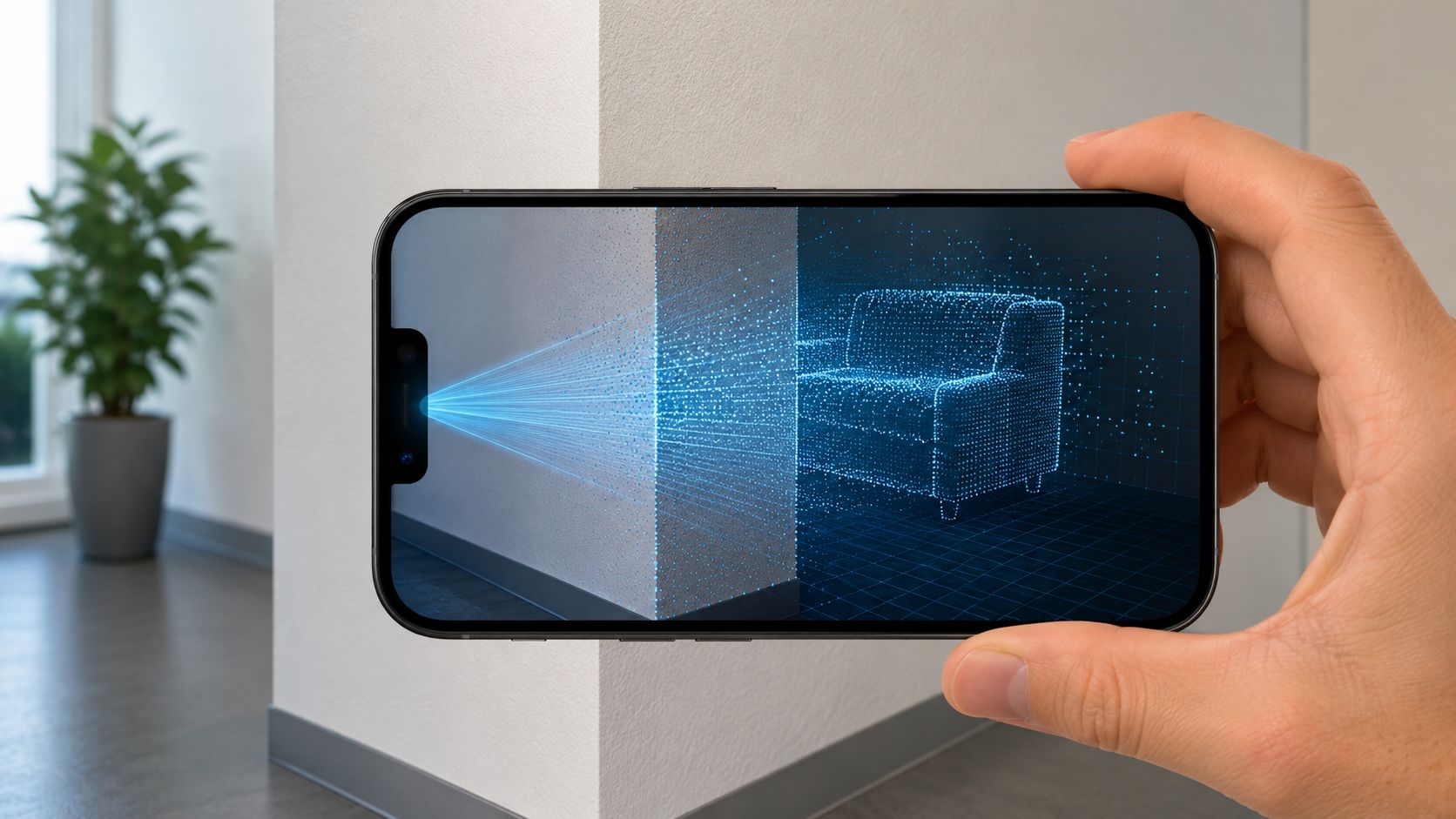

MIT research published in Nature shows that consumer LiDAR sensors, used in premium smartphones and evaluated in tests with hardware below $100, can capture weak reflections on walls and floors to track hidden objects, paving the way for applications in common devices, robots, and wearable devices.
Smartphones will be able to track objects hidden behind walls using LiDAR and an MIT algorithm described in Nature, an advancement that brings non-line-of-sight imaging to cheap sensors.
How smartphones can track objects out of visual range
The technology starts from a known LiDAR limitation. The sensor emits light pulses, measures the return time of the reflected signals, and calculates distances to map three-dimensional environments.
This supports augmented reality features and improves depth perception in premium models. The problem is that the conventional method only sees what is directly in front of the sensor.
-
Canary Island with 11,000 Residents and Over 500 Volcanoes Uses Wind and Water as a Giant Battery to Demonstrate Remote Areas Can Survive Without Fossil Fuels

-
Brazilian Craftsman Builds Small Hydropower Plants Generating Over 1,000 kWh Monthly, Paying for Themselves in Just Over a Year

-
Unknown Molecule Possibly Detected on Pluto and Titan by James Webb Telescope

-
Global Population Estimates May Be More Inaccurate Than Thought: Study Finds Rural Areas Underestimated in 35 Countries, Sparking Debate Over Earth’s 8.2 Billion Inhabitants




The algorithm created by researchers at the Massachusetts Institute of Technology changes this reading. Instead of ignoring weak reflections scattered on walls and floors, the system gathers these signals over several frames.

When the phone or object moves, the tool combines data captured from different angles. From this set, it can estimate the shape and movement of something hidden, without a direct line of sight.
Tests used consumer LiDAR under $100
In the experiments, the team worked with a standard consumer-level LiDAR sensor, costing less than $100. The targets were positioned behind walls and partitions.
Among the objects evaluated were a moving mannequin, cardboard cutouts, and letters. The sensor was pointed at the floor or the wall near the barriers, exploring indirect reflections.
The algorithm tracked the mannequin in real-time and produced approximate three-dimensional reconstructions of the hidden objects. In another test, it tracked multiple objects, including a person’s two hands, at 30 frames per second.
In this case, retroreflective gloves helped isolate the signal from the hands in relation to the light reflected by the torso, allowing better tracking of the movement.
What is still needed before use in common devices
The proposal has limitations. The technology works best when the software knows or can approximate the basic shape of the tracked object, a condition that simplifies the reconstruction made from weak signals.
The next steps involve expanding the method to unknown or changing shapes. If this stage progresses, NLOS imaging could reach consumer applications, robots, and wearable devices.
The central contribution is reducing the dependence on bulky and expensive equipment, previously associated with laboratories. With simple sensors and adequate processing, smartphones can track hidden objects and transform almost discarded reflections into useful visual information.
With information from .




I think criminals will love this idea.