






 Portuguese
  Spanish


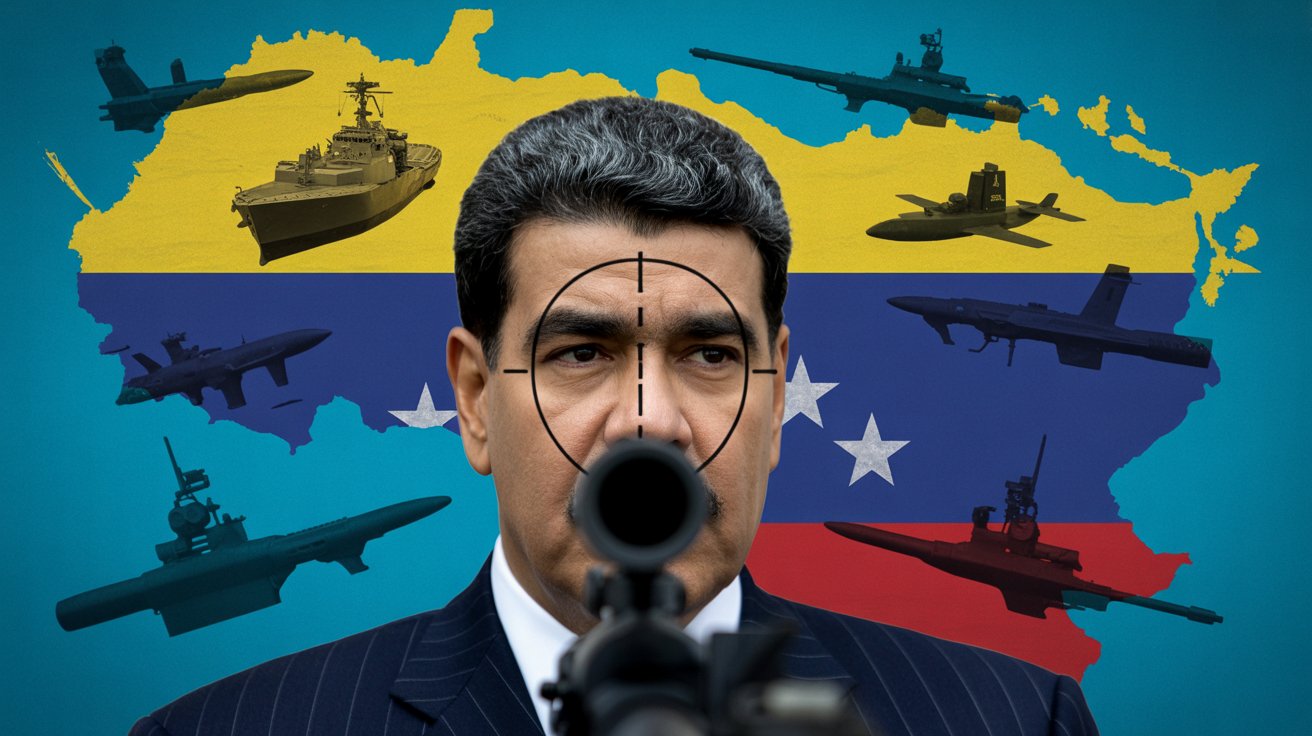


Mobilization Involves Drones, Fighters, Aircraft Carriers, and Submarines, Increases Reward for Capturing Venezuelan Leader and Intensifies Diplomatic Pressure Against Caracas
Although various channels report that Nicolás Maduro may have been taken to a maximum-security bunker in Caracas, the Venezuelan government has not officially confirmed the information. There is no expectation that the location will be disclosed, nor details about the duration of stay or whether the president was actually transferred to the underground shelter. Maduro’s last public appearance occurred on Friday during the exhibition Expo Simón: From Child to Liberator, held in the Venezuelan capital.
U.S. Military Escalation
According to information released by Voz da Bahia and confirmed by international news portals, the order came directly from the Pentagon to Southcom, responsible for operations on the continent. Aircraft carriers, nuclear submarines, drones, and fighter planes were deployed to bases in Puerto Rico, Panama, Colombia, the Bahamas, and the Antilles.
-
U.S. Establishes Permanent Embassy in Jerusalem, Reigniting International Debate Over Israel’s Capital

-
The world has nearly 12,000 nuclear warheads, with the majority held by the United States and Russia; see the figures for China, France, and the United Kingdom.

-
Venezuela Faces UN Alert for Hunger, Disease, and Service Collapse After Earthquakes Cause Nearly 2,000 Deaths and $6.7 Billion in Damages

-
Brazil Deploys Navy Field Hospital with ICU, Orthopedics, Pediatrics to Earthquake-Stricken Area in Venezuela, Offering 30 Beds and 150 Daily Consultations


Donald Trump’s government officially declared that the mission’s objective is to combat drug cartels classified as terrorist organizations. However, diplomats point out that the scale of the operation indicates a greater strategic reach, representing a clear message to regimes that challenge U.S. interests in Latin America.
Military sources claim that among the targets of the mobilization is directly the regime of Nicolás Maduro, accused of using international trafficking as a source of funding.
Million-Dollar Reward and Rising Pressure
Alongside the military operation, Washington has increased the reward for information leading to the capture of the Venezuelan president. The amount rose from US$ 15 million to US$ 50 million, approximately R$ 272.5 million at current exchange rates.
The accusations against Maduro include links to the so-called “Cartel de los Soles,” sending large shipments of cocaine to North America and Europe, as well as connections to the Tren de Aragua and the Mexican cartel of Sinaloa. These allegations support the U.S. narrative of combating “narcoterrorism” in the region.
According to analysts, the increase in the reward heightens the risk of internal defections and attracts the interest of mercenaries from different countries, amplifying the climate of insecurity surrounding the Chavista leader.
Maduro in “bunker” and Regional Reactions
The Venezuelan press has not yet confirmed whether Nicolás Maduro was taken to a maximum-security bunker, and the government has also not officially commented on the matter.
Internally, Caracas classifies U.S. movements as acts of imperialism, reinforcing its alignment with Russia, Iran, and China. Chavista rhetoric insists on denouncing an attempt at external destabilization, but the presence of U.S. military personnel in neighboring countries is seen as direct pressure on the regime.
In Brazil, the official stance thus far has been silence, prioritizing the maintenance of diplomatic relations with Russia, Iran, and China. This choice has drawn criticism from Western diplomats, who see a risk of isolation in international forums.

U.S. Intervention Capacity
The Southern Command, based in Doral, Florida, coordinates the operation. The structure includes nuclear submarines, long-range patrol aircraft like the P-8 Poseidon, as well as expeditionary forces of Marines.
The P-8 Poseidon plays a central role in monitoring strategic areas, with advanced sensors, prolonged autonomy, and the ability to launch torpedoes, missiles, and depth charges. This technology guarantees the United States the possibility of rapid and suffocating naval blockade against Venezuela if the escalation advances.
The mere news of the military mobilization has already caused financial effects, reducing resources available to the Chavista regime. Diplomats assess that Maduro fears not only a direct intervention but also a prolonged blockade that could collapse the economy in a matter of weeks.
Military Exercises and Internal Scenario
In response, the Venezuelan government announced internal military exercises to demonstrate strength. However, images display poorly equipped troops, old Soviet tanks, and limited readiness, contrasting with U.S. military superiority.
Furthermore, reports indicate that Russia maintains a weapons factory in Venezuela, while Iran supplies drones and precision armaments. Nevertheless, experts state that the disparity in forces makes Venezuelan military resistance highly impractical in the event of direct confrontation.
Internally, the regime faces high inflation, food shortages, and allegations of human rights violations. Instability grows even after Maduro promoted more than 2,000 military personnel to generals, a measure seen as an attempt to shield the government from internal betrayals.
Possible Developments
The information that hundreds of U.S. military personnel are already in Brazil for the joint exercise Tapio 2025 reinforces the message of strategic alignment between Washington and regional partners. This movement, according to official sources, involved the largest contingent of equipment sent by the U.S. in recent years.
Experts interviewed by international media highlight that the military operation represents a shift in the stance of the United States, which seems willing to go beyond economic sanctions to contain regimes regarded as threats to continental stability.
The combination of military pressure, economic sanctions, and diplomatic isolation creates an uncertain scenario for the future of Venezuela, which could redefine geopolitical trends in South America in the coming months.





Ditador se esconde em bunker, mas não da própria queda
U’e,as hordas bolsonaristas não gostavam da ****?bolsonaro não amava a **** militar?porquê reclamam?acho que só provaram a dita, se preparem que vem a dura,cana dura
O Trump, chega mais a baixo um pouco e limpa esse hospício!!!