Portuguese
  Spanish


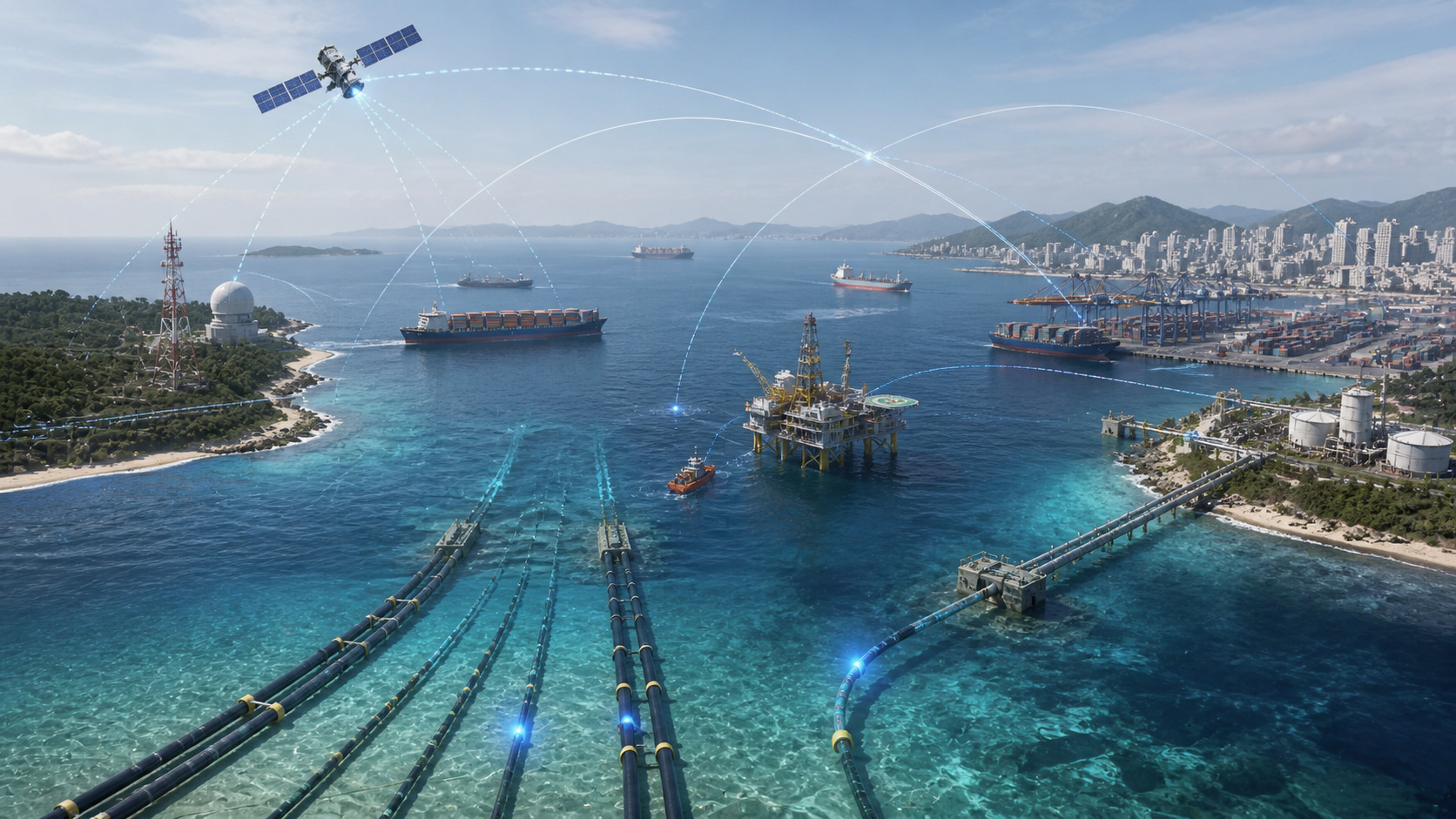

WEF warns of vulnerable critical infrastructure in 2026, with submarine cables, satellites, energy, ports, and stablecoins under pressure.
In 2026, the World Economic Forum placed critical infrastructure at the center of a global alert amidst escalating geopolitical competition. Published on January 14, the Global Risks Report 2026 pointed out that the world has entered an “era of competition,” with geoeconomic confrontation and inter-state conflicts among the main immediate risks, while an analysis by the forum itself warned that essential energy, water, transport, and digital network systems remain vulnerable and underestimated in the global debate.
The most sensitive point is that the invisible infrastructure of the modern world has ceased to be merely technical support and has taken on a strategic position. Submarine cables, satellites, oil pipelines, ports, maritime straits, electrical grids, and digital systems support the internet, banking, payments, trade, energy, food, and entire industrial supply chains; on January 12, 2026, the Global Cybersecurity Outlook 2026 reported that 64% of organizations already considered geopolitically motivated cyberattacks in their risk strategies, including critical infrastructure disruptions and espionage.
World Economic Forum warns that critical infrastructure is underestimated even while supporting entire economies
In January 2026, the World Economic Forum published a specific analysis on the vulnerability of critical infrastructure, highlighting that it remains exposed to risks such as extreme events, cyberattacks, and geopolitical tensions.
-
Ayatollah Ali Khamenei’s Funeral Draws 15 to 20 Million in Tehran, Calls for Revenge Against Trump After Joint Israel-U.S. Attack

-
U.S. Establishes Permanent Embassy in Jerusalem, Reigniting International Debate Over Israel’s Capital
-
The world has nearly 12,000 nuclear warheads, with the majority held by the United States and Russia; see the figures for China, France, and the United Kingdom.

-
Venezuela Faces UN Alert for Hunger, Disease, and Service Collapse After Earthquakes Cause Nearly 2,000 Deaths and $6.7 Billion in Damages


The most concerning point is that, despite this dependence, “disruptions to critical infrastructure” appear only in 23rd position among the long-term risks assessed, signaling a possible underestimation of the problem.
This interpretation is relevant because critical infrastructure does not only involve visible works, such as highways or power plants. It also includes submarine fiber optic networks, satellites, energy systems, ports, pipelines, data centers, payment platforms, and logistical systems that operate silently every day. When these systems fail, the consequence can spread in minutes across seemingly disconnected sectors, such as banking, aviation, hospitals, fuel, and food.
Submarine cables become digital bottleneck because they carry almost all international internet traffic
Submarine cables are one of the most critical and least visible infrastructures on the planet. Reuters highlighted, in April 2026, that these cables support about 99% of international internet traffic, connecting continents, banks, digital platforms, cloud services, governments, and businesses.
The report also showed that the Strait of Hormuz, known for oil, is also a sensitive corridor for fiber optic cables connecting Asia, the Gulf, and Europe.


The problem is that these cables can be damaged by accidents, such as anchors and fishing activities, but they have also entered the radar for sabotage and geopolitical pressure.
In conflict regions, repair becomes more difficult due to permissions, risk to maintenance vessels, and maritime threats. This transforms a cable on the seabed into a potential weapon of economic disruption, capable of degrading connections, delaying digital services, and affecting large-scale financial operations.
Ports, straits, and maritime routes show how global trade depends on a few vulnerable points
Maritime infrastructure has also entered a phase of extreme exposure. UNCTAD warned in March 2026 that the Strait of Hormuz is one of the world’s most critical maritime choke points, responsible for about a quarter of global seaborne oil trade, in addition to significant volumes of liquefied natural gas and fertilizers.
This data shows that the risk is not just about oil. A disruption in Hormuz can affect freight, fuel, fertilizers, agricultural production, food prices, and industrial supply chains.
UNCTAD also highlighted that shocks in the strait spread across maritime transport, energy, food, and finance, showing that 2026 geopolitics began to operate on interconnected systems.
Pipelines, gas, and fertilizers enter the same geopolitical risk board
Pipelines and energy routes have always been strategic, but the difference in 2026 is the overlap between energy, food, and industry. When an oil or gas route is threatened, the impact is not limited to the price of a barrel. It reaches fertilizers, transport, electricity, agricultural production, and inflation.
UNCTAD itself includes liquefied natural gas and fertilizers among the critical flows passing through vulnerable regions like Hormuz.
This is decisive because fertilizers heavily depend on natural gas and sulfur in various production chains. An energy crisis can quickly turn into a food crisis, especially in countries dependent on imports and with little capacity to replace suppliers in the short term.
Satellites and digital signals amplify the fragility of systems that seem invisible to the common citizen
Satellites are an essential part of contemporary critical infrastructure. They support navigation, communications, weather forecasting, logistics, financial network synchronization, precision agriculture, and military operations. Even without physical destruction, signal interference, blockages, cyberattacks, or service degradation can affect entire sectors.

This vulnerability connects to the broader warning from the World Economic Forum: competition between powers is no longer limited to land borders. It extends through digital networks, maritime routes, satellites, supply chains, and financial systems.
Infrastructure has become strategic territory, even when it is at the bottom of the sea, in space, or within servers spread across the world.
Stablecoins enter the financial alert because they can displace deposits and change emerging economies
The title also mentions stablecoins because they represent another type of invisible infrastructure: digital financial infrastructure. Reuters reported in October 2025, based on Standard Chartered estimates, that the use of stablecoins in emerging economies could reach US$ 1.22 trillion by 2028, with the risk of displacing up to US$ 1 trillion in deposits from traditional banks.
This data does not come from the World Economic Forum, but it reinforces the same logic of systemic vulnerability: money, savings, international payments, and protection against unstable currencies are migrating to private digital rails, often dollarized.
In countries with inflation, currency devaluation, or low banking confidence, stablecoins can function as an alternative form of protection, but they also reduce local monetary control and increase risks of bank runs. The critical infrastructure of 2026 is not just physical; it is also financial and digital.
Brazil is also exposed because it depends on cables, ports, fuels, fertilizers, and global financial systems
Although the warning is global, Brazil is not outside the problem. The country depends on submarine cables for international connectivity, ports to export commodities and import inputs, fuels for transport, fertilizers for agribusiness, and digital financial systems increasingly integrated into the global market.
A crisis in critical infrastructure outside Brazilian territory can raise freight costs, delay deliveries, make fertilizers more expensive, put pressure on fuels, and affect internal production chains.
This interdependence explains why geopolitical risk is no longer a matter restricted to diplomats and has begun to affect companies, consumers, and national governments.
The 2026 warning is that the infrastructure nobody sees supports almost everything the world uses
The main message of this scenario is simple and worrying: the modern economy depends on systems that most people never see. Cables at the bottom of the ocean, satellites in orbit, underground pipelines, narrow maritime routes, ports, data centers, and digital financial platforms form a global network that supports the internet, energy, food, trade, and payments.
When this network works, it seems invisible. When it fails, the impact appears in airports, banks, supermarkets, gas stations, hospitals, farms, and factories. Therefore, the most important warning of 2026 is not just about war, but about the transformation of critical infrastructure into an instrument of pressure between powers.
The direct question that remains is: is the world prepared to protect the invisible infrastructure that sustains modern life, or will it only realize its fragility when the internet, energy, commerce, and payments are simultaneously hit?