Portuguese
  Spanish


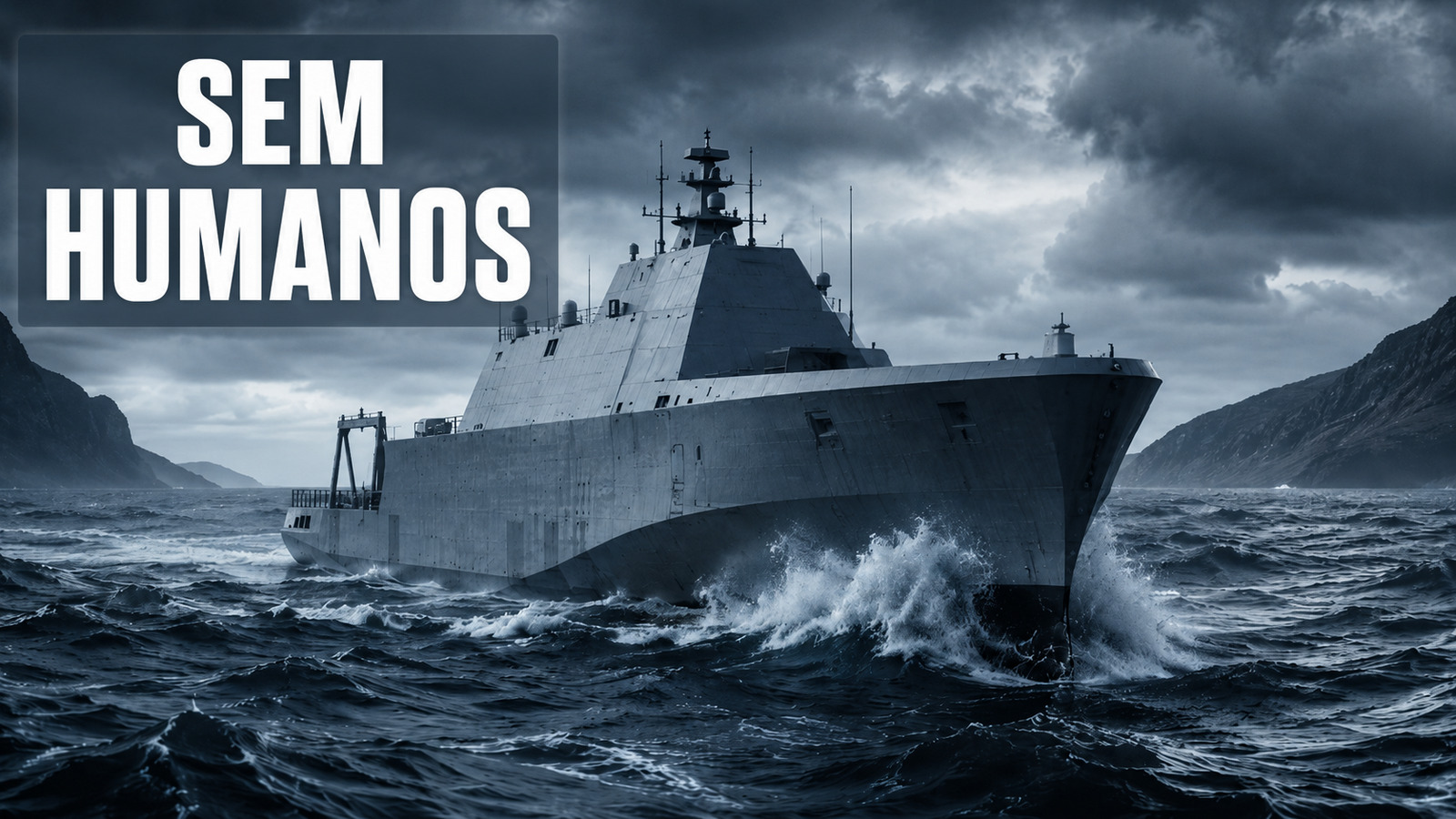

U.S. Navy program transforms commercial ships into autonomous platforms of up to 2,000 tons, with advanced navigation, cyber protection, and human supervision for high-risk naval missions
The Ghost Fleet Overlord converts commercial ships into large unmanned vessels, known as U.S. Navy ghost ships, weighing up to approximately 2,000 tons, to increase autonomy, reduce costs, and minimize human risks in dangerous missions.


Program bets on commercial ship conversion
The Ghost Fleet Overlord is a program by the U.S. Department of Defense and the Navy aimed at creating large unmanned surface ghost ships, called LUSVs.
The initiative transforms commercial hulls into autonomous naval platforms, instead of developing entirely new vessels from scratch.
-
European Parliament Approves Digital Euro, Aiming to Challenge Visa and Mastercard’s Dominance and Transform Payments Across Europe by 2029

-
Israel finds Hezbollah militarized tunnel over 200 meters long under village, with 4 missile launch shafts, 12 chambers, anti-tank missiles, drones, and weapons depots at a depth of 25 meters.

-
Ukraine launches largest drone attack on Moscow since 2022, Russia claims to have intercepted nearly 200 aircraft near the capital, Kapotnya refinery targeted again, and offensive reignites alert about war reaching the Russian energy heart just a few kilometers from the Kremlin.

-
Truck drivers, freight, and fines from 2022 take center stage in politics: Chamber approves MP with amnesty, mandatory tracking by CIOT, million-dollar penalties, and new minimum wage for those who spend more than 24 hours on the road.


The proposal reduces costs, accelerates timelines, and focuses efforts on operational systems.
The program is conducted by the Strategic Capabilities Office, a structure focused on rapidly deployable operational solutions. The vessels used come from the civilian market, especially fast support ships.
With this foundation, development focuses on autonomy, secure communications, combat integration, and cyber protection. The logic is to create means capable of operating in high-danger missions with less human exposure.
Ranger and Nomad opened the initial phase
The first phase of the Ghost Fleet Overlord involved the conversion of two commercial ships: Ranger, identified as OUSV 1, and Nomad, identified as OUSV 2.
The teams integrated autonomous navigation systems, made updates to hulls, machinery, and electrical systems, and validated safety and collision avoidance requirements.
In the second phase, the program extended mission duration and interoperability with manned assets. Ranger and Nomad completed thousands of miles of transits.
These voyages included passage through the Panama Canal in a mostly autonomous mode. Human control was restricted to critical sections, maintaining supervision at sensitive points of the operation.
How ghost ship autonomy works
The Ghost Fleet Overlord LUSVs operate in a semi-autonomous model. Human operators always remain “in the loop,” especially for decisions related to the use of force.
Navigation and payload management are automated. Nevertheless, human supervision remains mandatory, preserving the operators’ final say in the most sensitive actions.
The operational cycle begins with perception. Radars and cameras identify targets, obstacles, and sea conditions in real-time, providing data for mission execution.
In the autonomy stage, artificial intelligence algorithms propose evasive maneuvers and optimized routes. The objective is to fulfill the mission with local processing support.
Supervision occurs via remote control, with operators monitoring the system from a distance. Resilience depends on encrypted communications and combat virtualization, such as Aegis.
Ships are up to 90 meters and have varied modules
LUSVs are between 60 and 90 meters long and have up to approximately 2,000 tons of displacement. They also feature large fuel capacity and long endurance at sea.
The platforms are relatively inexpensive and designed to receive various modular “payloads.” These modules include surveillance sensors, command and control systems, and armaments.
Some models can employ vertical launchers with 16 to 32 cells. This configuration allows for the use of anti-ship missiles, land attack, and fire support for naval task groups.
Mariner and Vanguard expand program tests
Among the four ships, Mariner, identified as OUSV 4, stands out for integrating advanced autonomous navigation and a virtualized version of the Aegis combat system.
This combination allows testing the LUSV as an air and surface defense node in existing naval networks. This advancement expands the program’s experimental role.
Ranger, Nomad, Vanguard, and Mariner receive support from companies such as Austal USA, L3Harris, Leidos, and Lockheed Martin. The first units were transferred to the Navy in 2022.
New tests until 2026 are expected to guide future generations of unmanned surface vessels, keeping the Ghost Fleet Overlord as an evaluation basis for naval autonomy.
With information from O Antagonista.