






 Portuguese
  Spanish


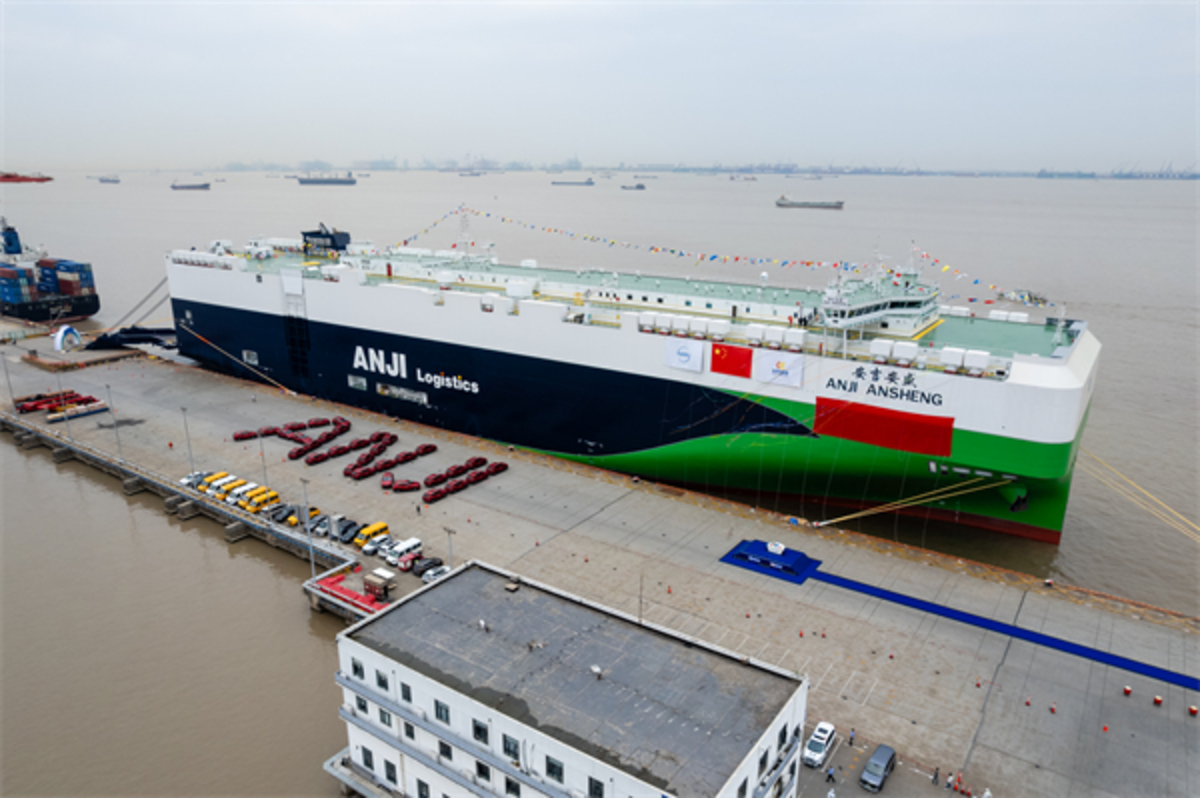

With 224 Meters in Length and Sustainable Technologies, the Anji Ansheng Vessel Was Delivered in Shanghai and Establishes Itself as the Largest Vehicle Carrier on the Planet, Surpassing Competitors Such as BYD Shenzhen
On the afternoon of May 15, Shanghai was the stage for the official delivery of the largest cargo ship in the world. The vessel, named Anji Ansheng, was delivered at the Haitong International Automotive Terminal, one of the city’s most important logistics centers.
The ship stands out not only for its size but also for the low-carbon technologies integrated into its operation.
With a length of 224 meters and a gross tonnage capacity of 21,000 tons in summer, the carrier operates under the flag of Liberia. The construction is from 2025. The Anji Ansheng was developed by SAIC Anji Logistics Co., Ltd., a subsidiary of the Chinese giant SAIC Motor Corporation Limited.
-
Meta to Launch Arena, a New Prediction App Targeting 3.56 Billion Users, Competing with Polymarket and Kalshi

-
Scientist Challenges Famous Human Evolution Theory, Argues Homo Sapiens Evolved Gradually Over Thousands of Years
-
15-Year-Old American Builds Ocean Generator with PVC Pipe and 3D-Printed Propeller for $12, Wins National Prize, Presents at White House, and Makes Forbes 30 Under 30 List

-
$12 Billion Invested in AI Data Centers in Semi-Desert Mexican State, But 17 of 18 Municipalities Now Face Water Shortages, Residents Receive Water Only 3 Days a Week




Impressive Capacity and Energy Efficiency
The Anji Ansheng has space to transport up to 9,500 vehicles. According to the latest information, the ship is scheduled to sail to Europe carrying approximately 7,000 new energy vehicles manufactured in China. Among the models onboard are cars from the MG brand, owned by SAIC.
In addition to capacity, the ship is remarkable for its efficiency. It is equipped with intelligent low-carbon technologies that allow for high-energy yield operations.
The system is also capable of using carbon-neutral fuels, reinforcing its commitment to sustainable transport.
Response to Competition
The launch of the Anji Ansheng comes shortly after the introduction of another large vessel, the BYD Shenzhen. The previous month, the Chinese manufacturer BYD unveiled a carrier with a capacity for 9,200 vehicles.
This ship, measuring 219.9 meters in length and 37.7 meters in width, also prioritizes clean and sustainable technologies.
The BYD Shenzhen features a high-efficiency engine, shaft generators, a hybrid battery system, and various innovations aimed at reducing emissions.
Even with these advanced features, the new Anji Ansheng surpasses its total cargo capacity, solidifying its position as the largest oceangoing carrier in operation in the world.
Focus on Innovation and Automotive Logistics
SAIC Anji Logistics is responsible for the construction of the Anji Ansheng and ranks first in the automotive logistics sector in China.
The company also ranks 10th in the overall logistics ranking of the country. The maritime division of the company is known for its focus on research and development of new technologies applied to shipbuilding.
This sector is responsible for managing international vessels, projects, and supervision of ships, domestic roll-on/roll-off (Ro-Ro) logistics, international maritime transport, and freight forwarding services.
The company operates strongly at major automotive terminals along the Yangtze River and China’s coastal areas.
Present in Shanghai
According to AIS (Automatic Identification System) data received less than an hour before the official announcement, the Anji Ansheng is still docked in Shanghai.
The expectation is that the vessel will soon begin its transoceanic activities, expanding China’s vehicle export capabilities.
The delivery of the Anji Ansheng reinforces China’s position as a leader in the global naval and logistics sector, especially in the vehicle transport area. The advancement also signals the growing adoption of sustainable solutions in maritime transport.
With information from Interesting Engineering.





