






 Portuguese
  Spanish


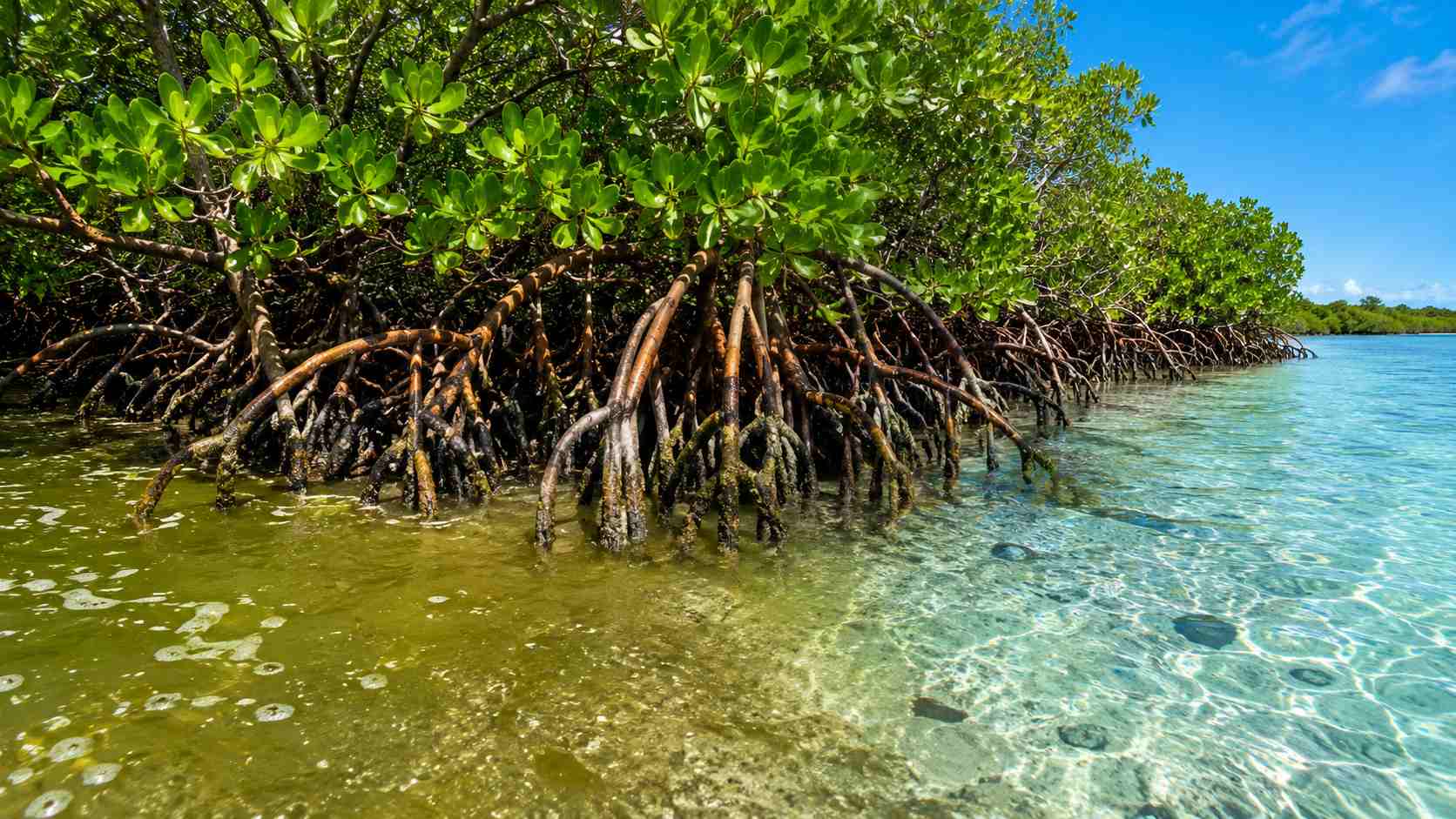

Mangroves remove about 960 thousand tons of nitrogen from water systems every year, providing an environmental service estimated at US$ 8.7 billion annually and still little understood by science, with the potential to exceed 5.5 million tons under ideal conditions
Mangroves remove 960 thousand tons of nitrogen from water systems every year. The findings, published on April 29 in the journal Earth’s Future, estimate this service to be worth US$ 8.7 billion per year.
The removal occurs in tropical and subtropical coastal forests, from salt-tolerant plants that grow between high and low tide lines. Their tall, tangled roots retain microbe-rich sediments, capable of transforming part of the nitrogen present in the water into gases that leave the ecosystem.
The study also calculated that, under ideal conditions of temperature, salinity, and nitrogen availability, mangroves could remove more than 5.5 million tons of the nutrient per year. In this scenario, the economic value of the service would reach US$ 57 billion annually.
-
China Develops Custom 140-Ton Electric Mining Truck with 770 kWh Swappable Battery, Deploys 290 Units in Xinjiang’s Largest Zinc Mine

-
Meta to Launch Arena, a New Prediction App Targeting 3.56 Billion Users, Competing with Polymarket and Kalshi

-
Scientist Challenges Famous Human Evolution Theory, Argues Homo Sapiens Evolved Gradually Over Thousands of Years

-
15-Year-Old American Builds Ocean Generator with PVC Pipe and 3D-Printed Propeller for $12, Wins National Prize, Presents at White House, and Makes Forbes 30 Under 30 List

Mangroves remove nitrogen from water
Nitrogen pollution is linked to excess nutrients entering water systems from human activities, such as agriculture. Between 2002 and 2010, this runoff amounted to 35.9 million tons of nitrogen per year in freshwater ecosystems.
This excess favors algal growth and can cause blooms that drastically reduce oxygen availability for other species. High nutrient presence can also release toxins into the water, posing a risk of disease.
The removal capacity of mangroves is poorly understood. Benoit Thibodeau, an assistant professor in the Department of Earth Sciences at the Chinese University of Hong Kong, stated that science is still in the early stages of understanding what drives this removal.
The researcher explained that the process involves removing reactive nitrogen and sending it into the atmosphere as N₂, a non-reactive form that can remain for thousands of years. Ziyan Wang, a doctoral student in environmental sciences at the same university, also participated in the interview.
Study compiled 51 previous researches
Thibodeau and Wang analyzed results from 51 previous studies and measurements carried out by the researchers themselves. The objective was to estimate global nitrogen removal rates in mangroves, separating data observed in nature and possible values under ideal conditions.
Actual rates represent the removal recorded in natural environments. Potential rates, on the other hand, indicate how much nitrogen could be absorbed if temperature, salinity, and nutrient levels were at ideal levels.
With these averages and an estimated global mangrove area of 52,459 square miles, equivalent to 135,869 square kilometers, the researchers arrived at the global figures. The result was an actual rate of 960 thousand tons per year and a potential rate exceeding 5.5 million tons per year.
The current removal is approximately equivalent to the mass of 650 giant sequoias. In the potential scenario, the amount removed would reach the weight of more than 4 thousand giant sequoias.
Microbes perform natural cleaning
The process depends on microorganisms present in mangrove sediments. They remove nitrogen through two main pathways: denitrification and anaerobic ammonium oxidation, known as anammox.
In denitrification, nitrate present in the water is transformed into nitrogen gas and nitrous oxide. Nitrous oxide is a greenhouse gas, while nitrogen gas leaves the ecosystem in a non-reactive form.
In anammox, nitrite and ammonium are converted into nitrogen gas. This gas makes up 78% of the atmosphere and is not considered a greenhouse gas.
Both pathways work best when there are high concentrations of nitrogen. The study also points out that there is a limit beyond which the removal capacity decreases.
These processes do not occur only in mangroves. Seagrass beds and other coastal environments also exhibit similar nitrogen removal pathways.
Even so, mangroves are especially effective because their sediments have low oxygen. This condition favors the microbial activity necessary to transform nitrogen compounds and remove the nutrient from the water system, Wang explained.
Economic value reaches billions
The authors used a market-based credit approach to estimate the economic value of this service. The calculation was similar to carbon credits used to offset emissions from activities like flying.
The reference came from what municipalities in countries like Australia and the United States pay to remove nitrogen from their water systems. Based on this, Thibodeau and Wang arrived at just over US$10,000 per metric ton removed.
Wang stated that the carbon credit market is already well-established, but the nitrogen market is not yet. The investigation initially assessed how different markets and sectors deal with this type of pollution.
At the current removal rate, the service provided by mangroves was estimated at US$8.7 billion per year. If removal reached 5.5 million tons annually, the value would rise to about US$57 billion.
Researchers already recognized mangroves as carbon sinks and as areas capable of offering coastal defense against storms and protection against erosion. The new study adds nitrogen removal, a lesser-known service given the impacts caused by pollution in aquatic ecosystems.






