






 Portuguese
  Spanish




After a Notable Career, the F-14 Tomcat, One of the Most Iconic Aircraft of the U.S. Air Force, Was Officially Retired in 2006. But the Story of This Powerful Aircraft Did Not End There.
In an unusual measure, the U.S. Navy decided to destroy all remaining examples of the F-14 Tomcat, cutting them into pieces and eliminating any possibility of reuse. The reason for this extreme action? To ensure that no parts of the F-14 fell into hostile hands, especially in Iran, the only country besides the U.S. to operate this model.
The creation of the F-14 Tomcat was driven by the growing rivalry between the United States and the Soviet Union during the Cold War.
The U.S. Air Force needed a long-range fighter to intercept Soviet bombers equipped with anti-ship missiles, a real threat to American carrier fleets.
-
Former Atacadão Employee Turns Online Cake-Baking Lessons into a Confectionery Brand with Factory, Store, Delivery, and Nearly $400,000 in Revenue

-
Brazilian Startup Sells Nearly 9 Million Surprise Bags of Near-Expiry Food, Prevents Thousands of Tons of Waste, Aiming for $42 Million Revenue by 2026
-
How to Prevent Brown Recluse Spider Bites: Common Hiding Spots and Free Tips to Reduce Risks

-
Natto: The Unusual Japanese Superfood Gaining Popularity on Social Media and Driving Record Exports




After unsuccessful attempts with models like the Douglas F6D and the F-111B, the Navy launched the VFX program, which sought an air superiority aircraft with variable geometry wings. In 1969, Grumman was chosen to develop the model that would become the legendary F-14 Tomcat.
Advanced Technology and Historical Role of the F-14 Tomcat
The F-14 Tomcat was a masterpiece of military engineering. Equipped with the AN/AWG-9 radar system and capable of tracking up to 24 targets simultaneously, it carried AIM-54 Phoenix missiles, with a range of up to 200 km.
This capability made the F-14 Tomcat an essential defender of the U.S. naval fleets. Operational since 1974, it replaced the F-4 Phantom and quickly demonstrated its value.
In the 1980s, during a confrontation with Libyan fighters in the Gulf of Sidra, the F-14 was crucial in defense and combat missions, solidifying its reputation.
Retirement and the Risk of Technology Proliferation
Over the years, the complexity and maintenance costs of the F-14 Tomcat became a burden, leading the Navy to replace it with the F/A-18 Super Hornet in 2006.
However, a greater concern arose: Iran was still operating 79 F-14s purchased in the 1970s when the country was a U.S. ally.
After the Iranian Revolution, relations between the two countries deteriorated, but Iran kept its aircraft and continued to use them extensively, especially during the Iran-Iraq war.
Why Destroy the F-14 Tomcat?
The decision to destroy the F-14 Tomcat was driven by the possibility of Iran obtaining spare parts to extend the lifespan of its aircraft.
Investigations revealed that Iranian agents were acquiring parts at U.S. military surplus auctions. In response, the State Department decided to eliminate all remaining F-14s.
In 2007, the Pentagon hired a company to dismantle the aircraft, shredding them into 60 cm pieces, rendering any recoverable component unusable.
A Legacy of Power and Controversy
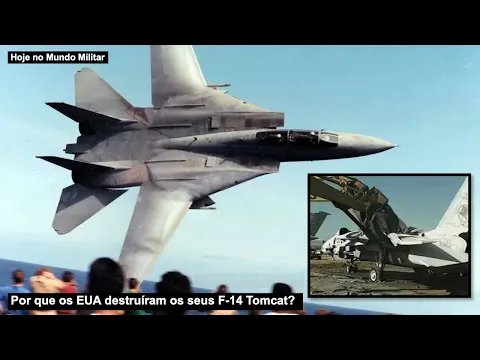

The F-14 Tomcat was more than just an aircraft; it represented the pinnacle of air defense for the U.S. Air Force for decades.
Its destruction symbolizes the importance the U.S. government placed on this technology and the fear that enemy powers could use it against U.S. interests.
This drastic measure is a reminder of how geopolitics and national security can lead to surprising, albeit painful, decisions for aviation enthusiasts.
Thus, the F-14 Tomcat, which marked generations, remains in history as an icon, even after its destruction.








Um aparelho fantástico, com um histórico exemplar. Na guerra Irã/ Iraque, dizimaram a velha e ultrapassada Força Aérea do Iraque. Os Aiiatolas precisaram reabilitar a elite de pilotos treinados pelos Norte americanos, nos tempos da orgulhosa elite de pilotos de Reza Pahlevi.