






 Portuguese
  Spanish


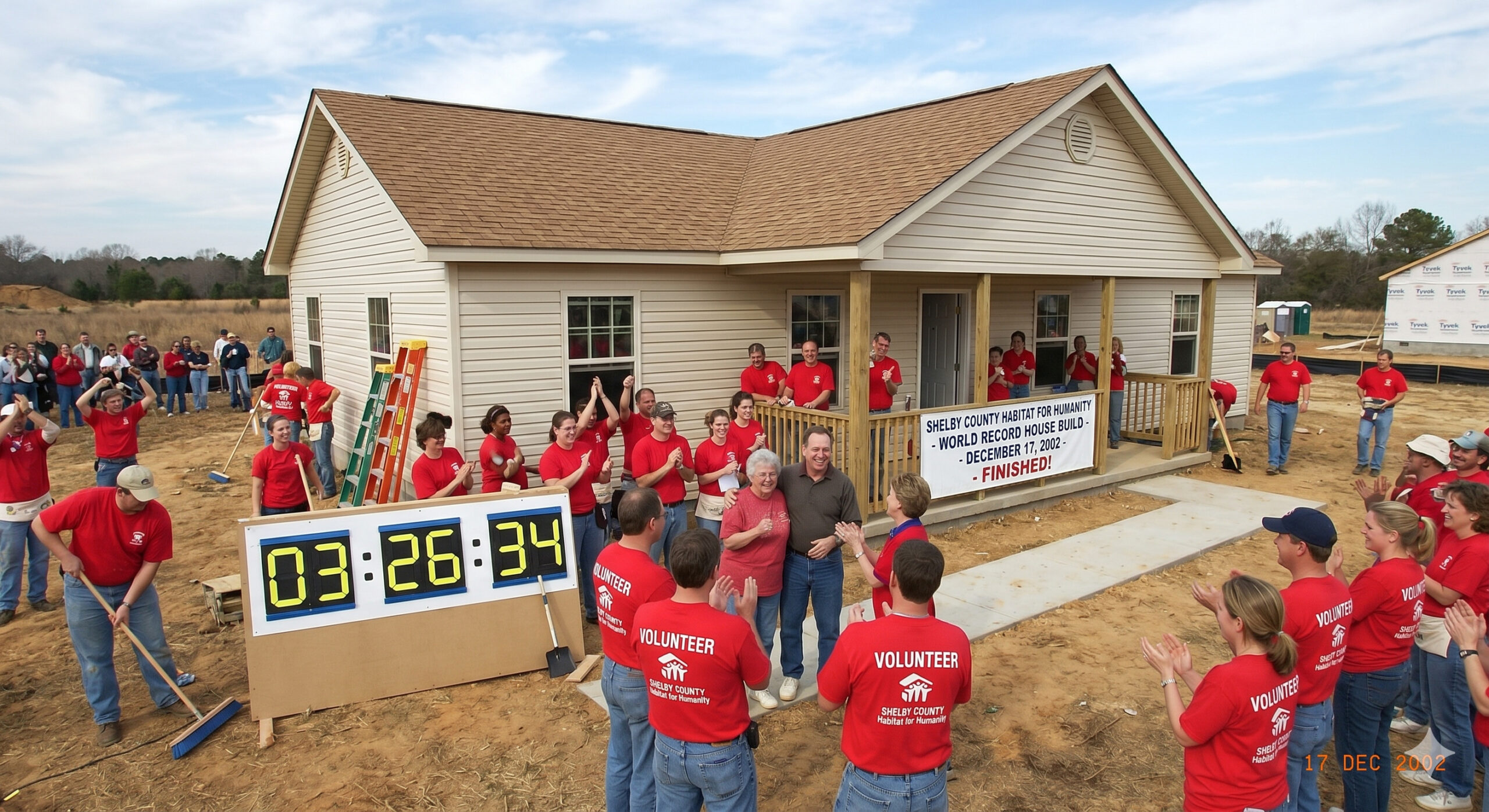

111 m² House Built in 3 Hours in Alabama Entered Guinness and Still Holds the World Speed Record.
On December 17, 2002, volunteers from the Shelby County Habitat for Humanity organization in Alabama, United States, accomplished a feat that continues to impress more than two decades later: building a complete 111 m² house in just 3 hours, 26 minutes, and 34 seconds. The project entered the Guinness World Records as the fastest-built house in the world. The residence was erected in Montevallo, Shelby County, and featured three bedrooms, two full bathrooms, electrical installations, functional plumbing, doors, windows, and a fully completed roof by the end of the operation. According to records from Guinness and Habitat for Humanity itself, the construction also surpassed the previous record from New Zealand, which was 3 hours, 44 minutes, and 59 seconds.
The house was built as a charitable initiative aimed at low-income families, within a housing program by Habitat for Humanity, an organization globally known for affordable housing projects.
Record-Holding House Was Built by Habitat for Humanity in an Operation Planned Over Months
Although the assembly took just over three hours, the project required months of preparation. According to Habitat for Humanity, the strategy involved detailed planning, prefabrication of components, and rigorous coordination among hundreds of volunteers, technicians, electricians, plumbers, and equipment operators.
-
U.S. City Builds Tiny Home Village on Water Company Land to House 136 Homeless People: Inside the Social Housing Units

-
Woman Turns Shipping Container into Home, Embraces Rural Life to Cut Monthly Expenses to Just Over $330
-
France Revamps 530 Social Housing Units with Large Balconies and Glass Facades Without Demolishing Existing Buildings

-
Facing high rent, couple transforms parents’ garage into a fully functional apartment, creating a complete home at a fraction of the market cost.




A large part of the structural pieces arrived ready at the assembly site. Walls, parts of the roof, and internal systems were organized in advance to reduce time on site.
The goal was to turn the construction into an almost choreographed operation, where each team executed specific tasks in an extremely precise sequence.
House Had Three Bedrooms, Two Bathrooms, and Fully Functional Installations
The house built in record time was not just a symbolic structure. According to operation records, the house was about 111 m², with three complete bedrooms, two bathrooms, a kitchen, functional electrical installations, plumbing, and basic finishing ready for residential use.
Additionally, the property received a complete roof and fully installed hydraulic systems within the record time frame.
The structure was designed to serve as a real residence for families served by Habitat for Humanity’s housing programs.
Operation used hundreds of volunteers and logistics similar to an industrial line
The record was only possible thanks to the enormous logistical coordination set up by the American organization. According to reports from the operation, hundreds of people participated simultaneously in the construction, including volunteers, construction professionals, and support teams.
Materials were organized in advance in the exact order of use. Trucks arrived in a planned sequence and each group received specific functions to avoid delays.
The process resembled an industrial assembly line applied to civil construction. While some teams installed walls, others were already executing electrical, hydraulic, roofing, and finishing at the same time.
Record surpassed New Zealand’s mark and remains unbeaten since 2002
Before the construction in Alabama, the world record belonged to a team from New Zealand. The previous mark was 3 hours, 44 minutes, and 59 seconds. Habitat for Humanity managed to reduce this time by about 18 minutes, setting a new official record recognized by the Guinness World Records.

The most impressive fact is that no other international initiative has officially surpassed the mark since then.
Even with the advancement of modular construction and industrialized techniques in recent decades, the record remains registered in the name of the American team from Alabama.
Rapid construction was possible thanks to pre-fabrication of components
The project used principles similar to those adopted today in modern modular construction. Much of the structures had already been pre-fabricated before the official start of the timer.
Walls, wooden structures, parts of the roof, and basic installations arrived practically ready for assembly on the site.
This allowed for a drastic reduction in traditional steps of conventional construction, such as manual cuts, continuous measurements, and long site preparation.
The strategy anticipated concepts that years later would gain worldwide strength within the industrialization of civil construction.
Habitat for Humanity turned the record into an affordable housing campaign
Habitat for Humanity used the event not only as a technical demonstration but also as a campaign to draw attention to the housing deficit.
The organization operates internationally, building houses for low-income families through programs based on volunteer work and affordable financing.
According to the institution, the record helped to show that faster construction processes could reduce costs and expand access to housing. The central focus was not just speed, but the possibility of building homes more efficiently and cheaply for vulnerable families.
Roof of about 6 tons was installed within the official time
One of the most complex points of the operation involved the installation of the roof. According to project records, the roof of the residence weighed approximately 6 tons and had to be hoisted and fitted quickly within the official record window.
The stage required precise use of cranes and coordination between different teams to avoid delays or structural risks.
The completion of the roof was considered one of the decisive moments for the validation of the world record.
Modular and prefabricated construction grew strongly after the 2000s
When the record was set, modular construction was still seen by many sectors as a limited or temporary solution.
In the following decades, however, the industrialization of construction began to gain strength in countries such as China, the United Kingdom, Japan, Singapore, Canada, and the United States.

Today there are hotels, hospitals, student residences, and even skyscrapers partially produced in factories before final assembly on site.
The Alabama case has often been cited as a pioneering example of the accelerated assembly logic applied to housing.
Extreme speed was only possible because the project was planned like a military operation
Construction experts point out that projects of this type depend much more on planning than just physical speed on the site.
Each stage of the Alabama house was rehearsed in advance. Teams knew exactly where to position materials, how much time they had, and which task they should perform.
This eliminated a good part of the common delays in conventional constructions, such as waiting for equipment, lack of materials, or interference between teams.
The level of organization was so high that many compared the project to a military operation or an automotive assembly line applied to residential construction.
Record continues to impress more than 20 years later
Even after the advancement of global modular construction, the record of 3 hours, 26 minutes, and 34 seconds remains one of the most impressive feats ever recorded in residential engineering.
Today, companies can manufacture entire modules in factories and drastically reduce schedules, but few operations have managed to complete a fully functional residence in such a short time under official Guinness criteria.
The achievement of Habitat for Humanity remains a symbol of extreme coordination, intelligent prefabrication, and collective mobilization.
The question that continues to intrigue engineers and construction specialists is straightforward: if a complete house was built in just over three hours more than two decades ago, how much further can the industrialization of civil construction reduce the time needed to create entire neighborhoods in the future?









