






 Portuguese
  Spanish


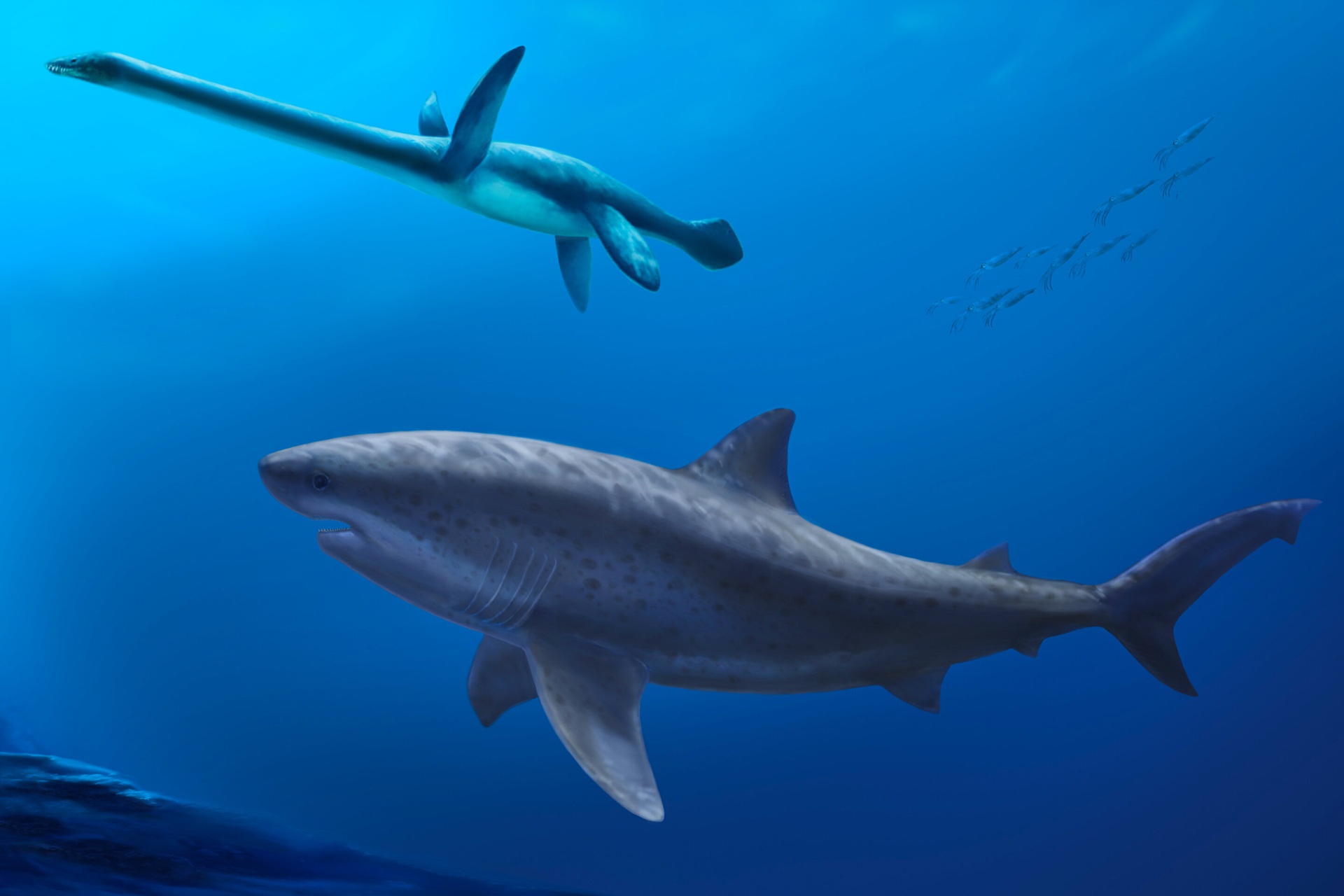
The Analysis Of Fossilized Vertebrae Found In The Darwin Region Of Australia Confirmed The Existence Of A Marine Predator About Eight Meters Long That Dominated The Oceans During The Cretaceous Period, Anticipating By Millions Of Years The Emergence Of Giant Sharks In The Modern Evolutionary Lineage Of Lamniformes.
Researchers identified an 8-meter shark that lived 115 million years ago near Darwin, Australia. The discovery based on fossilized vertebrae pushes back the emergence of megapredators in the modern lineage by 15 million years.
The Discovery Of The Predator In The Cretaceous Period
A monstrous shark prowled the waters of what is now northern Australia. It lived during the age of dinosaurs, long before whales or great white sharks.
The animal swam among the marine monsters of the Cretaceous period, according to new analyses. Researchers are studying enormous vertebrae discovered on a beach located near the city of Darwin.
-
Trump Signs Orders to Develop Quantum Computer and Bolster U.S. Systems Against Encryption-Breaking Attacks

-
Breakthrough in Clean Energy: Scientists Develop Battery-Free Artificial Photosynthesis Using Only Sunlight to Generate Chemical Energy
-
Revive Old Photos: Gemini’s Little-Known Feature Uses AI to Restore Damaged Images in Seconds with a Professional Six-Step Recovery Process

-
Young Brazilian Inventor Develops Microplastic Filter, Wins Scholarship to Study in China, and Implements Solution to Improve Water Quality in Southern Brazil


Experts state that the creature is now the oldest known mega-predator of the lineage. It lived 15 million years before the giant sharks found in previous records.
The ancestor of the modern great white shark was enormous and about 8 meters long. The authors of the article note that the modern great white shark currently measures only 6 meters.
Benjamin Kear serves as senior curator of paleobiology at the Swedish Museum of Natural History. He is one of the authors of the recently published study in the scientific journal Communications Biology.
Kear explains that the cardabiodontids were ancient megapredator sharks very common at the end of the Cretaceous. These animals dominated the oceans over 100 million years ago, according to the expert.
The new discovery expanded the scientific prediction of when we will find absolutely enormous cardabiodontids. Rediscovered fossils point to the existence of a huge shark much earlier than previously thought.
Evolution Of Lamniformes And Geological Context
Sharks have an evolutionary history that spans about 400 million years. However, lamniformes, the ancestors of today’s great white sharks, appear in the fossil record 135 million years ago.
At that distant time, these animals were small and probably only one meter long. The discovery that they were already gigantic 115 million years ago was surprising.
The vertebrae were found along the Australian coast in a location that was once mud. The bottom of this ancient ocean stretched from Gondwana to the region of Laurasia.
The mentioned geographical area corresponds to present-day Europe and Australia, respectively. It is a region rich in fossils of prehistoric marine life discovered to this day.
Long-necked plesiosaurs and ichthyosaurs are among the various creatures discovered at the site. The marine environment housed a complex fauna that coexisted with the newly discovered giant predator.
Detailed Analysis Of The Vertebrae And Methodology
Five vertebrae initiated the scientific quest to estimate the size of their owners. These fossils represent an ancient discovery that had been somewhat overlooked by scientists.
The items were unearthed in the late 1980s and 1990s. The fossils measured 12 centimeters in diameter and were stored in a museum.
When studying ancient sharks, the vertebrae are a true treasure for current paleontologists. Shark skeletons are made of cartilage, not bone, making preservation difficult.
The fossil record of these animals is primarily composed of teeth lost throughout their lives. Kear states that the importance of the vertebrae lies in the fact that they provide clues.
The vertebrae directly help in the clues about the real size of the prehistoric animal. Kear explains that trying to size animals based only on their teeth is a challenging task.
Large teeth may not necessarily correspond to large vertebral bodies, generating doubts in measurements. The exact size of ancient sharks remains a mystery in many studied cases.
Scientists used mathematical formulas to estimate the size of extinct sharks like the megalodon. This gigantic predator emerged later and may have reached a total length of 17 meters.
Final Modeling And Evolutionary Conclusions
The rarity of the vertebrae makes it difficult to answer precise questions about the size of sharks. The international research team spent years testing different methods to estimate size.
They used fishing data, computed tomography, and mathematical models on the cardabiodontids of Darwin. Finally, the researchers arrived at a likely portrait of the predator’s size and shape.
The animal would have the appearance of a modern, gigantic shark, according to Benjamin Kear. This is a body model that has worked successfully evolutionarily for 115 million years.
The study suggested that modern sharks ascended early to the top of food chains. Now, scientists could scour similar environments worldwide in search of specimens.
Kear claims they must have existed before, and this creature had ancestors. Studying ancient ecosystems can help researchers understand responses to current environmental changes.
The scientist states that it is in the past that our modern world begins. Analyzing what happened during climate and biodiversity changes provides a better understanding.
Understanding the result of these ancient transformations helps predict what may happen next. The study connects the deep past to the climate and biological challenges of the future.





-

-

4 people reacted to this.