Portuguese
  Spanish




More LNG Supply Starting in 2026 Could Change Global Dynamics and Boost Consumption in Asia, Says International Energy Agency.
A turnaround in the global natural gas market is already unfolding for the coming years. This is according to the report from the International Energy Agency (IEA) published in July 2025. Although 2025 indicates a slowdown, projections already point to a new growth cycle in 2026. Everything will be driven by a significant expansion in the supply of liquefied natural gas (LNG). Therefore, governments and companies are attentive to the scenario.
Sector Outlook: Slowdown, Transition, and Recovery
According to the IEA’s quarterly Gas Market Report, published in July 2025, the sector is undergoing a transition period. In this context, the market presents uncertainties and structural changes. Therefore, adaptation is necessary.
- In 2024, global demand grew by 2.8%. However, for 2025, the projection was revised down to 1.3%. This reflects both price pressures and macroeconomic factors.
- North America and Europe are expected to lead consumption growth in 2025. Meanwhile, the Asia-Pacific region is likely to record its lowest growth since the energy crisis of 2022.
- According to the IEA, the first half of 2025 was marked by tight market fundamentals. This scenario resulted from the decline in Russian gas exports to the European Union and modest growth in global LNG production.
- At the same time, the need for storage further increased European demand. This made energy security an urgent priority on the continent.
LNG Supply Will Gain Strength and Change Global Balance
For 2026, the report anticipates a new scenario characterized by the acceleration of global natural gas consumption.
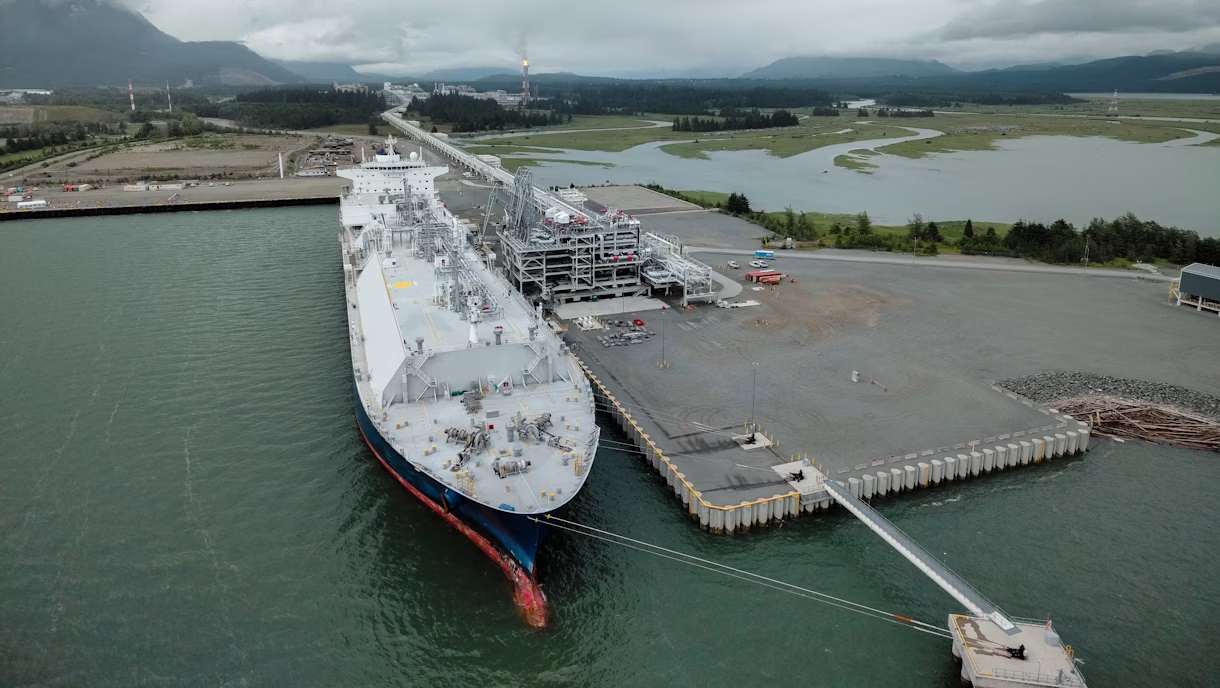
This advance will be primarily facilitated by the arrival of new LNG projects in countries like the United States, Canada, and Qatar. Together, they will enhance the global export capacity by around 40 billion cubic meters, the largest leap since 2019.
-
Oil production grows in Rio, but reserve replacement raises a warning sign

-
Petrobras is expected to complete the drilling of the Morpho well in the Foz do Amazonas in August 2026, the first well in the Equatorial Margin, an oil frontier that the ANP estimates at more than 30 billion barrels and could redraw the map of Brazil.

-
Oil returns to the center of concerns with tension between the US and Iran

-
IEA reduces forecast for global oil demand in 2026 after impacts of the Middle East crisis


- IEA experts emphasize that this expansion in supply should alleviate price pressures. In addition, this movement is expected to reignite demand, particularly in Asia.
- The estimated growth in global gas demand in 2026 is 2%. The recovery of Asian markets, which are traditionally sensitive to price fluctuations, is expected to be prominent.
- At the same time, the report pays attention to the strategic role of the Middle East. After all, geopolitical tensions in the region continue to influence price volatility.
Regional Highlights: Europe, China, and North America in Focus
The regional behavior of natural gas consumption in 2025 reveals important trends for the global sector. Each region faces its own challenges.
- In Europe, consumption increased by 6.5% in the first half of the year. This occurred mainly due to the electricity sector and the decline in wind and hydroelectric generation.
- While this movement does not signal a permanent trend, it highlights the crucial role of gas-fired power plants in the stability of European energy systems. Therefore, security remains a priority.
- In China, demand fell by about 1% compared to 2024. In addition, the country saw a drop of over 20% in LNG imports.
- In North America, demand rose by 2.5%. This increase was driven by colder temperatures in the first quarter, which raised gas use in residential and commercial buildings.
Uncertainties and Monitoring: Challenges for the Global Sector
Even in the face of recovery prospects, the global natural gas scenario remains surrounded by economic uncertainties and geopolitical risks. The IEA emphasizes the need for constant monitoring.
- Keisuke Sadamori, Director of Energy Markets and Security at the IEA, emphasized in July 2025 that the new wave of LNG projects will be crucial for alleviating pressures and sustaining growth.
- However, he warns that macroeconomic factors and the volatile geopolitical environment continue to pose challenges for the sector until 2026. Thus, governments and companies must remain vigilant.
- The IEA reinforces the commitment to market monitoring to ensure the security of global supply. Thus, the goal is to anticipate risks.
Impacts and Future: What to Expect from the Global Gas Market
The IEA report, published in July 2025, establishes itself as a reference for strategic decisions in the energy sector. Thus, the document projects a more dynamic market starting in 2026.
- The resumption of growth depends on the entry of new volumes of LNG and the response of Asian markets. Therefore, monitoring these movements will be essential.
- The geopolitical context, especially in the Middle East, will continue to influence prices and trade flows. For this reason, the sector needs flexibility.
- Regional transformations, supply and demand challenges, and the need for energy security keep the sector alert. Therefore, flexible strategies are required from governments and companies.
The New Cycle of Natural Gas: Challenge or Opportunity for the World?
Industry experts assess that the next cycle of natural gas could redefine the global energy balance.
However, realizing this potential requires informed decisions, rigorous monitoring, and continuous adaptation to the uncertainties of the global scenario. Thus, it becomes possible to seize opportunities.
Meanwhile, the movements of markets and governments already signal that energy, international trade, and geopolitics will continue to be increasingly interconnected until 2026. Therefore, close monitoring of the sector is indispensable.
What do you think will be decisive for the future of the global gas market: the advancement of new LNG offers or geopolitical instability?