






 Portuguese
  Spanish
  4 min of reading
  0 comments


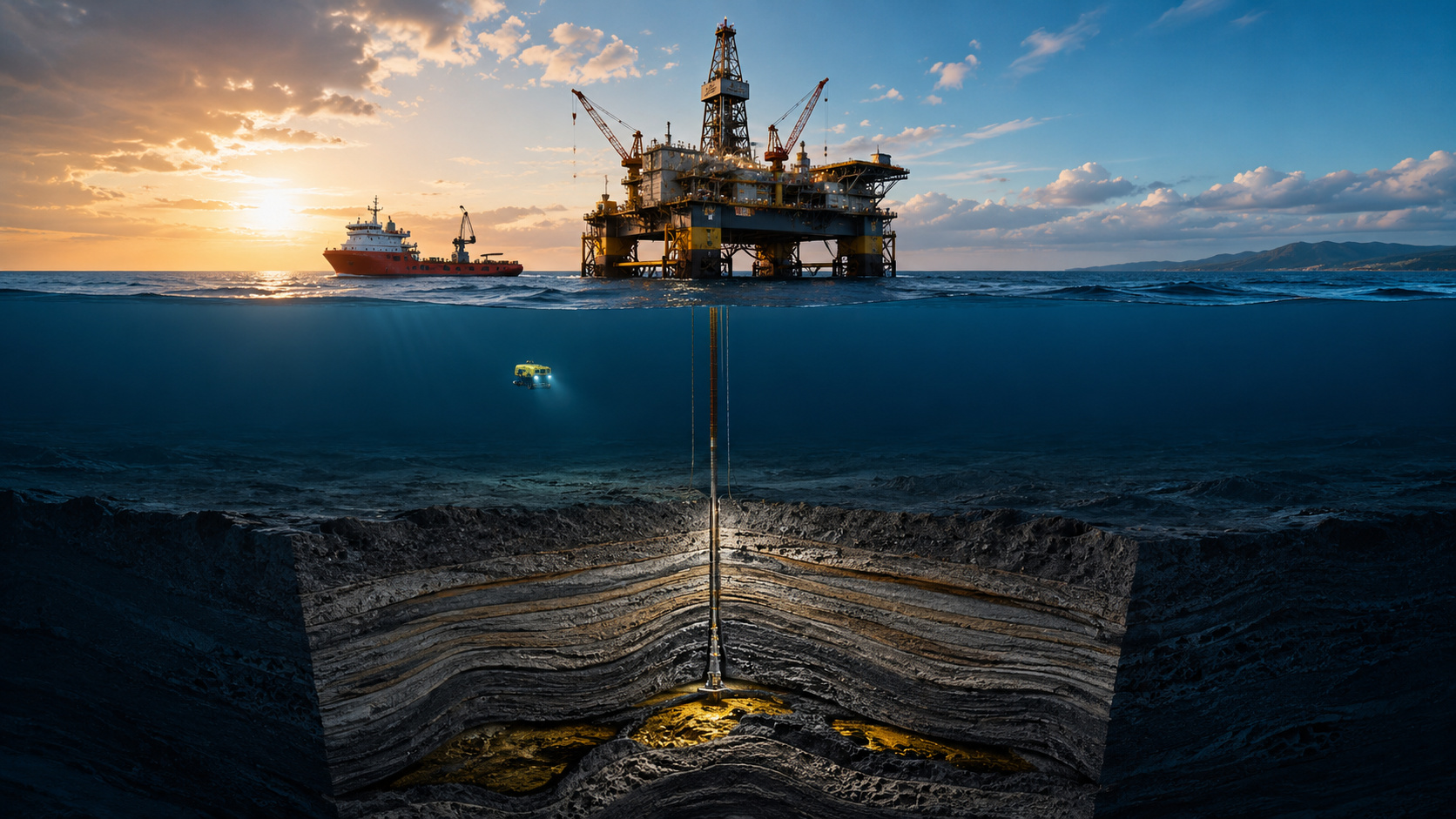
A new discovery of oil and gas in ultra-deep waters off the Brazilian coast has once again drawn the attention of the global energy sector. Located at almost 20,000 feet deep (about 5,855 meters) below sea level, the reservoir found in the Bumerangue block in the Santos Basin represents one of the largest technological bets in the oil industry today.
Additionally, experts highlight that finding oil at such extreme depths requires highly sophisticated equipment, advanced drilling systems, and billion-dollar investments. Therefore, each new well drilled in the Brazilian pre-salt areas functions as a high-tech complex operation.
Discovery is located in one of the most strategic areas of the pre-salt
The reserve was identified in the Bumerangue block, located in the Santos Basin, about 400 kilometers off the coast of Rio de Janeiro.
Furthermore, the region is part of one of the most productive areas of the Brazilian pre-salt, responsible for a large part of the national oil and natural gas production.
-
Petrobras is expected to complete the drilling of the Morpho well in the Foz do Amazonas in August 2026, the first well in the Equatorial Margin, an oil frontier that the ANP estimates at more than 30 billion barrels and could redraw the map of Brazil.

-
Oil returns to the center of concerns with tension between the US and Iran

-
IEA reduces forecast for global oil demand in 2026 after impacts of the Middle East crisis

-
Bank of Japan raises interest rates to 1%, reaching the highest level in over three decades



Experts consider the Santos Basin one of the most important energy frontiers on the planet.
Depth impresses even specialists
The well reached approximately 5,855 meters in depth.
For comparison, this distance exceeds several times the height of the world’s tallest skyscrapers.
Moreover, the drilling crosses multiple geological layers before reaching the hydrocarbon reservoirs hidden beneath the ocean floor.
Each drilling costs millions of dollars
Drilling in ultra-deep waters is among the most expensive operations in the energy industry.
Additionally, companies need to mobilize drillships, highly specialized teams, and technologies capable of operating under extreme pressure and temperature conditions.
Therefore, each drilling operation functions as a significant financial and technological gamble.
Cutting-edge technology allows reaching giant reserves
Technological advancements have completely transformed offshore exploration in recent decades.
Moreover, modern dynamic positioning systems allow drillships to remain stable even in the open sea during long periods of operation.
Without these technologies, exploration in ultra-deep waters would be practically impossible.

Reservoir presents promising characteristics
According to information released by BP, the drilling encountered a hydrocarbon column approximately 500 meters thick.
Additionally, the reservoir is located in a high-quality carbonate formation within the pre-salt layer.
These characteristics increase market interest in the potential of the discovery.
Pre-salt continues to surprise the energy sector
Since the first discoveries, the Brazilian pre-salt has established itself as one of the world’s greatest energy riches.
Furthermore, the region has geological conditions that favored the formation of enormous oil and gas reserves over millions of years.
Therefore, international companies continue to increase investments in the Brazilian coast.
High levels of carbon dioxide pose challenges
Despite the excitement about the discovery, initial tests also identified high concentrations of carbon dioxide.
Moreover, this factor can increase the complexity of production and require additional processing steps for the fluids found.
Experts state that laboratory analyses will be crucial to determine the economic viability of the project.
Production may still take years
Even after a discovery considered promising, the start of commercial production does not happen immediately.
Furthermore, experts estimate that deepwater projects can take four to ten years to effectively begin operations.
During this period, companies conduct geological studies, production tests, and planning of the necessary infrastructure.

Brazil maintains strategic position in the global market
Currently, Brazil ranks among the largest oil producers in the world.
Furthermore, about 95% of national production already occurs in maritime areas, mainly in the Santos and Campos basins.
This scenario reinforces the importance of offshore reserves for the Brazilian economy.
Engineering needs to face extreme conditions
Operations in ultra-deep waters require highly advanced engineering solutions.
Moreover, equipment needs to withstand gigantic pressures, intense corrosion, and extremely hostile environments.
Therefore, offshore exploration is considered one of the most sophisticated areas of modern engineering.
Market follows the economic potential of the discovery
The discovery has attracted the attention of investors and analysts in the energy sector.
Additionally, new reserves can expand Brazil’s production capacity and further strengthen the country’s presence in the international oil and gas market.
Experts believe that future assessments will determine the real size of the area’s economic potential.

What makes this discovery so important
Among the factors that draw the most attention are:
- Depth close to 20,000 feet
- Strategic location in the pre-salt layer
- Potential for new giant reserves
- Use of advanced drilling technology
- Engineering challenges in ultra-deep waters
- Possible impact on Brazilian energy production
Furthermore, the project reinforces Brazil’s role as one of the world’s leading offshore oil powers.
Ocean floor continues to hide billion-dollar riches
The discovery shows how the Brazilian coast still holds enormous energy reserves under deep layers of rock and salt.
Moreover, each new drilling demonstrates the technological evolution that allows reaching areas considered inaccessible a few decades ago.
As companies advance deeper into the ocean, the pre-salt layer continues to reveal reserves capable of moving billions of dollars and influencing the global energy future.


Be the first to react!