






 Portuguese
  Spanish
  5 min of reading
  0 comments


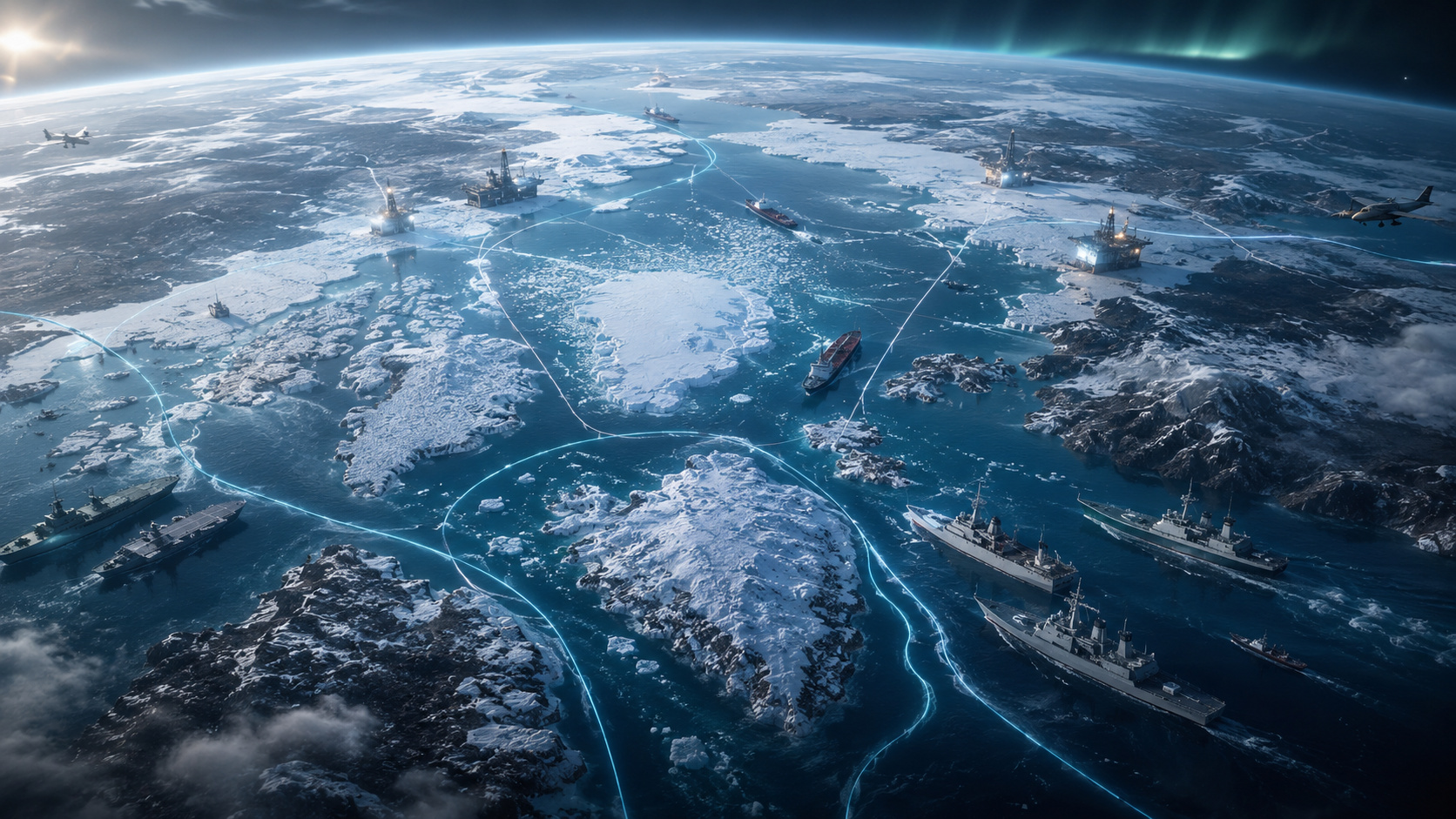
The Arctic holds 90 billion barrels of oil, shorter maritime routes between Asia and Europe, and a growing dispute between Russia, China, and the United States.
According to the Atlantic Council, the Arctic holds estimated reserves of 90 billion barrels of oil, equivalent to 16% of all undiscovered oil on the planet, as well as 1,669 trillion cubic feet of natural gas and 44 billion barrels of natural gas liquids. About 84% of these reserves are in offshore areas, under the Arctic Ocean floor.
The advancement of Arctic ice melting is profoundly changing this equation. The Northwest Passage has already extended its navigation season from two to four months per year, while the Northern Sea Route, along the Russian coast, is now navigable for six months. With the ice retreating, the Arctic ceases to be a natural barrier and becomes a maritime corridor, an energy frontier, and a zone of strategic competition.
The Arctic holds oil, natural gas, and the most coveted maritime route of the century
The strategic value of the Arctic is not only in the subsoil but also in the geography. When the polar routes become more open, the maritime distance between Shanghai and Hamburg can drop from 21,000 km via the traditional Suez Canal route to 15,000 km via the Arctic route.
-
Oil production grows in Rio, but reserve replacement raises a warning sign

-
Petrobras is expected to complete the drilling of the Morpho well in the Foz do Amazonas in August 2026, the first well in the Equatorial Margin, an oil frontier that the ANP estimates at more than 30 billion barrels and could redraw the map of Brazil.

-
Oil returns to the center of concerns with tension between the US and Iran

-
IEA reduces forecast for global oil demand in 2026 after impacts of the Middle East crisis


This reduction represents savings in time, fuel, and logistical costs on the world’s largest commercial axis. In a scenario of global trade pressured by bottlenecks, regional conflicts, and naval disputes, the Arctic Ocean is seen as a strategic alternative for cargo between Asia and Europe.
The decisive point is that, under this opening route, lie the reserves that countries want to control. The ice that once prevented navigation and exploration is retreating while exposing access to oil, natural gas, minerals, cables, and future submarine infrastructure corridors.
Russia controls half of the Arctic coast and attempts to advance to the North Pole
Russia occupies the most privileged geographical position in the Arctic. Half of the Arctic Ocean coast is Russian, which includes most of the Northern Sea Route, today the most direct route between Europe and East Asia via the north.


In 2001, Moscow presented to the UN a claim for the extension of the continental shelf based on Article 76 of UNCLOS, alleging that the Lomonosov Ridge would be a natural extension of the Russian shelf. If accepted, this thesis would place under Russian economic sovereignty an area of 1.2 million km² of ocean floor in the center of the Arctic.
While the final decision is pending, Russia has expanded its presence in the far north. The country maintains 40 icebreakers in service, of which 14 are nuclear, reactivated military bases in Siberia and on Arctic islands, and put into operation the nuclear icebreaker Ural, with 209 meters and the capacity to break ice 4 meters thick.
China tries to enter the Arctic without having an Arctic coast and created the idea of a near-Arctic state
China does not have a coastline in the Arctic, but decided to position itself as a political and economic actor in the region. In 2018, it published a White Paper in which it defined itself as a near-Arctic state, an expression without formal basis in international law, but used by Beijing to justify permanent interest in the High North.
The Chinese logic is economic and strategic. The country is the largest importer of oil and gas in the world and heavily depends on maritime routes that pass through areas monitored or influenced by rival powers.

A shorter Arctic route less exposed to bottlenecks like the Suez Canal Canal directly interests Chinese energy and commercial security.
Therefore, Beijing invested in icebreakers, polar technology, infrastructure in northern Norway, Greenland, and Russia, as well as financing Russian LNG projects in the Arctic.
Sino-Russian cooperation has come to explicitly include the Arctic, strengthening the Chinese presence in a region where it does not have its own geographical base.
United States falls behind in icebreakers and still disputes route with Canada
The imbalance of capabilities in the Arctic is strongly evident in fleet comparisons. Russia has 40 icebreakers, while the United States has only two, with the Polar Star having entered operation in 1976 and needing its lifespan extended.
This limitation is even more sensitive because Washington and Ottawa maintain a long-standing dispute over the Northwest Passage. Canada considers the route as Canadian internal waters. The U.S. treats it as an international navigation strait, an interpretation that would completely change who can or cannot navigate militarily through the corridor.
The impasse is strategic because it affects sovereignty, naval presence, and freedom of navigation in a route that could become central to global trade. Two NATO allies remain unresolved over who truly controls the corridor that global warming is making increasingly viable.
Paralyzed Arctic Council expands geopolitical vacuum in the region
The main multilateral forum for dealing with the Arctic was the Arctic Council, created in 1996 to bring together Russia, the U.S., Canada, Norway, Denmark, Finland, Sweden, and Iceland around topics like science, environment, and regional cooperation. Since March 2022, however, this mechanism has been in paralysis.
After the invasion of Ukraine, the other seven members suspended participation in meetings chaired by Russia.

The rotating presidency passed to Norway in 2023, but Russia remains a member with veto power in consensus decisions. In practice, the council exists formally but has lost real coordination capacity.
This blockade opens a vacuum precisely when the region needs rules for exploration, navigation routes, accident response, search and rescue, and environmental management. The Arctic gains economic and military value while simultaneously losing institutional governance capacity.
Melting of Arctic ice accelerates race for fossil resources and military presence
The latest climate models point to the first ice-free summer in the Arctic before 2050, possibly even before 2030 in scenarios of more accelerated warming.
Without summer ice, routes that are currently seasonal tend to become more widely accessible, and reserves previously blocked by permanent layers become technically exploitable.
This creates a central paradox. The phenomenon that opens access to Arctic oil and gas is the same that was driven by the burning of fossil fuels.
In other words, more warming facilitates the exploration of resources that, if extracted and burned, can generate even more warming.
At the same time, the Atlantic Council shows that the dispute has already moved beyond rhetoric. Russia conducted exercises with more than 150,000 soldiers in 2019, China and Russia conducted joint naval patrols in the Arctic in 2023, and NATO created an Arctic Command Center in 2024. The ice is melting, the routes are opening, and the powers are already positioning themselves.







Be the first to react!