






 Portuguese
  Spanish


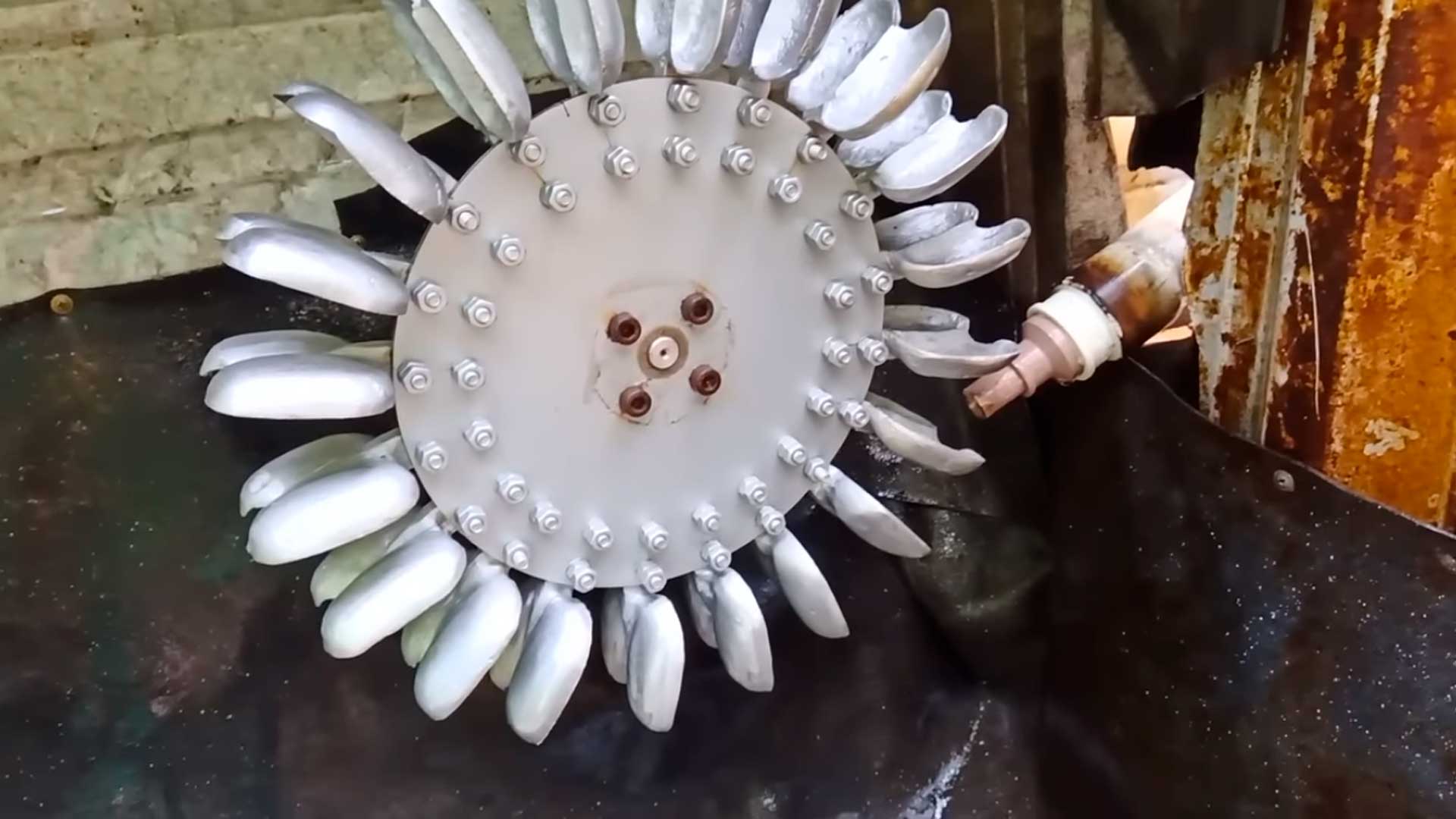


Artisanal Micro Hydroelectric Project Shows Aluminum-Cast Pelton Wheel Operating Continuously, with Adjusted Jet and Belt Transmission to a Three-Phase Generator.
An artisanal micro hydroelectric plant has undergone continuous operation tests and demonstrated stable performance. The highlight of the setup is the Pelton wheel cast in aluminum, which has been functioning for over a week with good mechanical stability. The system uses a concentrated jet, measured at about 19 mm in internal diameter, to drive the turbine buckets.
The project employs a closed water system, with a pressure reading of approximately 3.2 kgf/cm², which is equivalent to a water drop of over 30 m. This pressure level is compatible with typical Pelton turbine applications, known for performing well at high elevations and low flow rates. The jet was slightly constricted at the nozzle tip to increase flow coherence.
On the mechanical side, the wheel is coupled by an aluminum flange to the shaft that transmits rotation through belts and pulleys to a generator. According to the person in charge, the turbine remains “100% balanced,” reducing vibrations and losses. The control panel includes a three-phase circuit breaker and a control board, still turned off during the rotation and flow test.
-
Workers near the Vatican uncover lead pipe revealing Emperor Caligula’s name and site of his opulent garden from nearly 2,000 years ago

-
Workers renovating a playground in northern England uncover 176 World War II bombs buried underground; training artifacts still contained explosives.

-
Brazilian Architect Transforms Waste into Sustainable Homes with Solar Power and Rainwater Systems for 40 Years

-
Security Guard Becomes Doctor at Louisiana Hospital Where He Once Worked, Studied Chemistry Between Shifts





With the validation of basic operation, the next step is to install a needle injector nozzle, which allows modulating the jet passage area without significant loss of efficiency. The expectation is to achieve greater load control and an increase in global efficiency of the micro plant.
How the Homemade Pelton Wheel Was Built and Integrated to the Generator with Belts and Pulleys
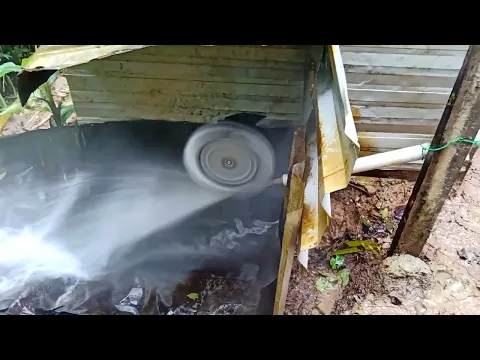

The Pelton turbine was cast in aluminum and mounted on a flange of the same material, which couples the assembly to the transmission shaft. Two bearings support the shaft, ensuring alignment and stability of rotation. The care taken in machining and balancing reflects in the smooth operation observed under full jet load.
The transmission uses a “25” pulley on the turbine shaft and another “17” on the generator shaft, resulting in a ratio close to 25 to 17. This increases the rotation in the generator, a common strategy when the turbine turns slower than necessary for the optimal range of the alternator. The belts were adjusted during testing to avoid slipping and noise.
On the electrical side, the setup includes a three-phase circuit breaker and a control panel, which have not yet been activated in the demonstration. The indication of readings such as “247” was recorded without a detailed unit, suggesting that the instrumentation is still being calibrated for formal measurements of voltage, current, or rotation.
Water Pressure and Equivalent Falls, Why the Needle Injector Nozzle Should Improve Performance
The test indicated static pressure of just over 3 kgf/cm² (about 3.2), a value compatible with a manometric height of over 30 meters. This equivalence between pressure and water column height is a well-established reference in applied hydraulics. According to the technical guide Flow of Fluids TP-410 by Crane (2018 edition), 1 bar corresponds to approximately 10.2 meters of water column, which supports the project’s estimate.
For the jet geometry, a 20 mm tube with an internal diameter of approximately 19 mm was used, whose nozzle was slightly closed to concentrate pressure on the buckets. In the Pelton turbine, the quality of the jet is decisive for efficiency: the more cohesive and well-oriented it is, the better the energy transfer to the wheel. The next step, a needle injector nozzle, aims to optimize this point precisely.
According to the U.S. Department of Energy, the Pelton is indicated for high elevations and low flow rates, operating with high efficiency when the jet is properly adjusted (Energy.gov, Hydropower Basics). The International Hydropower Association emphasizes that micro-hydropower solutions can achieve good yields and reduced environmental impacts when well designed and controlled.
Observed Performance, Rotation Balance, and Next Steps to Consolidate Microgeneration
During full flow opening, the wheel maintained stable rotation and low vibration, which corroborates the report of adequate balancing. This point is critical to reduce bearing wear and mechanical losses, in addition to improving overall system efficiency.
With the needle injector nozzle, the operator will be able to regulate the jet precisely without closing upstream valves, avoiding losses due to cavitation and turbulence. The expected result is greater control under different electrical loads, voltage stability, and better generator response.
Other possible improvements include checking the alignment of the pulleys, choosing appropriately profiled belts, and integrating a load controller into the panel. Activating the three-phase circuit board with the correct protections will allow for complete electrical tests, such as measurements of power, power factor, and heating under load.
Regulatory Context of Microgeneration in Brazil and Electric Safety Precautions
In Brazil, distributed generation has rules defined by Law 14.300, of January 6, 2022, which establishes the legal framework for systems such as micro hydroelectric plants connected to the grid. To connect to the electrical system, compliance with technical standards, protections, and procedures of the distributor is required, in accordance with ANEEL’s regulation.
Proper selection of circuit breakers, grounding, and protection devices is essential for operational safety. In three-phase systems, phase balancing, the presence of disconnection devices, and protection against energy return to the grid are critical points highlighted in ANEEL’s sectoral technical guides and international best practices.
Lessons from the Test for Low-Cost and Replicable Pelton Turbine Projects
This trial reinforces three fundamentals for the micro hydroelectric plant: well-formed jet, balanced Pelton wheel, and mechanical transmission adjusted to the generator. The combination of a 19 mm nozzle and pressure in the range of 3.2 kgf/cm² shows feasibility when there is available drop and control of losses in the piping.
According to the International Hydropower Association, micro-scale solutions gain efficiency when the hydraulic and electromechanical design is treated in an integrated manner, something that the use of needle nozzle, three-phase protection, and calibrated measurements tends to consolidate. For replication, attention should be given to casting and machining of the wheel, the quality of the bearings, and the sealing of the piping to minimize leaks and pressure loss.
What do you think about building a Pelton turbine artisanal versus purchasing a commercial microgeneration kit? Does home engineering compensate in cost and learning, or does the reliability of industrial components speak louder? Leave your comment and share your experience, especially regarding needle injector nozzles and wheel balancing.




Minha modesta opinião é que a escolha do alumínio foi a parte equivocada do projeto. Alumínio e água não são adequados pra trabalharem juntos de forma permanente.
Use bicos injetores tipo Venturi que sua eficiência irá melhorar uns 15 a 20%..