






 Portuguese
  Spanish
  6 min of reading
  0 comments


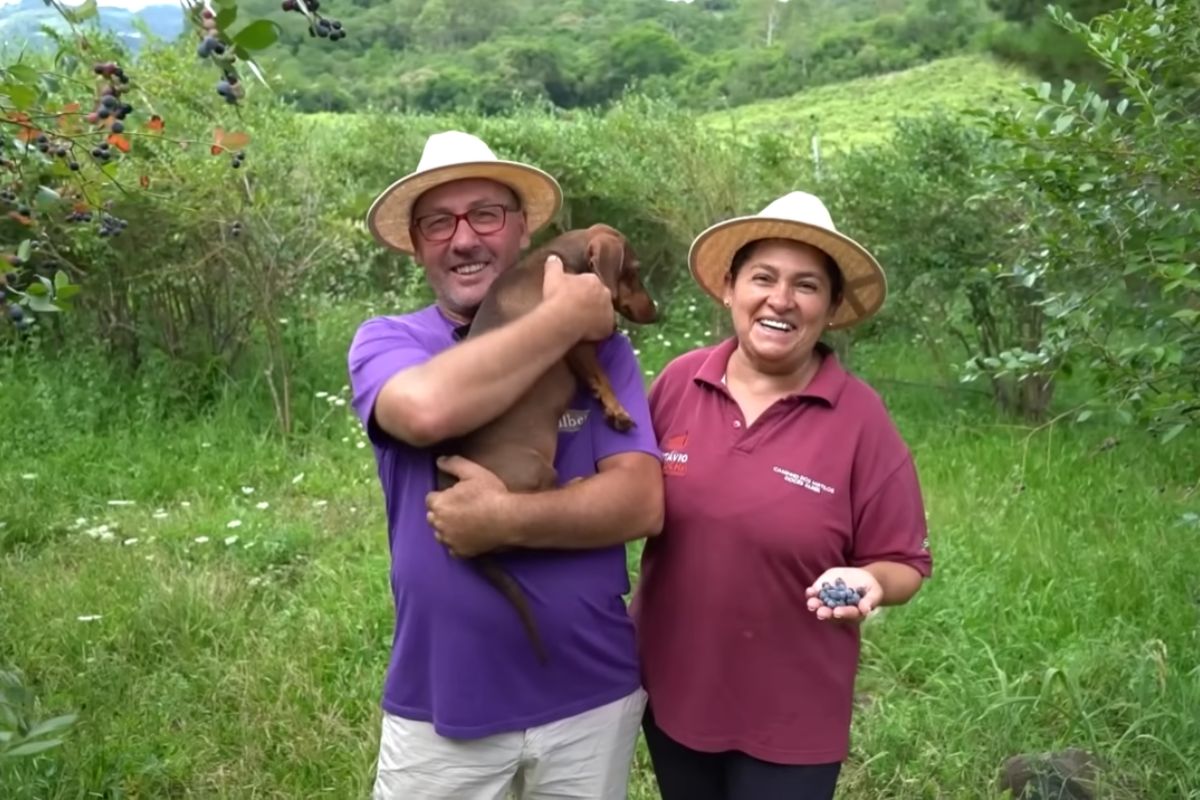
With Blueberries Still Majoritarily Imported in Brazil, the Bernard Family Turned an Organic Crop of More Than 2 Thousand Seedlings in Flores da Cunha in the Serra Gaúcha into Income, Agroindustry, and Rural Tourism, with Manual Harvesting, Selection in Containers, and Products Like Jams, Cakes, and Ice Creams Each Harvest
The blueberry has gained the status of an expensive product and, at certain times, can be referred to as a “luxury fruit,” with prices ranging between R$ 48 and R$ 60 per kilogram, and potentially even higher during off-seasons. When a small fruit becomes a price reference, each stage of production begins to be charged in detail.
In the Serra Gaúcha, in Flores da Cunha, the story of a family helps explain why blueberries left the import shelves and started to gain space in the field, agroindustry, and rural tourism. The bet started in 2003, crossed years of uncertainty, and today mixes cultivation, processing, and visitation in a same income logic.
Why Blueberries Still Come from Abroad and Why It Affects the Price

Brazil still imports about 80% of the blueberries it consumes, according to local production reports.
-
Low-Demand Brazilian Beef Offal Gains Popularity Abroad: Indonesia Purchases $19.5 Million, Boosting Revenue and Reducing Waste

-
Soy Expansion in Former Brazilian Savanna Sparks Water and Land Conflicts in Major Agricultural Frontier
-
Mexican Pest Threatens U.S. Cattle Herds at Historic Lows, Potentially Boosting Brazilian Beef Exports as Burger Prices Soar

-
Avocado Boom for European and U.S. Markets Fuels Water Crisis in Drought-Stricken Chilean Region




This fact alone explains part of the final value: when internal supply is limited, the market becomes more exposed to variations in availability, logistics, and seasonality, impacting the consumer’s wallet.
National production is described as concentrated in small properties, with an estimated planted area of approximately 250 hectares.
In this scenario, Rio Grande do Sul has established itself as a pole, with about 70 hectares planted and an estimated annual production of 400 tons.
Brazilian blueberries are presented as sweeter and completely hand-picked, but this also means high labor costs.
Flores da Cunha and the Bet That Started in 2003 When Almost Nobody Knew

In Flores da Cunha, in the Serra Gaúcha, the Bernard family claims to represent the fourth generation on the property.
It was there that Luiz decided to swap crops like plums and pears for blueberries, seeking something different from what “everyone else was planting.”
The choice came after the suggestion of a relative who had seen the fruit abroad, where it is also called blueberry.
The beginning was not simple. The first 1,000 seedlings were planted in December 2003 and another 1,000 in December 2004, but the crop took about four years to reach a more consistent level of production.
The local market was not familiar with the fruit, and according to the family, there was a moment when they considered cutting the plants and starting over with another crop.
The blueberry became a long-term bet before it turned into a showcase for rural tourism.
Manual Harvesting, Selection in Containers, and the Real Cost of “Fruit by Fruit”
The harvesting of blueberries is described as entirely manual, and this changes everything. A worker can spend about 10 hours a day to harvest around 20 to 25 kilos, always “fruit by fruit.”
It’s a rhythm that does not combine with haste or industrial scale, and therefore productivity depends on the team, time, and weather.
The selection begins right on the plant. The family describes the use of two containers, around 1 kilo each, to separate the firmer blueberries suitable for fresh consumption from those destined for the industry.
This method also becomes part of the experience offered to visitors, with guidance on harvesting and tasting.
When the selection happens before the blueberries leave the farm, the line between production and rural tourism becomes shorter.
The Variety, The Harvest Window, and The Count of People Needed in the Crop
The farm in Flores da Cunha, in the Serra Gaúcha, cites a variety called Climax as the most productive, with the potential for over 10 kilos per plant.
This number helps to understand why blueberries can sustain a property, but also exposes a bottleneck: high volume does not mean ease, because the harvest remains manual and sensitive.
The harvest season is described as being between November 15 and January 15.
With just over 2,000 seedlings, the demand for labor can reach 15 to 20 people per day, for about 45 days.
This type of operation turns the harvest into an event: the window is short, the product is delicate, and any timing error leads to loss. With blueberries, haste tends to be costly, and so does delay.
Agroindustry Since 2010 and the Logic of Utilizing the Surplus Without Wasting
The turning point mentioned by the family occurred in 2010 with the construction of the agroindustry. Previously, all sales were of fresh blueberries.
After that, the surplus began to have a destination, with cleaning, sanitizing, packaging, and freezing.
The process includes an initial cooling step in an external chamber, referred to by them as a “dirty chamber,” before the blueberries move on to the processing environment.
The family reports a harvest of around 12 tons in one year, with internal consumption of about 5 to 6 tons, which reinforces the need to transform part of the volume.
Among the products mentioned are preservative-free jams, versions with pepper, combinations with berries, as well as options without added sugar, using apple pulp.
The agroindustry acts as insurance against loss and also against the fluctuations of the fresh fruit market.
Rural Tourism as Direct Sale, Landscape, and a Route That Becomes a Product
Rural tourism appears as a strategy to bring the customer to the property and sell there, “at a fair price,” according to the family. In Flores da Cunha, in the Serra Gaúcha, visitors find blueberry cake, blueberry ice cream, colonial coffees, and picnic areas in the midst of nature.
The journey to the farm is made in a converted cart from an old rural vehicle, along a path of just over 500 meters on dirt road, with vineyards, forest, and the blueberry area already at the end of the harvest.
The tour is described with seven stopping points, where varieties are presented, family history is shared, and panoramic views of the valley and mountains are offered.
There are also adventure attractions, with a climbing point and three rappelling routes. Among the episodes mentioned, one stands out: the family’s “nono,” who is 92 years old, descended a rappel of 85 meters.
When rural tourism enters the equation, blueberries stop being just food and become an experience.
Organic Certification, Medal in 2015, and The Moment When Demand “Found” The Farm

The recognition mentioned by the family passes through two milestones.
One of them is the registration as organic, certified by the Ecovida network, which would have helped in the publicity and in building trust in a product still little known in the region at that time.
The other milestone came in 2015, when they reported winning a gold medal in a contest linked to Expo Inter. From then on, according to the narrative, clients began to visit the property, and the operation gained momentum to expand, including in rural tourism and agroindustry.
In blueberries, reputation and trust tend to be worth almost as much as the kilogram.
The blueberry that reaches R$ 60 per kilogram is not valued only for its taste.
In Flores da Cunha, in the Serra Gaúcha, the Bernard family describes a chain that combines manual cultivation, careful selection, need for team, short harvest window, agroindustry since 2010, and rural tourism as direct sale and experience.
The “gold” of blueberries, in this case, is less of a metaphor and more of a sum of work with strategy.
If you found blueberries at R$ 60 per kilogram, what would weigh more in the decision: the price, the national origin, the fact that it is organic, or the possibility of buying directly through rural tourism? And, thinking about Flores da Cunha and the Serra Gaúcha, would you consider spending a day harvesting blueberries to understand practically why it costs what it does?





-

-

-

-

4 people reacted to this.