Portuguese
  Spanish


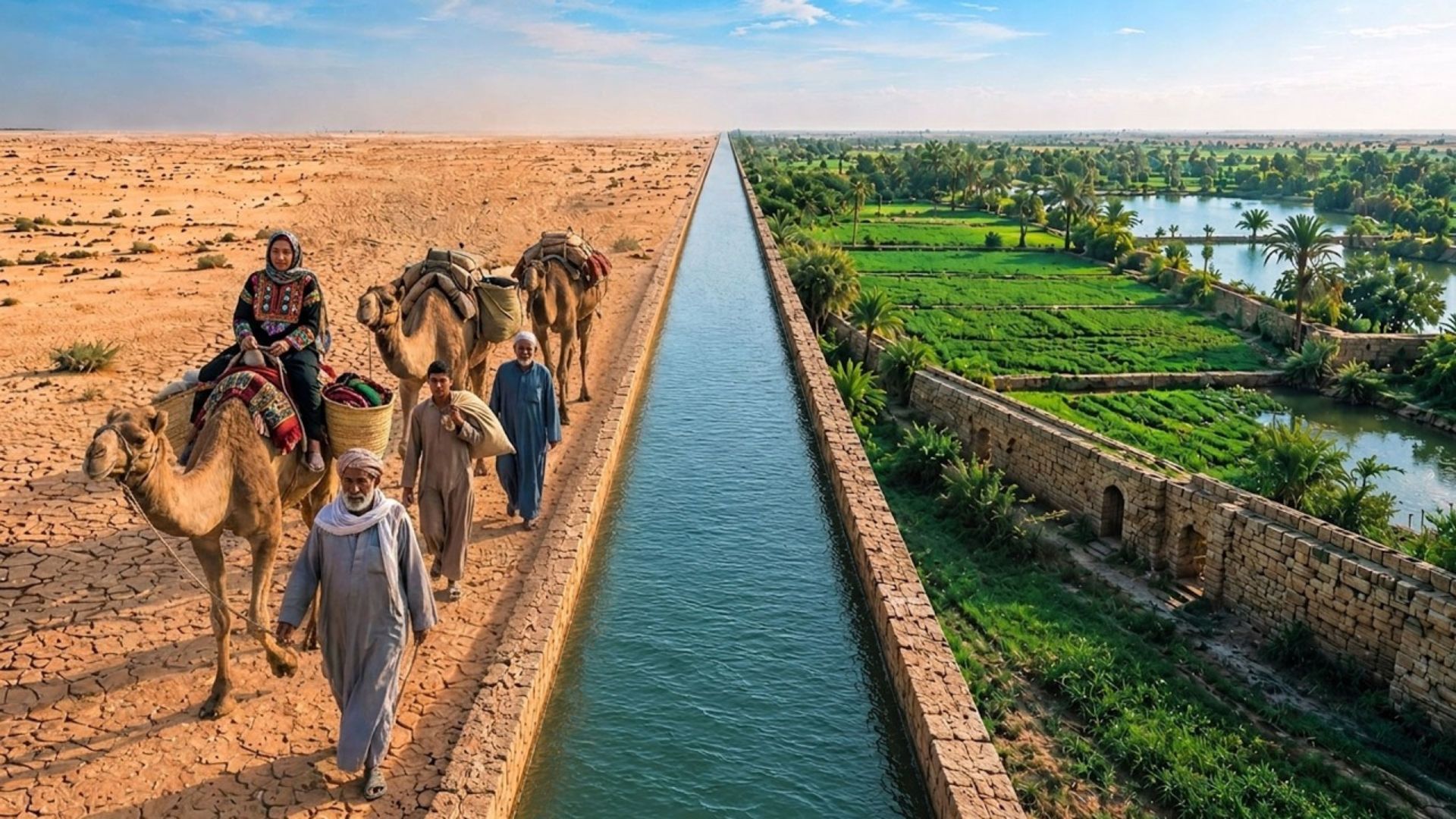


Satellites captured an unlikely change in the Thar Desert, India: scorching sand turning into a green patch of wheat, cotton, and mustard crops. But the same irrigation effort that feeds millions of people has already caused salinization and flooding of tens of thousands of hectares, threatening to degrade the land that has just flourished in the country’s largest desert.
Satellite images captured over the past decades have recorded a transformation that seemed impossible in the Thar Desert, in northwestern India: vast areas of sand, where temperatures exceed 50 degrees Celsius and evaporation far surpasses rainfall, have gradually been covered by green vegetation and productive crops. The phenomenon is the result of half a century of human effort, combining ancient water harvesting techniques with mega engineering projects, especially the Indira Gandhi Canal, transforming part of the desert into lands of wheat, cotton, mung bean, and mustard.
But the same miracle that feeds millions of people has a dark side. The excess irrigation in the Thar Desert has caused the water table to rise and salts to accumulate on the soil surface, in a process called salinization, which has already degraded tens of thousands of hectares of agricultural land. The result is a paradox: the same water that made the sand bloom now threatens to make cultivation unfeasible in entire areas, a warning about the limits of forcing nature to change too quickly.
How satellites captured the Thar Desert turning green

The Thar Desert, also known as the Great Indian Desert, covers about 320,000 square kilometers, equivalent to approximately 10% of India’s territory, and hosts one of the highest population densities among the world’s deserts, with tens of millions of inhabitants. For decades, it was seen as an almost impossible environment for agriculture, marked by extreme heat, sandy soils, and scarce rainfall concentrated in a few weeks of monsoon.
-
Vertical Farming Company Backed by SoftBank and Jeff Bezos Files for Bankruptcy, Valuation Plummets from $1.9 Billion to Under $15 Million

-
Indian Inventor Develops Solar-Powered Machine Enabling Blind Farmers to Independently Manage Crops with Sensors and Audio Alerts

-
Brazilian Honey Supplying U.S. Supermarkets Faces Price Hike and Job Threats Amid New Tariff Round
-
Drought in France Threatens Beet Crops, Raising Fears of Sugar Price Surge Across Europe


The change began to appear in satellite images from the 1980s, when large irrigation projects started bringing water to the heart of the desert. Studies analyzing the primary productivity of vegetation between 1982 and 2012 confirmed a significant increase in green cover in part of the region. What the satellites captured in the Thar Desert was not a natural phenomenon, but rather the effect of one of the largest human interventions ever made in an arid environment on the planet.
The ancient cisterns that helped tame the Thar Desert

Communities reactivated and expanded traditional rainwater harvesting techniques, such as taankas, underground cisterns that store water from the short monsoons. Courtyards and roofs are designed with a slope to function as collection funnels, and the water passes through a sand and mud filtration system before entering the closed reservoir.
Underground storage protects the water from the desert’s two biggest enemies: evaporation and contamination. Since sunlight does not penetrate the lid, there is no algae growth, and the closed structure prevents the entry of disease-carrying insects. Measurements indicate that the water inside the cistern is 10 to 15 degrees cooler than the external environment. Another traditional technique, the khadin system, uses earth embankments to retain floodwater and force its infiltration into the soil, creating residual moisture crops without modern irrigation in the Thar Desert.
The Indira Gandhi Canal and the mega-project that changed the Thar Desert


The major turning point came with the Indira Gandhi Canal, originally called the Rajasthan Canal and renamed on November 2, 1984, after the assassination of then Prime Minister Indira Gandhi. It is one of the largest irrigation systems in the world, with about 650 kilometers in length, combining the feeder canal and the main canal, bringing water from the rivers of the state of Punjab to the heart of the desert, parallel to the border with Pakistan.
The economic impact was enormous. Lands once covered only by shrubs began to produce rice, cotton, wheat, and mustard, and according to studies, about 1.86 million hectares came under cultivation thanks to the project. The state of Rajasthan became the national leader in mustard production, and the irrigation infrastructure ensured food security for millions of people, as well as attracting labor back to rural areas. Wherever the canal passes, drought has receded, and the Thar Desert has given way to intensive agricultural clusters.
The paradox of salinization that threatens the Thar Desert
The problem is geological. Beneath the sand of the Thar Desert are layers of gypsum and clay that are not very permeable. When the canal and irrigated fields’ water infiltrates excessively, it cannot drain and remains trapped above these layers, causing the water table to rise rapidly, in some areas about 1 meter per year. This mineral-laden water rises by capillarity and, with the extreme heat, evaporates on the surface, leaving behind layers of salt crystals.
The phenomenon, known as salinization and waterlogging, has already compromised vast areas that were once productive. Studies of the canal region indicate that tens of thousands of hectares suffer from severe salinity, and scientific projections warn that a significant portion of the irrigated area could be at risk of waterlogging by the end of the century if nothing is done. Nature, according to researchers, responds with negative signals when the balance is disrupted, and the excess greenery in the Thar Desert can become as problematic as the former lack of water.
Invasive species and ecological imbalance
In addition to salinization, there is an ecological problem linked to introduced vegetation. One of the trees most associated with the green advance of the Thar Desert is Prosopis juliflora, a species native to Central America, probably introduced in the region between 1980 and 2000. Although it helps fix nitrogen in the soil and contain sand, it is considered invasive by experts, who point to its expansion as one of the causes of the reduction of native pastures in Rajasthan.
It is worth the technical clarification that there is a common confusion between this invasive species and Prosopis cineraria, known as khejri, a native and culturally revered tree in the desert, with roots that dive deep in search of water. The replacement of native vegetation with exotic species alters the fauna, flora, and soil water regime, showing that the greening of the Thar Desert, when not conducted with scientific criteria, can lead to biodiversity losses that are difficult to reverse.
Precision solutions to save the Thar Desert
Faced with the risk of salinization, management in the Thar Desert has entered a new phase, focusing on smart and sustainable governance. Instead of flooding the fields, farmers are increasingly adopting drip irrigation, which delivers water directly to the base of each plant, with the help of moisture sensors and real-time satellite data. This precision agriculture can reduce water use by half and increase productivity, while also preventing excess water from seeping in and feeding the water table.
In parallel, India is investing in large environmental projects, such as the so-called Indian Great Green Wall, a strip of vegetation inspired by the African model, and in drainage initiatives to lower the water table in critical areas. The Thar Desert has also become a hub for renewable energy, with the enormous Bhadla solar park and agrivoltaic projects, where solar panels generate electricity and at the same time create shade that reduces soil evaporation, in an arrangement that attempts to combine energy generation and water conservation.
The transformation of the Thar Desert is both one of the greatest achievements of human engineering and a warning about its limits. Bringing water and vegetation to one of the most hostile environments on the planet has ensured food and income for millions of people, but it has also taught, in practice, that forcing nature to change too quickly comes at a price. The future of the region depends on balancing production and sustainability, with precision technology and respect for natural cycles, so that the green conquered in the sand does not turn into a salt desert.
Do you believe that the case of the Thar Desert serves as a lesson for irrigation projects in Brazil, such as those in the northeastern semi-arid region? Do you think it’s worth transforming deserts into farmland, even with the risk of salinization? Leave your comment, tell us what you think about this paradox between progress and the environment, and share the article with those interested in agriculture, climate, and major engineering works.