






 Portuguese
  Spanish


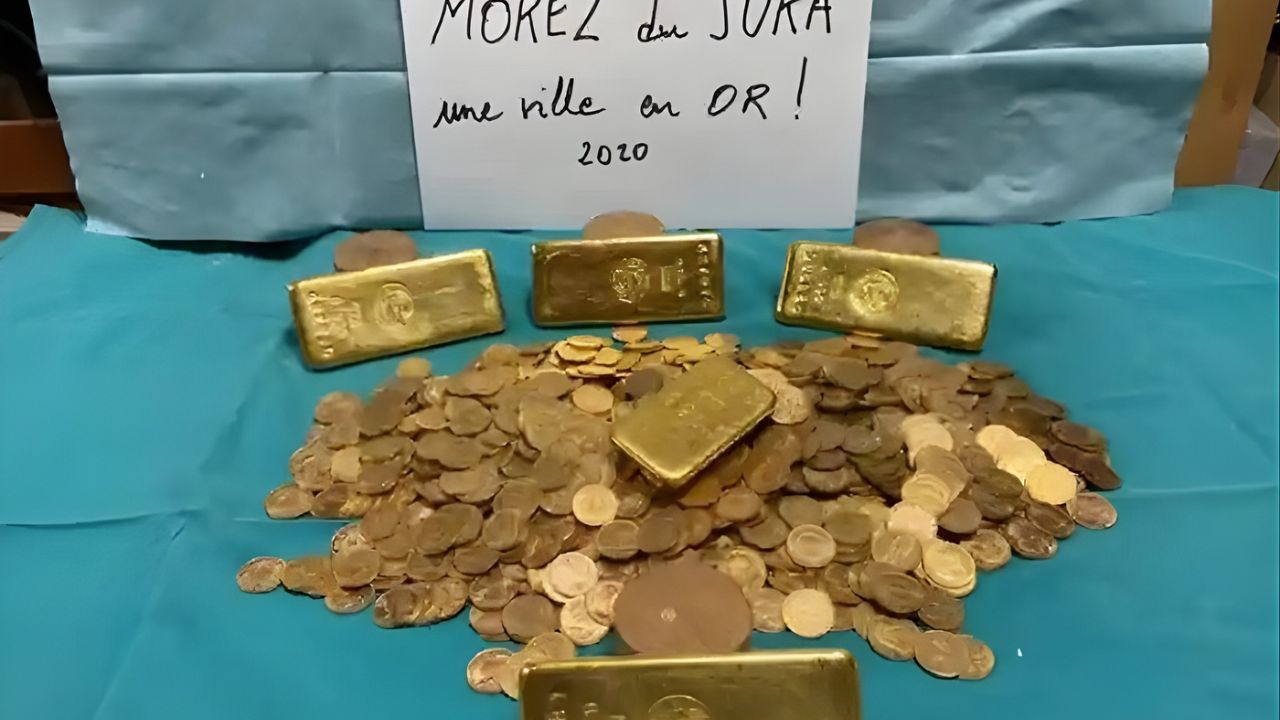


Old house in France reveals over €600,000 in hidden gold in pots and a secret safe, discovered by chance and linked to an unknown past.
In 2021, an unexpected discovery in Morez, in eastern France, revealed how entire fortunes can remain hidden for decades within seemingly ordinary properties. In a report published by The Guardian on April 16, 2021, local authorities reported finding five gold bars and over 1,000 gold coins concealed in various locations within an old house in the city center, including pots and a safe hidden behind boxes in a closet.
According to the same report, the treasure was valued at over €600,000 and was linked to the family that had occupied the property for generations. The case gained attention precisely for exposing a rare and direct point: an ordinary house functioning, for years, as a physical hiding place for significant wealth, invisible until a modern intervention revealed the contents.
The central point of the story is straightforward and rare: an ordinary house functioning, for decades, as a physical hiding place for significant wealth, invisible until a modern intervention revealed the contents.
-
A 3-year-old deaf student received the first white belt in Jiu-Jitsu and understood the achievement because the teacher learned Libras to communicate with him, in a video that surpassed 7 million views and moved social media by showing inclusion happening on the mat.

-
Miguel Krigsner opened a small compounding pharmacy in Curitiba in 1977, turned Brazilian fragrances into a national success, and created O Boticário, now one of the largest beauty networks in the world.

-
Meet the charming parrot grandpa, who became known for hugging free birds and revealed how he gained their trust over the years.
-
After 18 years of development, Bridgestone launches the AirFree airless tire, which requires no inflation and is puncture-proof, into daily service in Japan, starting with autonomous vehicles up to 20 km/h, used for transporting elderly people.





Gold was distributed among pots and a hidden safe inside the house
Unlike discoveries concentrated in a single location, the gold found in Morez was spread across different areas within the residence.
Among the identified hiding places were:
- Pots with gold coins
- Discreet compartments in furniture and structures
- A hidden safe that was not visible upon first inspection
This distribution suggests a deliberate hiding strategy, possibly to reduce the risk of total loss in case of discovery.
The choice of multiple hiding places reinforces the idea of planning and caution, common traits in periods when trust in financial institutions was limited.
Former owner accumulated wealth without formal records
Investigations indicated that the gold belonged to the former owner of the house, described as a discreet person who accumulated wealth over the years. However, there was no clear documentation regarding:
- The exact origin of the gold
- The time it was hidden
- The intention for use or transmission
This type of situation is not uncommon in historical contexts where individuals preferred to keep wealth in physical form, especially in precious metals.
The absence of formal records contributed to the treasure remaining unknown for decades, even after the owner’s death.
High value reflects not only the weight of gold but its preservation
The estimated value of over €600,000 mainly considers the gold content of the found pieces.

However, additional factors also influence the evaluation, such as:
- Condition of preservation
- Possible historical or numismatic value of the coins
- Rarity of some pieces
The preservation of the material over decades indicates that the hiding places were effective in protecting the gold from moisture, oxidation, and physical damage.
This increases not only the financial value but also the historical interest of the find.
Discovery raises legal questions about treasure ownership
Cases like this often involve legal issues related to the possession of the found property.
In France, the legislation may determine that:
- Part of the value is allocated to the State
- The remainder is divided among heirs or current owners
- The find is analyzed by cultural authorities
The classification of the treasure may vary between private property and historical heritage, depending on the characteristics of the pieces and the context of the discovery.
These decisions are made after evaluation by specialists and competent authorities.
Common house transforms into invisible safe for decades
One of the most impressive aspects of the case is the fact that the house remained apparently ordinary throughout the entire period the gold was hidden.
Without external signs of wealth, the property functioned as an invisible safe, protected only by its physical structure and anonymity. This type of concealment is possible precisely because it does not depend on technology, but rather on the exclusive knowledge of the owner.
The absence of clues or records makes discovery highly unlikely without direct intervention, such as renovations or detailed inspections.
Similar cases show that hiding wealth at home was a common practice
Historically, hiding money and valuables inside homes was a common practice in various regions of Europe.
Among the reasons are:
- Lack of secure banking systems
- Fear of confiscation during wars or crises
- Distrust in financial institutions
These conditions led many people to create domestic hideouts, which in many cases were never revealed. This explains why discoveries of this kind continue to occur even centuries later.
Accidental discoveries reveal fragments of private economic history
Each find of this type offers a rare insight into how individuals dealt with wealth in the past. Unlike official records, these hidden treasures reflect personal decisions, often made in contexts of uncertainty.
They serve as silent records of economic behavior, preserved outside formal systems.
In the case of Morez, the gold found reveals not only a financial asset but also a protection strategy adopted by the owner.
Find reinforces the historical and economic value of old properties
In addition to real estate value, old houses may carry additional potential related to unexpected discoveries. Although rare, this type of occurrence:
- Increases interest in historical properties
- Highlights the importance of detailed inspections
- Reinforces the cultural value of these constructions
The case of Morez demonstrates that the past can be physically present within seemingly ordinary structures, waiting to be revealed.


