Portuguese
  Spanish


House made with mushroom waste and invasive shrubs in Namibia shows how mycelium blocks have entered the debate on sustainable construction, affordable housing, and biomass reuse on an experimental scale.
A house made with mushroom waste and invasive shrubs in Namibia has put mycelium blocks into the debate on sustainable construction.
The material, formed from the vegetative part of fungi, was used by the MycoHab project in a demonstration house open to the public in February 2024, in Brakwater, north of Windhoek.
The initiative reappeared in 2025 publications on concrete alternatives, housing crisis, and biomass reuse.
-
Brazilian Innovator Converts Old Car into Electric Vehicle Using Laptop Batteries and Forklift Motor, Achieves Nearly 90 km/h in Urban Settings

-
Brazil Launches Mobile ID as Mercosur Approves Mutual Recognition of Digital Identities for Public Services Across Member Countries
-
Denmark sinks 20 massive concrete blocks to build a 3.5 km tunnel under the strait, connecting the country to Sweden by road and rail.
-
Tutankhamun’s Tomb: Science Unveils Possible Explanation Behind the Legendary “Pharaoh’s Curse” After Over 3,000 Years




The project combines three documented issues in the country: lack of affordable housing, advancement of invasive shrubs over grazing areas, and disposal of waste generated in mushroom cultivation.
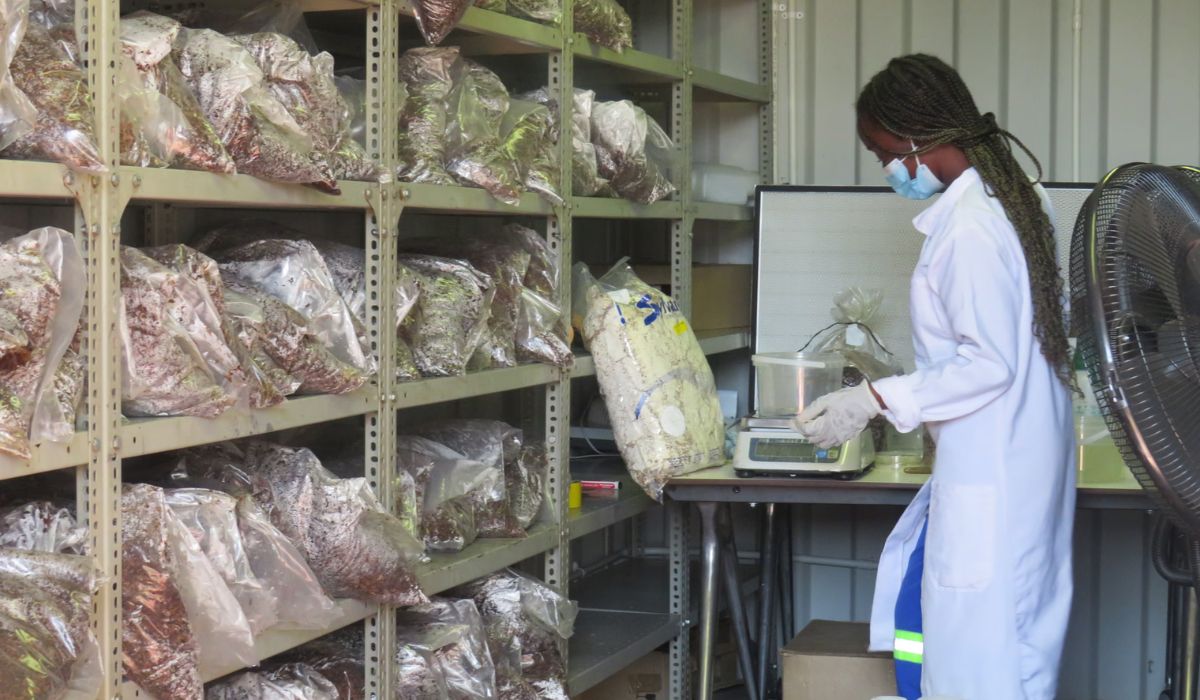
In the process described by MycoHab, the shrubs are shredded and used as a substrate to grow oyster mushrooms.
After harvesting, the remaining waste is compressed and heated to form large brown blocks, called mycelium blocks.
The technology should not be presented as a widely disseminated solution on a large scale.
The initiative itself is treated as a project in the experimental phase and still faces challenges of cost, transportation, certification, and acceptance in the construction sector.
The demonstration house built in 2024, however, allowed for real-scale testing of a fungus-based material application in a dwelling.
This point is relevant because it takes the discussion out of the laboratory and brings it to a physical prototype, subjected to conditions of use and visitation.
A recurring question, according to Kristine Haukongo, senior cultivator at MycoHab, involves the smell of the blocks.
“People think the house would smell because the blocks are made from entirely natural products, but it does not smell,” she told The Guardian.
According to Haukongo, there is sometimes a slight wood odor, but the material is described as practically odorless.
How mushroom waste becomes construction blocks
The project’s operation begins with the management of woody invasive shrubs that have advanced over large areas of Namibia.
These plants compete with grasses, affect agricultural regions, and are associated with impacts on groundwater recharge in a country with low water availability.
Instead of allocating this biomass solely for charcoal or wood production, MycoHab adopts another utilization flow.
The material is ground and used as a base for cultivating oyster mushrooms, which can be sold in the local market.
After harvesting the mushrooms, the substrate used in cultivation undergoes a new stage.
The residue is compressed and heated to form mycelium and biomass blocks that can be applied in construction systems.
According to information released by the project and international reports, each block uses about 10 kilograms of invasive shrub.
The logic of the process is to transform a material associated with environmental impacts into input for food and construction.
Production, however, requires technical control.
Mycelium-based materials depend on the type of fungus, humidity, compaction, drying, shape, and water protection to maintain adequate performance in a construction.
Housing deficit in Namibia enters the center of the project
Namibia faces a housing deficit and a significant presence of informal housing.
The original text mentions that the country, with a population of about 2.7 million inhabitants at the time of the referenced data, needed at least half a million new houses to address the housing shortage.
There was also a reference to 2016 data indicating that almost 90% of households earned less than N$ 2,700 per month, equivalent to about US$ 145 at that time.
In this scenario, part of the population cannot access formal housing built with conventional materials.
The housing issue intersects with another environmental challenge.
Reports and materials related to the project mention about 45 million hectares affected by invasive shrubs in the country.
The Namibian government planned to reduce part of this biomass, including burning and charcoal production.
Environmentalists interviewed in the original article pointed out that this model releases carbon, especially when the shrubs are used for charcoal and wood.
“Traditionally, invasive shrubs in Namibia are harvested and used for charcoal and wood production, which causes a large release of carbon emissions,” stated environmentalist Tulimo Uushona in the original text.
In this context, MycoHab presents an alternative route for part of this material.
The proposal does not replace public policies on housing, environmental management, and urban infrastructure, but tests a different construction chain from traditional cement-based production.
First mycelium house was opened to the public in 2024
The most relevant update of the case is the demonstrative house opened to the public on February 29, 2024, in Brakwater, Namibia.
The project was presented by MIT Sloan Executive Education as the first structural mycelium construction of MycoHab.
The initiative results from collaboration between Standard Bank Group, MIT Center for Bits and Atoms, MIT Label Free Research Group, and Redhouse Studio.
Local organizations are also associated with the project, especially in the discussion about affordable housing.
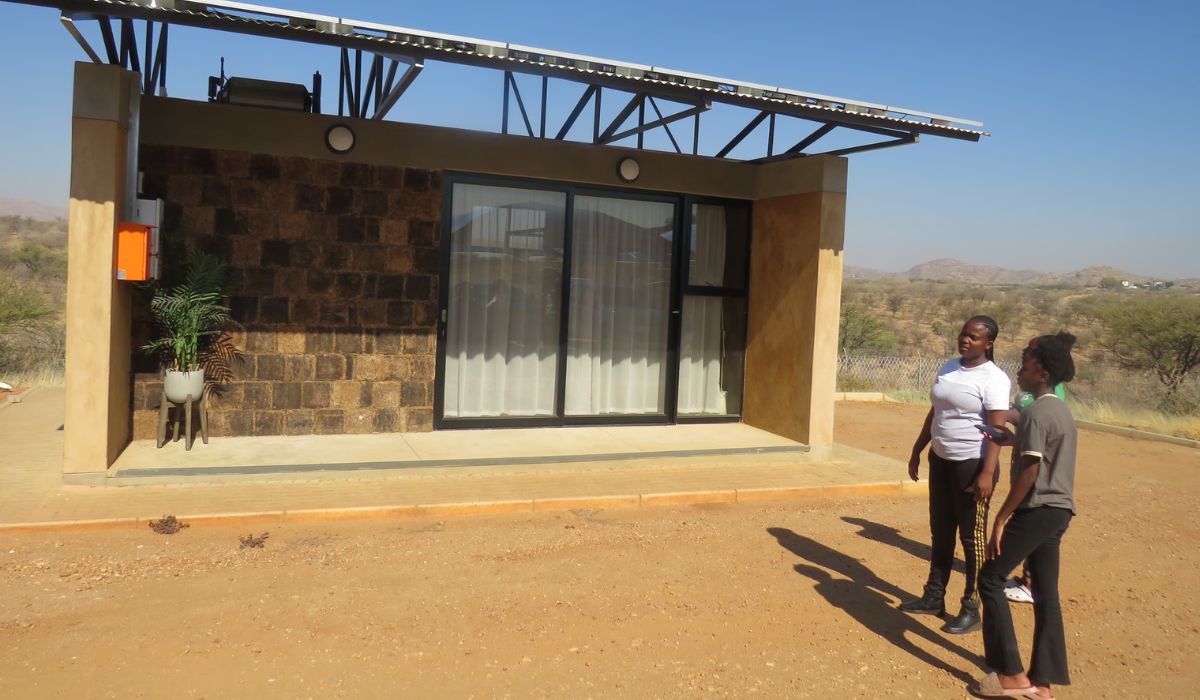
The construction served as a technical demonstration to show how the blocks could form a real dwelling.
According to NASA Spinoff, MycoHab completed in 2024 a demonstrative house that uses mycelium as a structure, aiming to exemplify the use of the bricks in a low-cost house.
The relationship with NASA appears because mycelium materials are also studied for space habitats.
Research on extreme environments inspired terrestrial applications in materials that can grow from local waste.
In Namibia, the focus is different.
The application is linked to the availability of biomass, the need for housing, and the reuse of waste generated in mushroom cultivation.
MycoHab claims that its proposal seeks to regenerate areas affected by shrubs, store carbon in construction materials, produce food, and offer housing.
These goals, however, depend on evaluation as the project progresses in scale, real use, and technical validation.
Mycelium blocks have no smell, but face logistics
Curiosity about the smell of the blocks arises because the material comes from fungi and organic waste.
Haukongo stated that the blocks have no odor and explained that, in some cases, there is only a wood-like note.
Practical viability involves other factors.
Heinrich Amushila, co-director of the Namibia Shack Dwellers Federation, stated that the blocks are fire-resistant and environmentally friendly, but the cost may still be an obstacle.
According to Amushila, house prices could be relatively close to those of concrete constructions.
The reason, according to him, is that transporting the mycelium blocks to construction sites is still expensive.
The federation seeks to reduce costs by involving future residents in the block manufacturing process and in the construction of the homes.
This model also brings production closer to the public who may come to occupy the houses.
This point helps to contextualize the difference between production cost and final cost of a dwelling.
A unit may use cheaper material, but the total price also includes transportation, labor, foundation, finishing, licenses, infrastructure, and community organization.
Haukongo stated that the blocks are heavier than conventional bricks, but can be erected more quickly.
According to her, a small house for a family would require more than 12 tons of bush.
Mycelium, concrete, and environmental impact of construction
Interest in mycelium materials is also linked to the climate impact of the construction industry.
Studies and technical reports indicate that concrete accounts for a significant portion of global carbon dioxide emissions, mainly due to cement production.
The Guardian article cites estimates that concrete accounts for 4% to 8% of global CO₂ emissions and can emit nearly 1 kilogram of CO₂ equivalent for every kilogram produced.
MycoHab, in turn, estimates that mycelium blocks store 0.8 kilograms of CO₂ equivalent per kilogram of material produced.
These numbers should be read as estimates associated with the material and process described by the project.
They do not represent a definitive comparison for all types of construction, as the environmental performance of a house depends on transportation, lifespan, maintenance, moisture protection, material origin, and component replacement.
Research in mycelium has attracted the attention of architects, engineers, and laboratories.
In 2014, the experimental installation Hy-Fi, in New York, had already used agricultural waste and mycelium as building material, showing that this field of study predates the Namibian project.
In the case of MycoHab, the difference lies in the association with a specific local condition.
The initiative uses abundant biomass linked to pasture degradation to cultivate mushrooms and produce blocks intended for housing.

Oyster mushrooms are part of the production chain
Before becoming a block, the biomass feeds oyster mushrooms.
This step allows the project to produce food while preparing the material that will be used in the construction.
The cultivated mushrooms can be sold to local retailers, according to The Guardian.
After harvesting, the exhausted substrate becomes raw material for the blocks.
In a conventional mushroom farm, this waste could be discarded or used as compost.
In MycoHab, it is compressed and processed to become construction material.
“If this technology becomes widespread, we could mitigate much of the over 300 million tons of bushes that the Namibian government wants to reduce,” said Haukongo.
She added that, in a common mushroom production, the substrate would be discarded or composted, whereas in the project it is transformed into mycelium blocks.