Portuguese
  Spanish


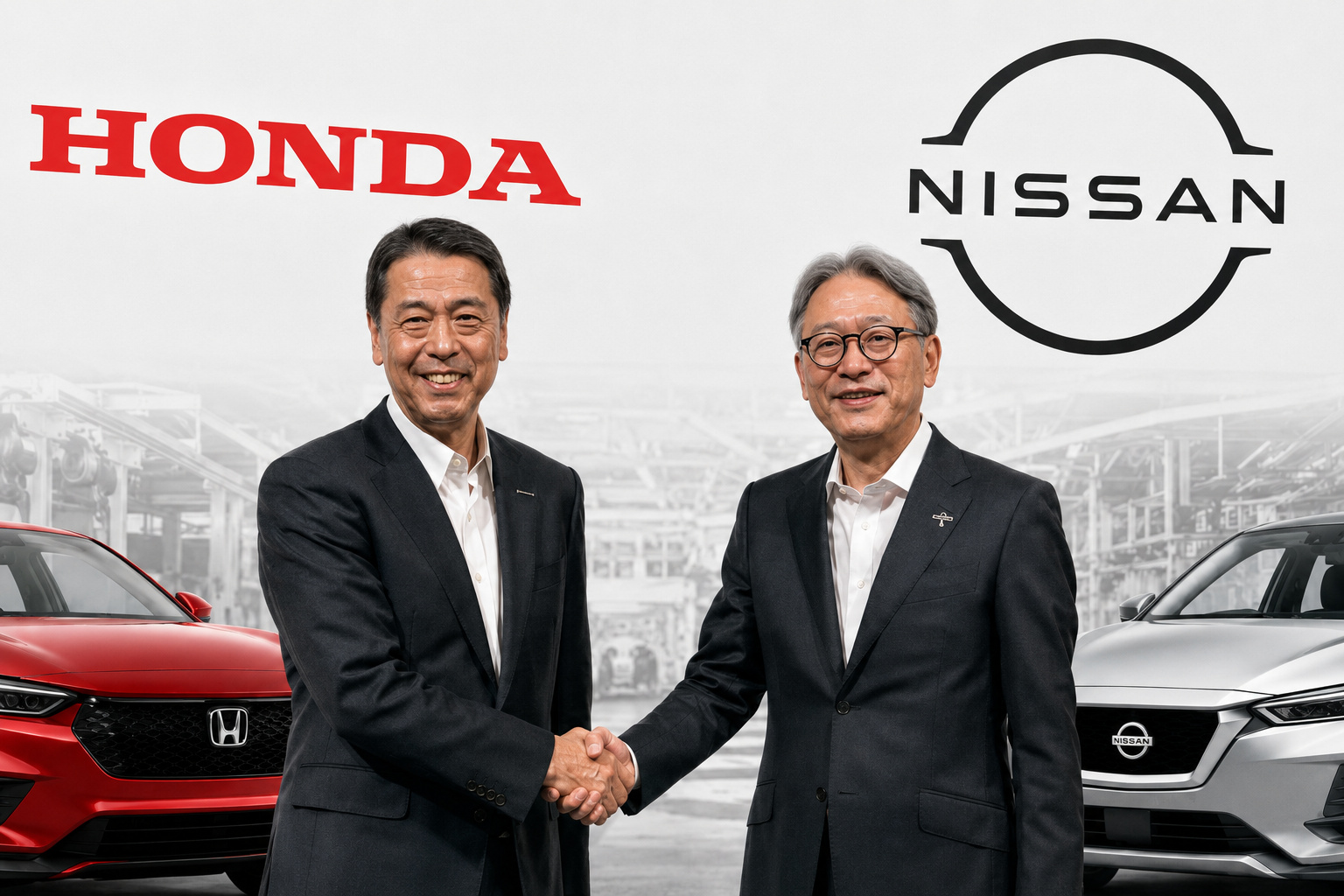

Honda and Nissan accelerate a new alliance after abandoning the merger, focusing on electronic centers, cost reduction, and launches that could reshape the competition with Chinese brands.
Honda and Nissan have come closer again and are about to announce a new partnership, now far from the merger idea that stalled at the beginning of 2025. The conversation gained momentum because the two Japanese automakers seek to cut costs and accelerate projects in a market increasingly pressured by competition with Chinese brands.
According to Autopapo, Honda’s president and CEO, Toshihiro Mibe, told shareholders that negotiations are at an advanced stage and close to an announcement. This time, the focus is not on a corporate union but on specific cooperation, focusing on technology, parts, and shared development.
The change in direction comes after a failed attempt to create a joint holding. Now, the idea is to work on specific projects without turning one company into the controller of the other. At the center of this new stage are the cars’ electronic control units, known as ECUs, which can be used in future hybrid and electric models of both brands.
-
Hyundai Phases Out Powerful Engine in HB20, Reduces Turbo Version in Strategic Shift Affecting Creta and HB20S, Potentially Impacting Car Prices in Brazil.

-
Carflix Overcomes Setbacks to Achieve $250 Million in Used Car Sales with Backing from Mercado Livre and SMZTO, Aiming for 300 Locations and $650 Million Revenue

-
Brazil’s Cheapest Car Outperforms Onix, HB20, Polo, and More: Priced Under $15,000 with 1.0 Engine, 681 km Range, 75 HP, and Air Conditioning.
-
Brazil’s Most Powerful Truck, Priced at $320,000, Delivers 770 HP and 3,700 Nm Torque, Surpassing Volvo’s Previous Record and Serving as a Base for a $600,000+ Motorhome



Partnership now targets specific projects, not a merger

The conversations between Honda and Nissan evolved after the failure of the merger negotiations, which ended in February 2025. At the time, the companies had signed a memorandum of understanding to study the creation of a holding company, but the plan did not progress.
According to the released material, Honda advocated for a tougher scenario, with Nissan transformed into a subsidiary and deeper cost cuts, including layoffs and factory closures. The proposal was rejected by the rival, and the negotiation took a different path.
Now, the direction is different: collaboration in technical and industrial fronts that allow for cost-sharing and accelerated launches. Mibe summarized the new phase as a relationship where “everyone wins,” without revealing all the details of the package.
ECUs, hybrids, and electric vehicles enter the center of the negotiation
One of the most important fronts discussed by the automakers is the joint development of electronic control units for hybrids and electric vehicles. These components function as the brain of various car systems and have a direct impact on production costs and model standardization.
The idea is that the parts will be shared between Honda, Nissan, and possibly Mitsubishi. This could pave the way for a more integrated platform among the three brands, with common components in vehicles planned for the end of the decade.
The design of this cooperation, however, has not yet been publicly detailed. What is already clear is that the partnership has a practical target: to reduce development expenses at a time when the sector is rushing to keep up with the technological shift and competitive pressure.
Mitsubishi enters the negotiation and Renault still observes from the sidelines
Mitsubishi may participate in this new arrangement, expanding the reach of the alliance. The Japanese automaker already appears as a possible third piece in the negotiation, which strengthens the view that the collaboration aims to be broader than a simple exchange of technology between two companies.
Behind the scenes, Renault is also expected to have a voice in the movement. The French company still holds 15% of the voting capital of Nissan. In 2023, this stake had already been 43%, which shows how the participation has been reduced over time.
Even without direct prominence in the new partnership, Renault remains a relevant name at the table. Any change in Nissan’s course affects the network of alliances built around the automaker in recent years.
Restructuring, loss, and the pressure from Chinese brands
The negotiation between Honda and Nissan takes place amid a period of strong pressure for the two Japanese companies. Nissan is executing the RE:Nissan plan, which foresees the closure of seven factories, the shutdown of two design studios, the layoff of about 20,000 employees, and the reduction of annual production capacity from 3.5 million to 2.5 million vehicles.
Honda has also been reviewing its strategy after recording its first annual loss since going public in 1957. The net loss was about $2.7 billion in the fiscal year ended in March, resulting from billion-dollar write-downs in the electric business and weaker demand in the United States.
Additionally, the automaker cut part of its investments in electric vehicles, abandoned the goal of becoming fully electric by 2040, and began focusing efforts on hybrids. The company promises 15 new models by 2030, with a sedan and SUV duo planned for 2028.
In the end, the new partnership appears as a direct response to the speed of Chinese automakers, which have been forcing traditional manufacturers to share costs and accelerate projects. If the agreement is confirmed, it could mark an important turning point in the race for space until 2029. And you, do you think this rapprochement between Honda, Nissan, and Mitsubishi can give new momentum to the Japanese companies? Comment and share the report.