Portuguese
  Spanish


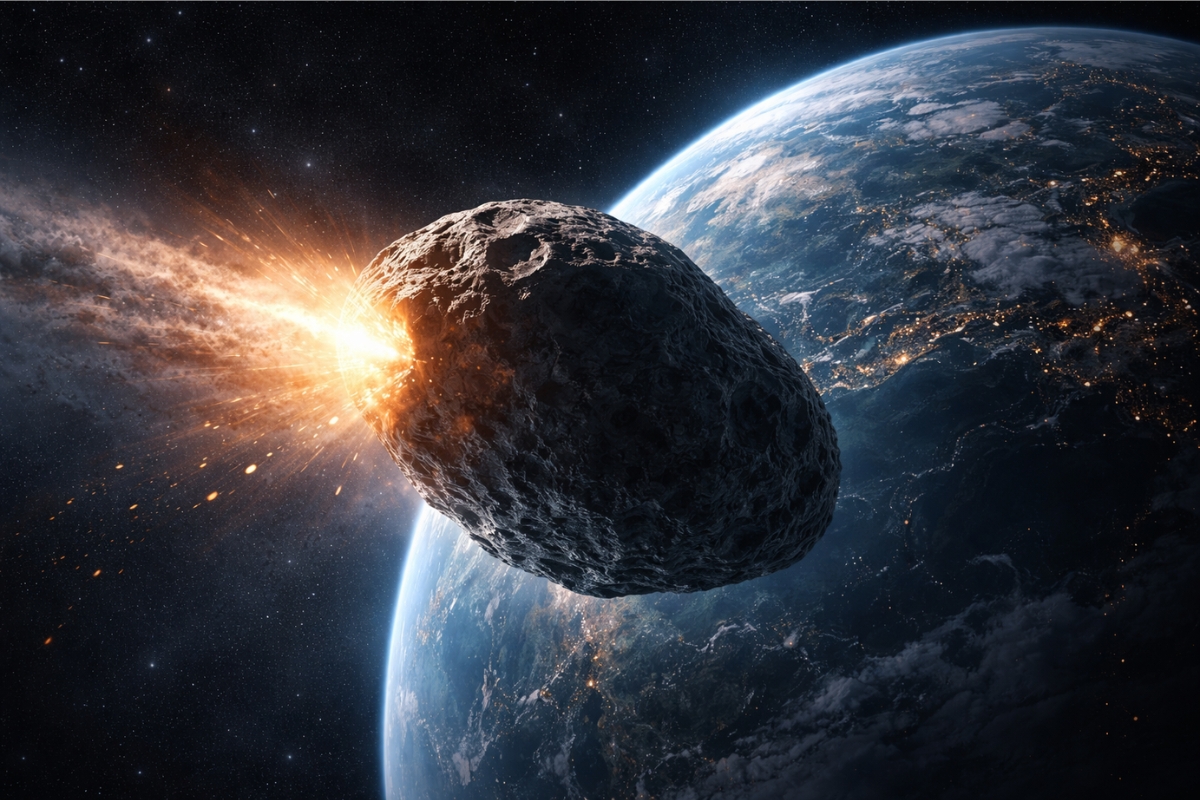


Iron-Rich Asteroids May Respond Differently: Greater Mechanical Resistance and Less Ejection May Reduce Thrust and Require a Different Strategy
For decades, the idea of using a nuclear explosion against an asteroid has been treated as a movie script. However, in science, the most discussed goal is not to “destroy” the body in space. The focus is on diverting its trajectory enough for it to pass far from Earth.
This detail changes everything, because in planetary defense, a minimal adjustment in speed can result in a huge difference in distance over the course. In other words, millimeters per second can mean thousands of kilometers of separation, depending on the time available.
How Nuclear Deflection Could Push a Space Rock
The principle behind nuclear deflection is more “physical” than explosive. The most realistic proposal considers releasing energy near the asteroid to heat its surface extremely.
-
Amateur Detectorist Discovers 3,400-Year-Old Bronze Age Gold Treasure with 121 Pieces in Transylvania, Including a Unique Ring

-
Italian Designer Develops Solar-Powered Terracotta Water Purifier Producing Up to 5 Liters of Drinking Water Daily Without Electricity

-
New Hydrogel Made from Algae and Shrimp Shells Absorbs 60 Times Its Weight in Water to Combat Drought in Spanish Agriculture
-
Scientists Discover Unexpected Intelligence in Solitary Octopus During Jar-Opening Challenge


When part of the outer layer is vaporized, there is an ejection of material. This ejection acts like a natural “jet” that generates thrust in the opposite direction, creating the necessary push to change the course.
The Deciding Point for Success: No Standard Asteroid Exists
Here is the game changer: the composition and internal structure of the asteroid can completely alter the outcome of any attempt to divert.
An iron-rich body, for example, may be more resistant than previously thought. Meanwhile, a porous object filled with voids may “absorb” part of the energy and reduce the effect of the push.
The problem is that without understanding “what it is like inside”, any strategy becomes more uncertain. And in space, uncertainty is costly.
Why Modern Simulations Are Taking This More Seriously
The topic has gained traction because science can now model better something that was once a major blind spot: how energy couples with the material of the asteroid.
Moreover, laboratory experiments help estimate how meteorite-like materials behave under extreme conditions. This improves the level of confidence in simulations and reduces the number of “dark” assumptions.
The result is a more grounded debate. Less “movie idea” and more calculable scenarios.
When the Nuclear Option Appears as the “Last Resort”
The discussion about nuclear deflection tends to gain ground when the scenario is tight, the risk is high, and time is short. In these cases, the search for a method capable of generating a lot of thrust in a short time becomes a priority.
Still, it is not a magic solution. It depends on technical data, planning, and, above all, understanding the target. Otherwise, the intervention may not produce the expected push.
The Risk That Almost Nobody Mentions: Turning One Problem into Many
One of the biggest technical fears is that a poorly sized strategy may generate unpredictable fragmentation.
Not always does “breaking” mean “solving.” Depending on the case, you could end up with multiple fragments on complex trajectories, making the risk scenario harder to manage.
Therefore, the line between diverting and complicating can be very thin.
The Future of Planetary Defense Is Information, Not Improvisation
The clearest solid trend is: detect early, characterize well, and only then decide. The earlier a dangerous object is identified, the greater the chances of choosing a safer and more predictable technique.
The “secret” lies in turning a topic full of assumptions into a data-driven engineering problem. And this requires knowing the basics before acting: composition, density, porosity, and internal structure.
The Evidence That Reinforces This Shift
One of the main recent references that brought this topic back to the center of the debate is a study released by the University of Oxford, indicating that iron-rich asteroids may be more resistant than previously assumed and that this directly influences any mitigation decision.
In the end, the message is straightforward: nuclear deflection may cease to be fiction, but it only works in the real world when science understands exactly what type of space rock it is dealing with.