






 Portuguese
  Spanish
  6 min of reading
  0 comments


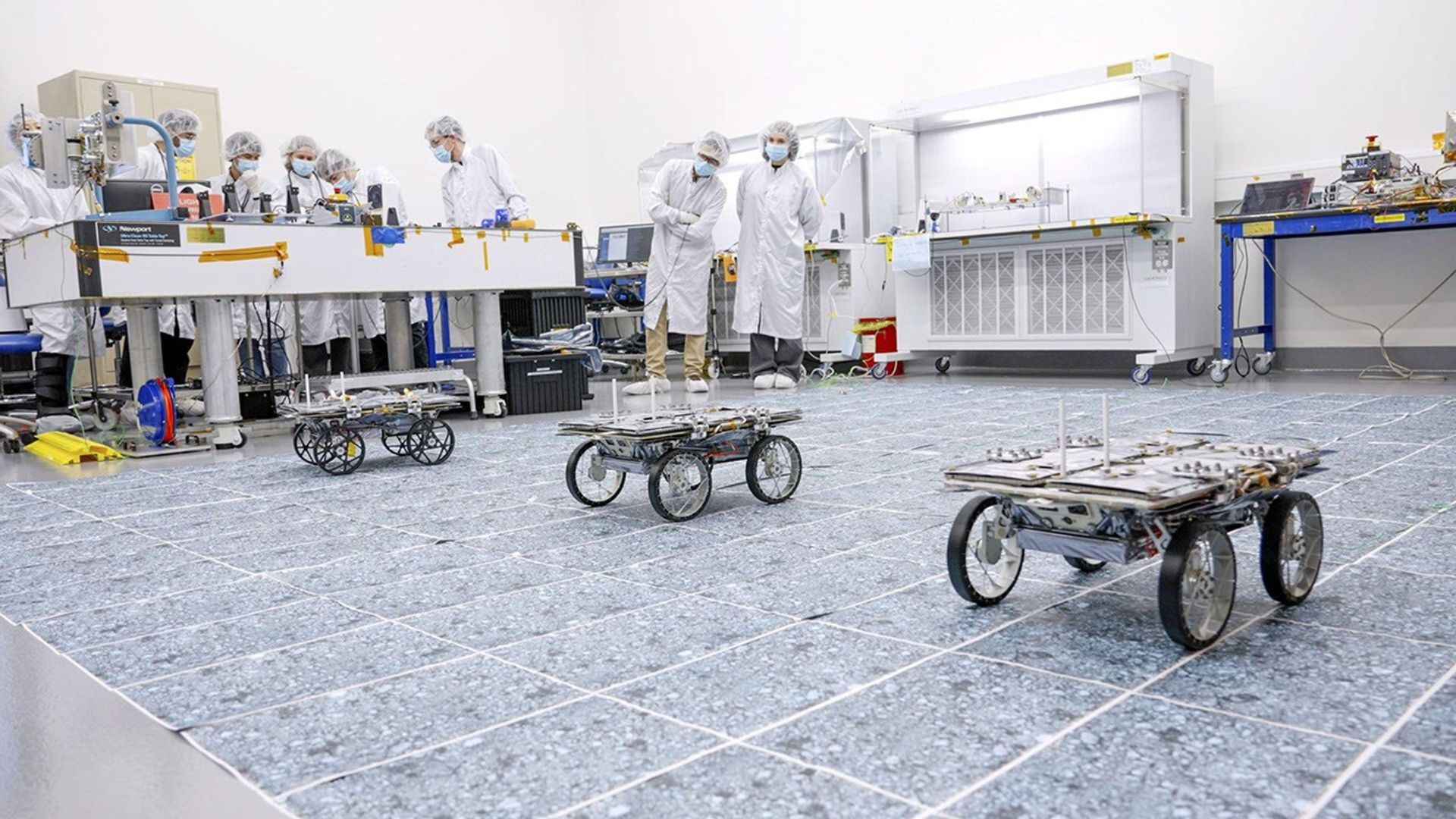
Unprecedented mission bets on three robots working together on the Moon, with their own communication, autonomous decisions, and technology capable of mapping the subsurface in 3D, signaling a change in the model of space exploration based on cooperation between machines.
NASA advances with the CADRE, an acronym in English for Cooperative Autonomous Distributed Robotic Exploration, a technological demonstration that brings together three small rovers designed to work together on the Moon.
Instead of repeating the traditional model of a single vehicle guided step by step from Earth, the mission was conceived to prove that a group of robots can move, exchange data, and perform coordinated tasks with broad operational autonomy.
CADRE mission and new logic of lunar exploration
The experiment is led by the Jet Propulsion Laboratory (JPL) and integrates the portfolio of technologies that the agency intends to validate in the lunar environment before broader applications.
-
Survivor of 1966 SS Daniel J. Morrell Shipwreck in Lake Huron Recounts 38-Hour Ordeal in Extreme Cold

-
The Greatest Hoax in World Cup History? The Film That Denied Brazil’s 1958 Victory and Exposed How Fake Evidence Can Seem Convincing on TV
-
Fake South Korean Online Stores Offer Shopping Thrill Without Spending Money or Receiving Products
-
The War of Jenkins’ Ear: How a Severed Ear Sparked One of the 18th Century’s Most Unusual Conflicts


The proposal is simple in concept and ambitious in execution: to spread robots across the same area, allow them to share information in real-time, and verify if this collective behavior produces more efficient scientific and operational results than exploration concentrated on just one vehicle.

According to NASA and JPL, CADRE will head to the region of Reiner Gamma, on the near side of the Moon, as part of the IM-3 mission from Intuitive Machines, within the Commercial Lunar Payload Services initiative, the program created to send scientific and technological instruments to the lunar environment with support from the private sector.
The area was chosen for its scientific interest and for providing a suitable scenario to test navigation, coordination, and data acquisition on the surface.
How NASA’s autonomous rovers work
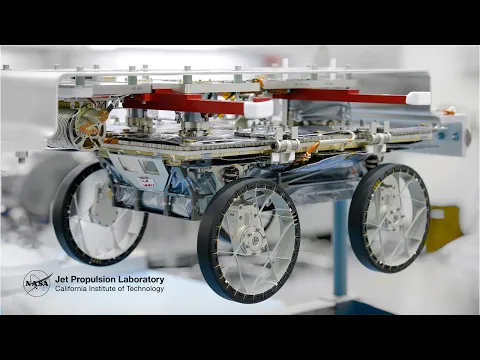
Each rover is small, comparable to a small suitcase, and carries a set of instruments designed to work in harmony with the others.
The units have four wheels, solar panels, orientation sensors, stereo cameras, an inertial measurement unit, and communication resources that allow the formation of a local network among the machines.
At the center of the experience is the ability of each robot to interpret the surrounding situation, relay information to partners, and adapt its actions to the overall goal of the team.
This arrangement changes the classic logic of space robotics.
In conventional missions, the rover typically relies on command sequences defined on the ground, with constant human validation before almost every relevant movement.
In CADRE, autonomy does not appear as secondary support but as the core of the test.
What NASA wants to measure is the extent to which multiple agents can receive broad goals, organize their own movement, and conduct a distributed observation campaign without continuous intervention from controllers on Earth.
Mesh network and communication between robots on the Moon

Communication between the vehicles is one of the pillars of the mission.
The three rovers will exchange data through radios in a mesh network, a system where each unit functions as a communication point and reinforcement of the information flow.
Additionally, the group will be connected to a base station installed in the landing module.
This architecture allows position, movement, high-level commands, and scientific measurements to circulate among the agents during operation, reducing the need for detailed instructions sent at each step of the work.
3D radar and mapping of the lunar subsurface
Another central element is the ground-penetrating radar in multistatic configuration, a technology that should allow mapping of the lunar surface and subsurface in three dimensions.
In practice, CADRE is not just looking to show three robots walking side by side.
The mission aims to demonstrate that a distributed set of sensors can generate a more complete picture of the terrain when measurements are taken in a coordinated manner, at different points and within the same operational interval.
The scientific advantage of such an approach is direct.
When multiple vehicles observe the environment simultaneously, it becomes possible to expand the coverage of the studied area and compare readings obtained under similar conditions, without prolonging the operation through successive orders sent from Earth.
This can be especially valuable in remote, rugged, or hard-to-monitor areas, where an autonomous team of machines would be able to cover more ground and respond more quickly to mission plan demands.
Operation on the Moon and mission duration

The planned routine for the rovers was designed to explore exactly this potential.
After landing and releasing the system on the lunar surface, the vehicles should leave the platform, open their solar panels, establish communication with each other, and initiate a sequence of coordinated movements and measurements.
The goal is not to cover long distances or turn each rover into an isolated protagonist.
The focus is on validating collective action, with distributed decisions and constant information exchange about navigation and scientific tasks.
According to official NASA material, the operation is expected to occur over one lunar day, equivalent to about 14 Earth days.
During this period, the robots will use solar energy to maintain locomotion, sensors, and communication systems.
Since the mission is a technological demonstration, success will be measured less by specific scientific discoveries and more by the ability to show that autonomous cooperation works in a real environment, subject to communication delays with Earth and severe energy and terrain constraints.
Origin of technology and next uses
CADRE also represents an important step in the transition from laboratory research to space application.
The project derives from previous work by JPL with the A-PUFFER system, a family of compact and foldable robots created for hard-to-reach planetary environments.
The experience accumulated in this development helped form the basis of the multi-agent software that will be used on the Moon, now adapted for flight hardware and a much more rigorous operational scenario.
There is also a broader strategic aspect.

NASA has been investing in smaller missions to test technologies that can be reused in future campaigns on the Moon, Mars, and other destinations in the Solar System.
In this context, CADRE focuses on two relevant trends in current exploration: the increase in onboard autonomy and the bet on distributed systems, capable of dividing functions instead of concentrating all responsibility in a single robot or a remote team on Earth.
The agency considers this type of architecture promising for environments where human presence may grow in the coming decades.
Teams of smaller robots, operating in cooperation, can pave the way for inspection of areas of interest, local mapping, logistical support, and preliminary terrain reconnaissance before the arrival of more complex missions.
Still, CADRE remains, at this stage, as a technological test: its function is to demonstrate capability, not to anticipate results that still depend on performance in flight and on the lunar surface.
The interest surrounding the mission arises precisely from that.
The image of the solitary rover, receiving instructions and advancing almost individually, may begin to share space with a more flexible model, in which multiple machines form an intelligent work network.
By sending three rovers and a base station to operate integratively in Reiner Gamma, NASA is trying to turn an idea studied for years into concrete operation in the lunar environment.





Be the first to react!