Portuguese
  Spanish


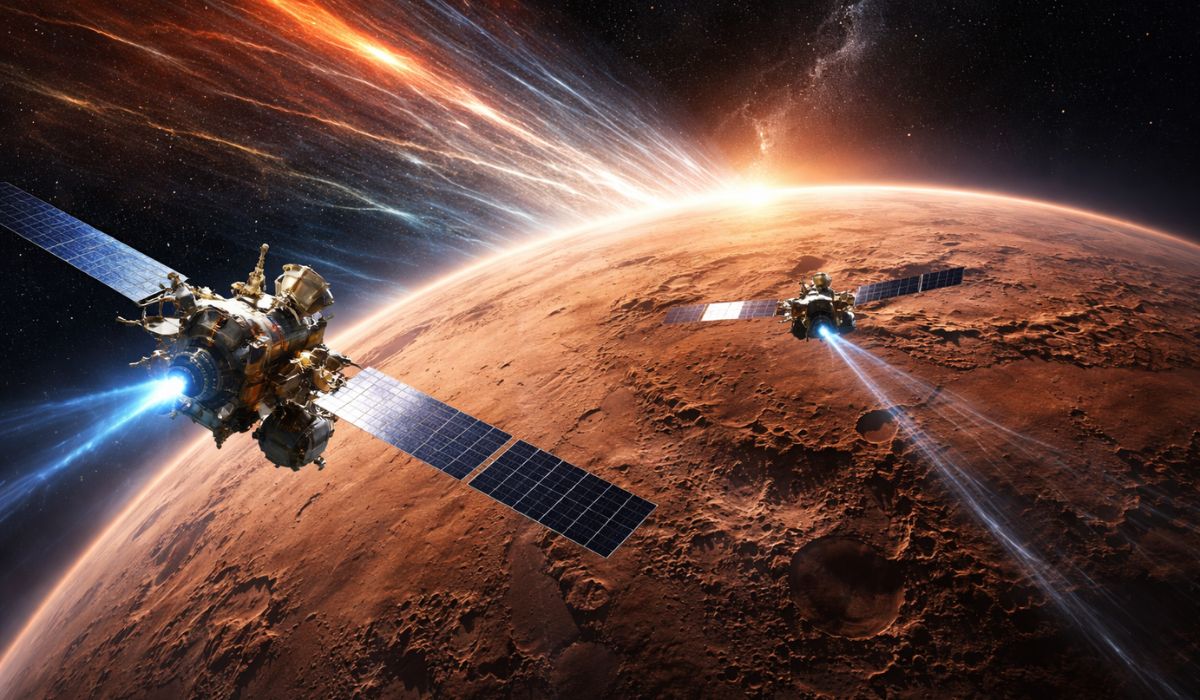

Two NASA spacecraft were launched to observe how solar wind affects Mars and increases the loss of gases from the planet, in a mission that seeks to deepen the understanding of the transformation of the Martian environment over time.
NASA has begun a new phase of research on the transformation of Mars with the launch of the ESCAPADE mission, consisting of two identical spacecraft designed to study how solar wind interacts with the Martian magnetic environment and contributes to the gradual loss of the planet’s atmosphere.
The mission’s goal is to enhance understanding of why Mars, which preserves geological signs of a past with liquid water, became cold and dry over billions of years.
ESCAPADE Mission and Martian Atmosphere
The duo was launched on November 13, 2025, aboard the New Glenn rocket from Blue Origin.
-
16-Year-Old from Brazil’s Sertão Wins Young Scientist Award for AI Predicting Rainfall with 94.5% Accuracy to Aid Farmers

-
Netherlands Reports First Child Euthanasia Case Since Rule Expansion for Minors

-
Brazilian Innovator Survives Homemade Submarine Dive in Paraty Despite Hatch Leak and False Oxygen Alarm
-
China Develops Custom 140-Ton Electric Mining Truck with 770 kWh Swappable Battery, Deploys 290 Units in Xinjiang’s Largest Zinc Mine



According to NASA, the trajectory to Mars will be longer than that of other missions, with arrival expected in 2027, when the spacecraft should begin the preparation phase for scientific observations in orbit.
What the Mission Wants to Observe on Mars
The goal of ESCAPADE is not to measure the Martian atmosphere in a generic way, but to monitor the relationship between particles emitted by the Sun, local magnetic fields, and the escape of gases into space.
For researchers in the field, this process is one of the central elements to explain the planet’s climate evolution.
Atmospheric loss is identified by scientific studies as one of the factors that help understand how Mars ceased to sustain, for long periods, conditions favorable to the presence of liquid water on the surface.
In this context, the mission seeks to gather more detailed data on this interaction.
One of the differentiators of ESCAPADE is the simultaneous use of two spacecraft.
Instead of recording a single observation point at a time, as occurs in many orbital missions, the project was designed to collect coordinated measurements in different regions of the Martian environment.
With this, scientists will be able to compare, in the same timeframe, how solar wind affects distinct areas around the planet and how the remaining magnetic field of the crust interferes in this process.
This observation model is considered relevant because Mars does not currently have a global magnetic field like that of Earth.
The planet only maintains localized magnetic fields, preserved in ancient parts of the crust.
In the assessment of researchers, this characteristic makes the interaction with solar wind more irregular and complex, favoring the escape of particles from the upper atmosphere.
Solar Wind and Loss of Martian Atmosphere
The solar wind is a continuous flow of charged particles emitted by the Sun.
On Earth, the global magnetic field reduces the direct impact of this bombardment on the atmosphere.
On Mars, the situation is different.
Without this planetary-scale protection, the upper atmosphere is more exposed to solar action, which, according to NASA and studies in the field, facilitates the escape of particles into space.
In recent years, data obtained from the MAVEN mission, also from NASA, have shown that Mars loses gases to space and that this process intensifies during solar storms.
These observations have reinforced, according to the space agency, the hypothesis that erosion caused by solar wind played an important role in the change of Martian climate over billions of years.
In this scenario, ESCAPADE was planned as a complementary step.
While MAVEN already gathers measurements dedicated to atmospheric loss, the new mission aims to add coordinated observations from two spacecraft regarding the planet’s response to solar activity.
Atmospheric loss is also linked to the history of water on Mars.
When water molecules reach the higher layers of the atmosphere, they can be broken down by solar radiation into hydrogen and oxygen.
Part of these elements escapes into space.
Hydrogen, being lighter, tends to escape more easily, and this dynamic is used by researchers to estimate how much water the planet may have lost over time.
Instruments of NASA Probes on Mars
The two spacecraft were equipped to measure particles and electric and magnetic fields associated with this environment.
Among the official instruments of the mission are electrostatic analyzers of ions and electrons, magnetometer, and Langmuir probe, used to investigate properties of plasma and interaction with solar wind.
According to the official materials of the mission, this set was developed to map how energy from the Sun circulates near Mars and under what conditions it may favor the loss of atmospheric material.
The proposal is to allow a more precise reading of the behavior of the space environment around the planet.
This point corrects a recurring confusion in texts about the mission.
ESCAPADE has not been officially presented by NASA as an operation centered on state-of-the-art mass spectrometers or on “almost instantaneous” laser communication with Earth.
In the agency’s documents, the scientific load is primarily described as focused on the study of plasma, magnetic fields, and the Martian environment’s response to solar wind.
How Mars Changed Over Time
The central question driving this scientific effort is old and remains open: how did Mars transition from a planet with signs of rivers and lakes to its current state.
Evidence gathered by orbiters and rovers on the surface indicates that the planet had, in the distant past, rivers, lakes, and a more active water cycle.
There are also NASA studies suggesting the existence of significant volumes of water in its early phase.
For this scenario to exist, the Martian atmosphere would need to be thicker than it is today, with climatic conditions different from those observed now.
According to researchers, the gradual loss of this atmosphere helps explain the transformation of the Martian environment.
One of the most accepted hypotheses in the scientific literature is that the weakening and disappearance of the internal dynamo, responsible for generating a global magnetic field, left Mars more vulnerable to the effects of solar wind.
As a result of this process, the upper atmosphere would have become more exposed, with cumulative effects on atmospheric pressure and the stability of liquid water.
Still, this story is not completely closed.
Scientists have already identified that atmospheric erosion played a significant role, but they continue to investigate the relative contribution of different escape mechanisms and the intensity of these losses at different moments in the planet’s evolution.
It is at this point that complementary missions, such as MAVEN and ESCAPADE, gain importance for research.
Why the Mission About Mars Goes Beyond the Planet
The scientific interest in ESCAPADE goes beyond Mars.
According to NASA, understanding how a rocky planet loses atmosphere over time helps refine models used to study the habitability of other worlds.
In this context, Mars serves as a relatively close natural laboratory to investigate the effects of solar activity and the absence of a global magnetic shield.
There is also an operational aspect.
Better understanding the Martian space environment, its variability, and how the Sun affects the upper atmosphere is important for planning future robotic and human operations near the planet.
For the space agency, this type of information can contribute to studies on navigation, communication, and safety in future missions.
The mission thus expands the database on the relationship between Mars and the Sun and is expected to provide new information about the planet’s evolution.
For researchers, each observation helps to refine the reconstruction of when, how, and at what rate Mars lost some of the environmental conditions it had in the past.