






 Portuguese
  Spanish


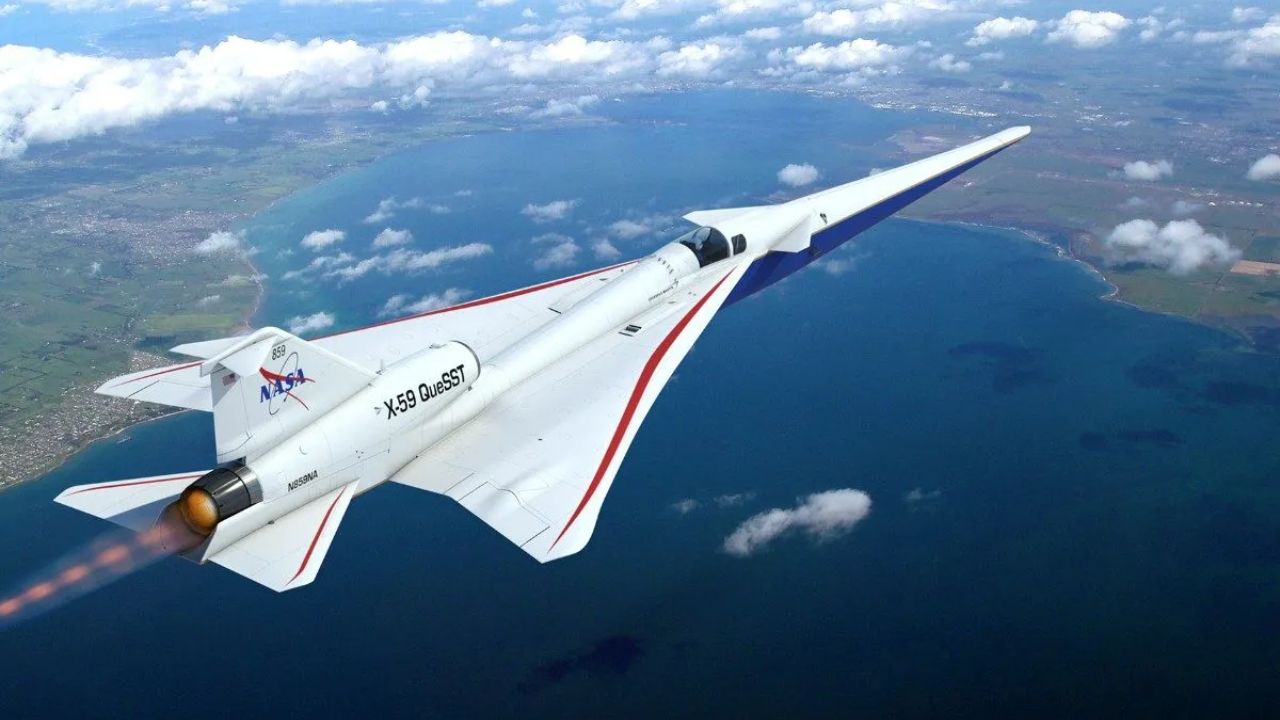


The X-59 reached 1,175 km/h in recent tests. Learn how NASA’s new jet aims to fly at Mach 1.5 with the sound of a car door closing.
NASA took a decisive step to enable the return of ultra-fast travel over inhabited areas with the new X-59 tests. During maneuvers performed on April 14, 2026, the aircraft demonstrated stability in precise turns and abrupt climbs, preparing the ground to break the sound barrier in an unprecedented way.
According to the website Aventuras na História, the project aims to reach Mach 1.5, but with a revolutionary difference: instead of the deafening boom that currently prohibits civilian supersonic flights over land, the jet will emit only a soft sound, comparable to the noise of a car door closing.
Altitude and Supersonic Speed Goals for NASA’s X-59
The QueSST (Quiet Supersonic Technology) project schedule sets ambitious goals for the next flight phases. NASA and manufacturer Lockheed Martin intend to take the X-59 to performance levels not seen in civil aviation for decades.
-
Tesla injected an additional $250 million into the German factory, doubled the battery cell target, and opened its own production line for startups.

-
No more TV stuck on the wall: Samsung The Freestyle+, the new projector with over 400 lumens projects on walls, floors, and ceilings, bringing cinema to any corner of the house.

-
A Japanese governor single-handedly stalled the construction of the world’s fastest train for nine years, and only now has he agreed to allow a tunnel excavated at a depth of 1,400 meters.
-
Almost 1 billion euros, two gigafactories, and a million-dollar public investment, Chinese company aims to turn Spanish city into Europe’s new battery hub.



The main technical goals include:
- Cruising Speed: Achieve Mach 1.4, which is equivalent to crossing the skies at over 1,500 km/h.
- Maximum Speed: The aircraft’s potential reaches Mach 1.5 (approximately 1,593 km/h).
- Operational Ceiling: Conduct silence tests at 16.7 thousand meters altitude.
- Current Mark: In the most recent trials, the aircraft has already registered 1,175 km/h, getting very close to the speed of sound.
The end of the traditional sonic boom
When an object breaks the sound barrier, it generates shockwaves that result in an audible explosion on the ground.

According to a statement from Lockheed Martin, continued testing will focus on different altitude ranges to calibrate this sound suppression.
Therefore, the jet’s success will not only be measured by travel time but by the acceptance of the noise by urban communities. If the “quiet boom” is validated, restrictions on supersonic flights over land could finally be reviewed.
History of Tests and Evolution of NASA’s Project
Although publicly unveiled in January 2025, the aircraft’s development already spans over a decade of research. Progress has accelerated in recent months, with the jet accumulating real flight experience in varied conditions.
- October 2025: Inaugural flight performed in subsonic regime.
- April 2026: Acrobatic maneuvers performed over the Mojave Desert to test control.
- Test Volume: The aircraft has already completed nine experimental takeoffs successfully.
- Stability: Recent turns and maneuvers proved that the exotic design does not compromise safety.

The feasibility of silent supersonic flight is seen as the “gateway” to a new era of air transport. While military aircraft already use these speeds, civil application depends on harmonious coexistence with cities. Furthermore, the interest of the global aeronautical industry is growing as the X-59 proves to be stable and controllable.
With information from the website Aventuras na História


