Portuguese
  Spanish


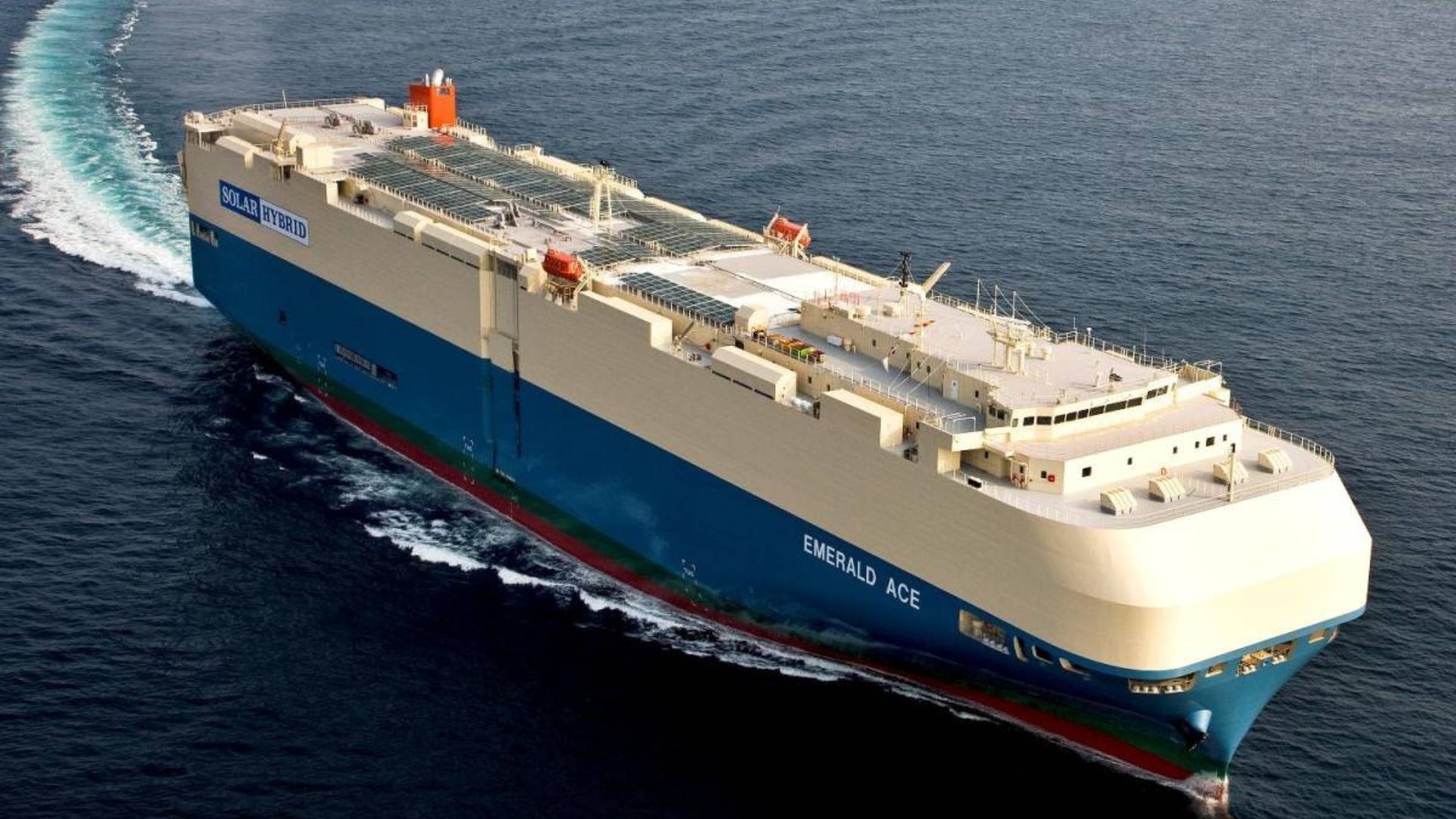


Embedded Technology Allows Capturing Microplastics During Commercial Voyages Without Interrupting Maritime Operations, Using Cyclone Separation System Attached to the Internal Circuits of the Ship and Already Officially Recognized by Japanese Naval Certification Entity.
A large cargo ship has begun sailing with a device capable of retaining microplastics present in seawater without interrupting operations, by utilizing the water that already circulates through the internal systems of the vessel during international voyages.
The equipment was tested starting in June 2022 on the car carrier Emerald Ace, operated by the Japanese shipping company Mitsui O.S.K. Lines (MOL), and received a formal innovation endorsement from the classification society ClassNK on November 21, 2023.
The proposal aims at particles up to 5 millimeters, a range commonly used to define microplastics in international reference materials, and seeks to transform a ship that already crosses oceans into a capturing platform during routine work.
-
Couple buys 1905 colonial house, plans to tear down walls to unite three rooms, but finds hidden service staircase and rethinks the entire renovation to preserve details that have survived for over a century.

-
Couple receives a quote of $50,000 to install a built-in refrigerator, decides to do the work themselves, spends $6,000, and claims to have saved over $100,000 by renovating the house.
-
At 77 years old, an elderly woman lives alone in an almost ghost village in the French Alps, at an altitude of 1,000 meters, where there is a town hall, a mayor, and an entrance sign, but only she lives there every day in a place destroyed by a landslide and almost erased from the map.

-
India excavates a 28 km artificial lake in the Thar Desert, lines the bottom with a giant plastic sheet to prevent 1.41 million tons of water from disappearing into the sand, and attempts to supply 5 million people throughout the year.


Collection of Microplastics During Commercial Navigation

Instead of relying on specific expeditions, surface barriers, or structures aimed at collecting visible debris, the system operates while the ship follows its commercial route, exploring the continuous flow of seawater that enters and exits internal lines.
In this design, the vessel does not “sweep” an area around it nor chase floating objects, as the technology’s cutoff is linked to what is captured by the ship’s own circuits, imposing a reach defined by the volume being treated.
Even with this operational limit, the idea draws attention for tackling a type of pollution that is difficult to contain, as microplastics spread across coastal regions and out in the open sea, often beyond the reach of visual cleanup efforts.
Tests on the Car Carrier Emerald Ace and Japanese Partnership
The development is attributed to MOL and Miura Co., Ltd., a Japanese industrial equipment company, which installed the system as a demonstration on the Emerald Ace, a car carrier used on long-distance routes and therefore suitable for assessing performance under real conditions.
The choice of this type of ship follows a logic of scale and regularity, as these vessels traverse repeated routes throughout the year, allowing for comparison of results across different maritime regions and periods, without altering the commercial schedule.
Company statements indicate that the system was designed to reduce interference in operations, so that collection can occur without stopping navigation, and the testing phase serves to confirm stability, efficiency, and compatibility with onboard routines.
Cyclone Separation System Integrated Into Internal Circuits

The mechanism described by the involved organizations uses cyclone separation, a method that induces a rotational flow to concentrate particles and facilitate retention, with the intention of maintaining continuous operation and reducing risks of clogging in a high-flow environment.
In practice, the device is connected to a line that captures seawater for cooling, utilizing a circuit that already operates during crossings, and then separates the fragments for storage, while the water follows the planned route.
The focus on microplastics, rather than larger waste such as bottles or nets, marks an important difference from more well-known cleanup projects, as the capture occurs at a controlled point in the system and not through broad collection on the surface.
ClassNK Certification and Innovation Recognition
ClassNK, also known as Nippon Kaiji Kyokai, has reported granting the equipment the certification of Innovation Endorsement for Products & Solutions, a recognition aimed at initiatives considered innovative and evaluated under technical and safety criteria.
The entity’s announcement cites the cyclone-type device and identifies the HQ-100/HQ100B versions, highlighting the capability to collect microplastics while the ship is in motion, which tends to reduce barriers for future adoption in the maritime market.
This type of endorsement does not replace source reduction policies or initiatives in rivers and coastal areas, but serves as a signal that the integration of the equipment into the ship has been analyzed by an institution with a recognized role in the certification of vessels.
Environmental Monitoring and Continuous Collection at Sea
MOL also presented retention as a way to obtain material for analysis and map the presence of microplastics along routes, as continuous collection creates a regular flow of samples, useful for comparing variations between sections and seasons.
At the same time, the company’s statements indicate that the system treats the water that passes through the connected circuit, meaning it is not an “suction” of the entire ocean, but rather a capture limited to the volume processed onboard.
The initiative fits into a trend of adapting existing infrastructure to incorporate environmental functions during operation, because when equipment operates without needing special missions, the discussion can focus more on technical replication than logistics.
If a ship that already crosses oceans can capture microplastics from an internal circuit, what other everyday structures, on an industrial scale, could be adapted to reduce pollutants during normal operation, without relying on dedicated operations?