Portuguese
  Spanish


In an almost empty commune in the French Alps, Josée Lecomte maintains a permanent routine in La Bâtie-des-Fonds, a place marked by historical landslide, low population, and absence of basic services in local daily life.
The Frenchwoman Josée Lecomte, 77 years old, was portrayed by The Sunday Times as the only permanent resident of La Bâtie-des-Fonds, a small commune in the Drôme department, in southeastern France.
The village is located at about 1,000 meters altitude, in a mountainous area near the Alps, and appears in French public sources as one of the least populated communes in the country.
The story draws attention because La Bâtie-des-Fonds still maintains signs of a common commune, even with minimal occupancy.
-
India excavates a 28 km artificial lake in the Thar Desert, lines the bottom with a giant plastic sheet to prevent 1.41 million tons of water from disappearing into the sand, and attempts to supply 5 million people throughout the year.

-
12-year-old girl develops a virtual receptionist with artificial intelligence for small businesses and demonstrates how the combination of creativity, programming, and automation can boost productivity, reduce repetitive tasks, and expand access to digital transformation.

-
A rock weighing almost 500 tons seems to defy gravity for over 11,000 years in Finland and remains balanced on a tiny base without collapsing or moving.
-
At 76 years old, a retired man reveals a subterranean labyrinth he dug by hand for 30 years under his own garden, descending 6 meters into sand dunes, erecting 1.5-meter concrete walls with calculations from his mathematician wife, and transforming a “crazy” idea into a hidden cave with a bridge and waterfall.


There is an entrance sign, municipal fountain, town hall, elected mayor, and its own administrative registry.
In daily life, however, the permanent presence is reduced to Lecomte, according to the British report published in December 2024.
The commune once had more activity.
In 1936, a major landslide destroyed an important part of the village and contributed to the area’s depopulation.
Decades later, in the 1970s, a small group linked to counterculture arrived in the area with proposals for alternative living and self-sufficiency.
Over time, the other residents left, and Lecomte remained.
Life in the valley requires planned travel.
According to The Sunday Times, Lecomte leaves La Bâtie-des-Fonds once a week to shop and pick up her granddaughter.
For medical care, the nearest service mentioned in the report is in another village, about ten miles, approximately 16 kilometers away.
“I am not isolated,” Lecomte told the newspaper. “Well, I mean, it’s all right. There is life around. No, no problem. The children come, the grandchildren come. It’s all right for now.”
Smallest commune in France
The Sunday Times reported that the locality assumed this title because Rochefourchat, another commune in Drôme that was known for having only one resident, now has new permanent residents.
In official data, the situation appears slightly differently because the statistics consider administrative criteria and reference years.
The Insee, the national institute of statistics of France, recorded four inhabitants in La Bâtie-des-Fonds in the 2022 census.
Meanwhile, the Banatic database, linked to the French Ministry of the Interior, reports a total population in effect in 2026 of six inhabitants, with a statistical reference from 2023.
This difference does not invalidate the report on the daily presence of Lecomte, but shows that “only permanent resident” and “administrative population” are not exactly the same thing.
In communes with vacation homes, absent owners, and formal registrations, official numbers may not reflect who lives there every day.
The Sunday Times itself mentions that the mayor of La Bâtie-des-Fonds is François Deloupy-Dobin, Lecomte’s son.
According to the report, he spends most of his time at another address and goes to the village on Tuesdays to handle municipal matters.
The Banatic database also identifies François Deloupy-Dobin as the mayor of the commune.
The existence of a mayor and municipal council shows that, even almost empty, La Bâtie-des-Fonds remains integrated into the French administrative structure.
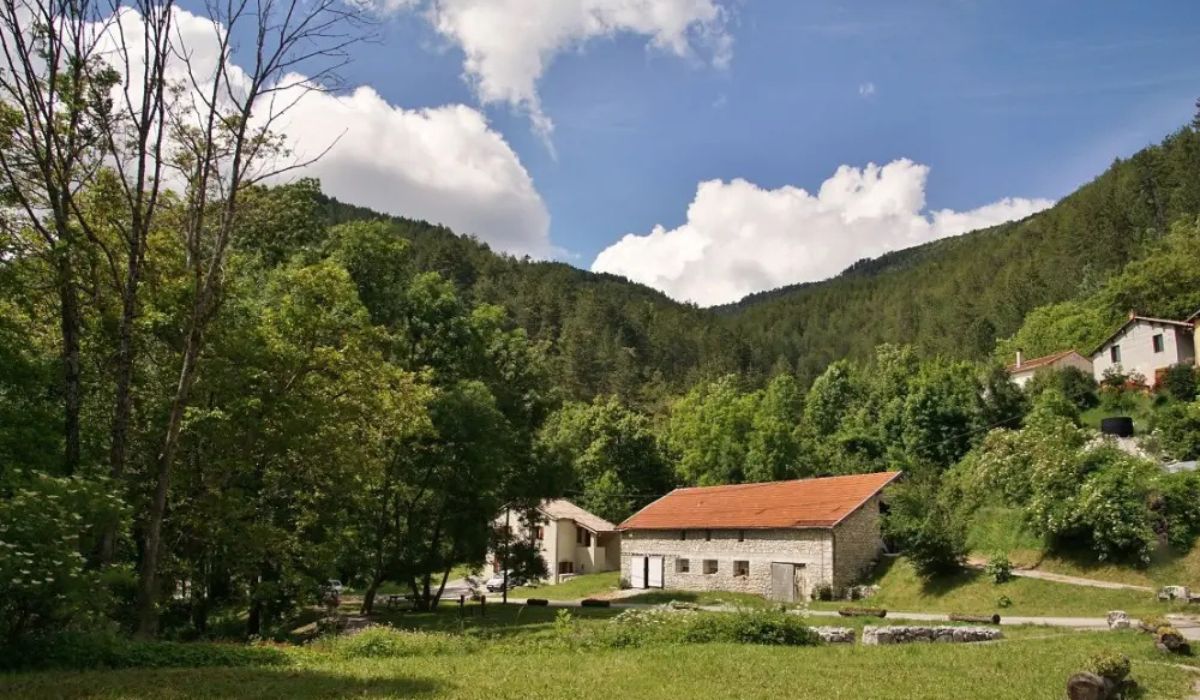
1936 Landslide in La Bâtie-des-Fonds
The history of the commune’s depopulation involves the disaster of 1936.
An article published that year in the Revue de Géographie Alpine described the glissement de La Bâtie-des-Fonds, or landslide of La Bâtie-des-Fonds, in Haut-Diois.
According to historical records gathered from French sources, the earth movement began after a period of heavy rains at the end of 1935 and advanced in early 1936.
The lower part of the village was affected, houses collapsed, lands were deformed, and the road had to be reorganized in a different layout.
No reliable information was found on deaths associated with the episode.
Local sources indicate that there were no victims, but the material impact was enough to alter the village’s configuration and contribute to its abandonment.
The tourist site of Pays Diois presents La Bâtie-des-Fonds as a commune where vegetation has reclaimed former built areas.
The page also mentions the route of the Drôme springs, with walkways over old vanished farms and visitor resources that tell the story of the river’s source.
This point helps explain why the current landscape mixes signs of human presence and abandonment.
The village has not formally disappeared, but part of the built space has given way to ruins, vegetation, and the memory of the landslide.
Arrival in the 1970s
Josée Lecomte arrived in La Bâtie-des-Fonds in the 1970s, according to The Sunday Times.
She told the newspaper that she ended up there “by chance,” coming from the south of France.
At the time, the commune received a small group of people from Paris and other regions, interested in a life away from urban centers.
The British report states that the group sought to produce part of their own fuel, including methane generated from manure.
This movement temporarily reoccupied a locality that was already experiencing population decline.
The Sunday Times describes the period as an attempt at an alternative community life, common to certain European rural experiences of the 1970s.
Over the decades, the collective experience lost members.
Lecomte’s children grew up and moved away, her husband died, and the other permanent residents left the village.
Her permanence turned her personal history into part of the administrative history of the commune.
However, Lecomte herself does not describe the place solely as isolation.
In an interview, she said that there are children and grandchildren nearby at certain times and that she does not feel ashamed of being the only permanent resident.
How a Nearly Empty Commune Works
In France, the commune is the smallest administrative unit in the country.
It can be a large city, like Paris, or a locality with few inhabitants, like La Bâtie-des-Fonds.
The system has historical roots and remains strong in French administration.
The Sunday Times states that France has nearly 35,000 communes, many of them with fewer than 500 inhabitants.
This high number creates unusual situations for readers from other countries.
A commune can have a town hall, budget, mayor, and administrative obligations even when almost no one lives there permanently.
In the case of La Bâtie-des-Fonds, the mayor is the son of the only permanent resident portrayed by the British report.
According to the newspaper, he was elected after the departure of the previous mayor, but does not live there daily.
François Deloupy-Dobin told The Sunday Times that he does not claim the monthly payment he would be entitled to for the position.
He also said that small localities could disappear if residents and local representatives stopped maintaining the administrative structure.
“If we give up, the people who sacrifice their time, like me, the small quiet places will disappear,” he said. “La Bâtie-des-Fonds will be completely abandoned. We are truly the last bastions.”
Routine without basic services
The routine in La Bâtie-des-Fonds depends on services outside the commune.
The Insee reports that, in 2024, the locality had no supermarket, grocery store, bakery, gas station, hairdresser, general practitioner, dentist, pharmacy, school, college, high school, or library registered in the permanent equipment database.
This data helps to contextualize the frequency of Lecomte’s outings.
Without local commerce and with medical services in another village, weekly trips are part of life in the valley.
According to The Sunday Times, for banking matters, she uses the nearest postal agency.
The report also states that the doctor attends once a week in a village about 16 kilometers away, if necessary.
Lecomte acknowledged to the newspaper that living there can be complicated in case of illness, but said she is fine.
“If you are sick, it’s not ideal here. It’s better not to be. But I am fine. I don’t have many concerns about it,” she said.
The statement shows how she presents her own routine.
There are practical limitations, but the resident does not describe life in the village only as abandonment or loneliness.

Water, mountain, and local administration
La Bâtie-des-Fonds is located in an area associated with the sources of the Drôme.
The name of the commune also refers to the springs, a term used in the region for small water sources.
To The Sunday Times, Lecomte made a direct reference to the presence of water in the area.
“We always have water!” he stated, listening to the river flow. “We don’t have a water problem. At least not yet.”
The availability of water does not eliminate other challenges of mountain life, but it helps to differentiate the commune from other rural places affected by a lack of basic resources.
In the case of La Bâtie-des-Fonds, the isolation is more related to distance, low occupancy, and the absence of everyday services.
The commune is also in a very dispersed rural area.