Portuguese
  Spanish


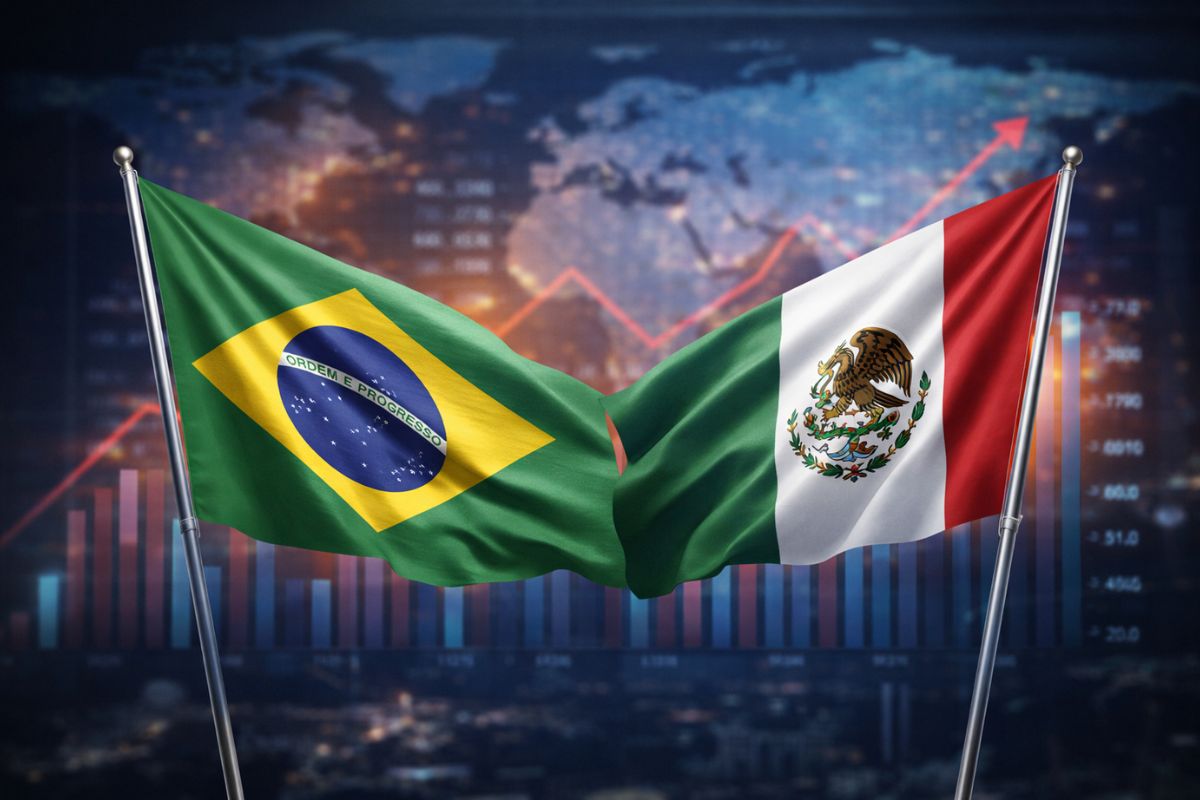

Brazil and Mexico, the two largest economies in Latin America, could enter the top 10 of global GDP by 2030, according to projections from PwC and Standard Chartered, with Brazil reaching 4.4 trillion dollars and Mexico 3.6 trillion, displacing European powers and altering the global balance.
The next major change in the global economic map may not come from Asia or Europe, but from Latin America. Projections from entities like PwC and Standard Chartered indicate that Brazil and Mexico have the potential to enter the top 10 of the largest economies on the planet by 2030, considering the Gross Domestic Product adjusted for Purchasing Power Parity. If the numbers hold true, the two Latin American countries would surpass several traditional European economies and position themselves as central players in a new multipolar economic order.
The phenomenon is not limited to the economic sphere. The simultaneous rise of Brazil and Mexico in Latin America could reshape geopolitical alliances, trade routes, and power dynamics that have favored the same powers for decades. While the United States, China, and Russia compete for global hegemony, Latin America prepares to claim a seat at the table of decisions that define the future of the global economy. The transformation is silent, but the numbers supporting it are significant.
The projections that place Latin America among the largest economies in the world

The data is concrete. Brazil would reach a GDP of over 4.4 trillion dollars by 2030, driven by growth in the energy sector, green mining, and technological expansion. Mexico, in turn, would have an economy around 3.6 trillion dollars, based on innovation, advanced manufacturing, and clean energy.
-
Brazil to Issue “Panda Bonds” in China, Aiming to Raise Up to 5 Billion Yuan at Lower Interest Rates Than Dollar Debt
-
NATO Faces Internal Tensions as U.S. Pushes for Increased Defense Spending, Targeting 5% of GDP by 2035, with Warnings for Countries Near 2% Level

-
Brazil to Introduce B16 Diesel with Increased Soybean Oil Content for Trucks by 2026
-
Brazil’s July Bolsa Família Payments May Include Extra $150 and $50 for Families with Children, Pregnant Women, and Updated CadÚnico Registration


Together, the two Latin American countries would account for more than 8 trillion dollars in economic output, a volume that exceeds the individual GDP of powers like Japan or Germany in some projections.
These values would not only position the two largest economies in Latin America above several European nations, but also establish them as natural leaders in the region’s development.
PwC and Standard Chartered arrived at these projections by analyzing factors such as population growth, productive transformation, investments in infrastructure, and market diversification. This is not about optimistic forecasts without foundation, but about trends supported by demographic and economic data that are already in motion.
How Brazil strengthens its global position from Latin America
Brazil is the largest economy in Latin America and already holds a relevant position in the international scenario. The country strengthens its presence in BRICS, consolidating ties with China, India, and Russia and projecting influence over the Global South.
The Brazilian energy sector, which combines pre-salt oil, ethanol, and the expansion of renewable sources, positions the country as a strategic supplier in a world seeking to diversify its energy sources.
Green mining, especially the extraction of lithium and rare earths essential for batteries and technology, adds another layer of strategic relevance to Brazil within Latin America. Technological expansion, with startups and innovation centers growing in São Paulo, Florianópolis, and Recife, shows that the Brazilian economy does not rely solely on commodities.
The country combines abundant natural resources with a diversified industrial base and a young population that represents labor for the coming decades.
Mexico and its strategic position between two worlds in Latin America
Mexico occupies a privileged geographical and commercial position that no other country in Latin America possesses. Integrated into the North American bloc through the trade agreement with the United States and Canada, Mexico acts as a bridge between the world’s largest economy and the rest of Latin America.
But the Mexican vision is increasingly independent, diversifying relations with Europe and Asia and reducing exclusive dependence on the American market.
Advanced manufacturing is the engine driving Mexican growth. Automobile, electronics, and aerospace factories established in the country attract investments from multinationals seeking competitive costs and proximity to the American market.
Clean energy complements the strategy, with investments in solar and wind positioning Mexico as a reference in energy transition in Latin America. President Claudia Sheinbaum shares with Lula the goal of transforming their countries into global centers for attracting investment and innovation.
What the rise of Latin America means for traditional powers
The entry of Brazil and Mexico into the global top 10 would not happen in a vacuum. Someone needs to fall for others to rise, and projections indicate that traditional European economies like France, Italy, and possibly the United Kingdom would lose positions in the ranking to make way for the two Latin American countries.
For nations that have historically dominated global economic decisions, seeing themselves surpassed by emerging economies represents a paradigm shift.
For the United States, China, and Russia, the rise of Latin America adds complexity to an already contested geopolitical board. Brazil, as a member of BRICS, strengthens a bloc that challenges Western hegemony.
Mexico, integrated into North America but with its own ambitions, creates a dynamic where the interests of Latin America can no longer be ignored in global negotiations. Both countries function as strategic bridges between East and West, a role that makes them key players in the new multipolar order.
The path to 2030 and the obstacles Latin America needs to overcome
Economic projections are not guarantees. For Brazil and Mexico to reach the global top 10 by 2030, both need to maintain sustainable industrialization policies, strategic energy agreements, and consistent investments in education and infrastructure.
Political instability, uncontrolled inflation, corruption, and institutional crises are real risks that could derail the growth trajectory. Latin America has a history of promising economic cycles that have been interrupted by internal crises.
The growing young population is one of the greatest assets of both countries, representing a workforce and expanding consumer market. But this demographic bonus only translates into real growth if accompanied by the generation of skilled jobs and access to quality education.
The economic rise of Latin America reflects a trend towards multipolarity, but consolidating it depends on decisions that both countries need to make in the next five years. The potential is in the numbers. The realization depends on politics.
Do you believe that Brazil and Mexico can really enter the top 10 largest economies by 2030? What does Latin America need to do to turn projections into reality? Leave your thoughts in the comments. Few debates are as relevant to the future of the continent as this one.