






 Portuguese
  Spanish
  5 min of reading
  0 comments


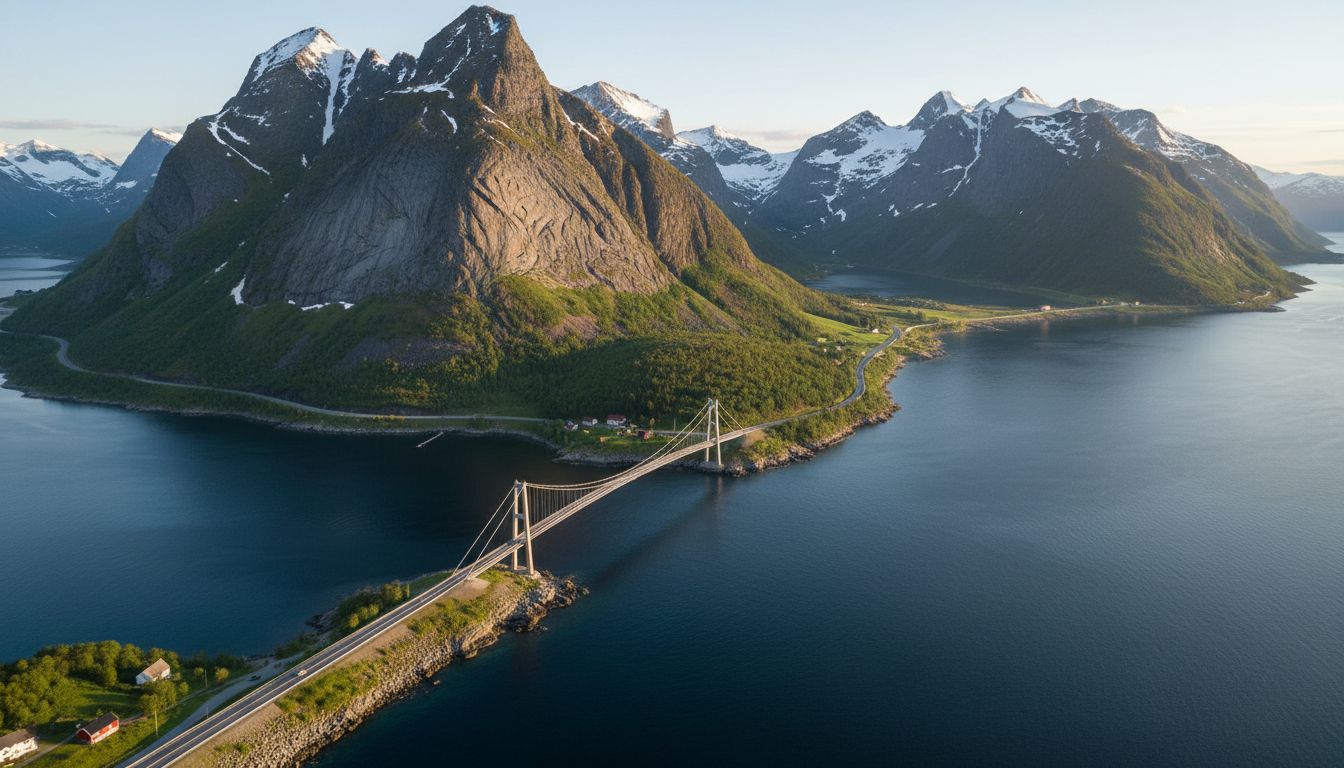
Norway builds 1,100 km E39 highway with 8 fjords, 1 km suspension bridge, and 11 km of double tunnels for €33 billion
Norway is building what could become the largest road project in Europe: the modernization of the E39 highway, which will connect Kristiansand to Trondheim along 1,100 kilometers of coastline, according to WeBuildValue. The total investment amounts to €33 billion, and the goal is to reduce crossing time from 21 hours to 11 hours by eliminating 7 ferries.
According to Statens vegvesen (Norwegian road authority), the project includes the sub-project Sotra Connection — a 1 km suspension bridge, 22 smaller bridges, a 4-lane highway, and 4 double-corridor tunnels totaling 11 km. In parallel, there are parallel projects for deep underwater tunnels for the wider fjords.
The E39 crosses 8 main fjords along the Norwegian west coast, including the Sognefjord (1,300 meters deep) and the Hardangerfjord (800 meters). Consequently, some sections require unprecedented engineering — anchored floating bridges and submerged floating tunnels 30 meters deep.
-
The hydroelectric plants on the Madeira River, like Jirau, came for the energy, but now the drought wave has reduced artisanal fishing by 39% and emptied the tables of the riverside communities in the Amazon.

-
The Zuluk road has 32 zigzag curves at 3,400 meters in the Himalayas, originated as the Silk Route in Sikkim and became a military border where foreigners cannot pass.
-
Rio de Janeiro receives more than R$ 5.5 billion in sanitation, includes almost 1 million residents from communities in the formal customer base, and brings water, sewage, and proof of residence to regions historically neglected by urban infrastructure.

-
Via Mar promises to relieve BR-101 in Santa Catarina, but it will be the state’s first toll state highway and faces soft soil and rice fields that threaten the timeline.


Sognefjord: the biggest engineering challenge of the E39
The Sognefjord is the second-longest fjord in the world, with 205 km in length and 1,308 meters maximum depth. Firstly, crossing it by car today requires two ferry trips. Secondly, Norway has designed an unprecedented system for this section: submerged floating tunnel anchored by tension cables to the bottom.
According to the project, the floating tunnel will be 4 km long, will float 30 meters below the surface, and will be anchored in a mesh of high-strength steel cables. Similarly, the concept is similar to an offshore platform — but with road traffic inside. Consequently, it will be the world’s first operational floating tunnel if completed.
According to Statens vegvesen, hydrodynamic and structural studies have taken more than 10 years. In parallel, wind tunnel simulations and scale test tank experiments were conducted in partnership with institutes like NTNU in Trondheim and MARINTEK. Therefore, the project must undergo final reviews before bidding in 2027.

Sotra Connection: the 1 km suspension bridge of western Norway
The Sotra Connection is the first major sub-project of the E39 actively underway. Firstly, it will connect the island of Sotra to Bergen, Norway’s second-largest city. Secondly, it includes a 1 km suspension bridge, 4 tunnels of 11 km, and 22 smaller bridges. Consequently, it will eliminate a critical traffic bottleneck for 80,000 residents in the region.
According to official data, the suspension bridge will have a 900-meter free span over the Knarvik Strait. Similarly, the pillars will reach 200 meters in height — almost the height of Christ the Redeemer seen from the Lagoon. In parallel, the highway will have 4 lanes with a speed of 110 km/h, the Norwegian standard for expressways.
According to the schedule of the responsible consortium (composed of Skanska, Aas-Jakobsen, and Sweco), the works should be completed by 2028. In comparison, previous projects in Norway like the Hardanger Bridge took 6 years to complete. Therefore, the pace of Sotra is considered aggressive within the Scandinavian standard.
Why Norway invests €33 billion in the E39
The central motivation is economic. Firstly, the Norwegian west coast concentrates 50% of the country’s GDP, with fishing, offshore oil, shipbuilding, and tourism industries. Secondly, time lost on ferries costs about 1 billion Norwegian kroner/year (~US$ 100 million) in productivity.
According to Statens vegvesen, the modernized E39 will reduce travel time by 50%, eliminate 7 ferries, and increase road freight capacity by 40%. Similarly, it will reduce CO2 emissions from transport by 30% by replacing maritime diesel from ferries with electric transit (Norway has 80% electric cars).
In parallel, the project creates 50,000 direct jobs in construction and another 200,000 indirect jobs. Consequently, Norway leverages revenue from the sovereign fund (Government Pension Fund Global, with US$ 1.7 trillion in assets) to finance internal infrastructure. To understand the scale, €33 billion equals 8% of the annual Norwegian budget.
- 1,100 km — total length of the modernized E39
- €33 billion — planned investment
- 21h → 11h — reduction in travel time
- 7 ferries eliminated
- 8 fjords crossed
- 1 km — span of the Sotra suspension bridge
- 11 km — length of the 4 double tunnels
The Norwegian model: how to finance megaprojects with a sovereign fund
Norway has the largest sovereign fund in the world: the Government Pension Fund Global, with more than US$ 1.7 trillion in assets. Firstly, the fund is fueled by offshore oil revenues. Secondly, the government annually withdraws about 3% for public spending — including infrastructure.
According to budgetary rules, the Norwegian fund is a reserve for future generations. Similarly, it prevents the economy from becoming dependent on oil prices. Consequently, projects like the E39 are paid for with income from the fund’s investments, not with new taxes.
In parallel, Norway has negative public debt: the government has more assets than liabilities. On the other hand, there is political debate about whether spending on megaprojects should increase. In comparison, Brazil has public debt of 80% of GDP and cannot finance megaprojects with a similar fund.

Lessons for Brazil: what the E39 teaches about infrastructure
Brazil can learn from Norway in some aspects. Firstly, long-term planning: the E39 was planned for 15 years before the first contract. Secondly, modal integration: the highway connects ports, airports, and logistics centers without bottlenecks.
According to comparative analysis, Brazil has 1.7 million km of highways, but only 13% paved to modern standards. In comparison, Norway has 90% of its federal highways with updated pavement. Consequently, Brazil needs similar strategic planning, especially in corridors like the Pre-salt, North-South railway, and Ferrogrão.
In parallel, projects like the BR-101 South Concession and Rota dos Cristais show attempts at modernization. Similarly, public-private partnerships in railways are advancing slowly. On the other hand, there is a lack of a sovereign fund with the scale to finance direct construction.

Caveat on deadlines and technical doubts
Although the project is ambitious, there are doubts. Firstly, the Sognefjord floating tunnel has never been tested on a real scale. Secondly, climate changes (storms, tides, glacial flow) can alter structural behavior.
According to analysis by the Norwegian University of Science and Technology (NTNU), there is a margin of uncertainty in the fatigue models of submarine cables under load cycles. Similarly, the original schedule anticipated completion in 2025 — now revised to 2030 or 2032. Other European megaproject coverages are in the Click Petróleo e Gás archive. Will Norway be able to inaugurate the world’s first floating tunnel this decade?





-

-

-

5 people reacted to this.