Portuguese
  Spanish


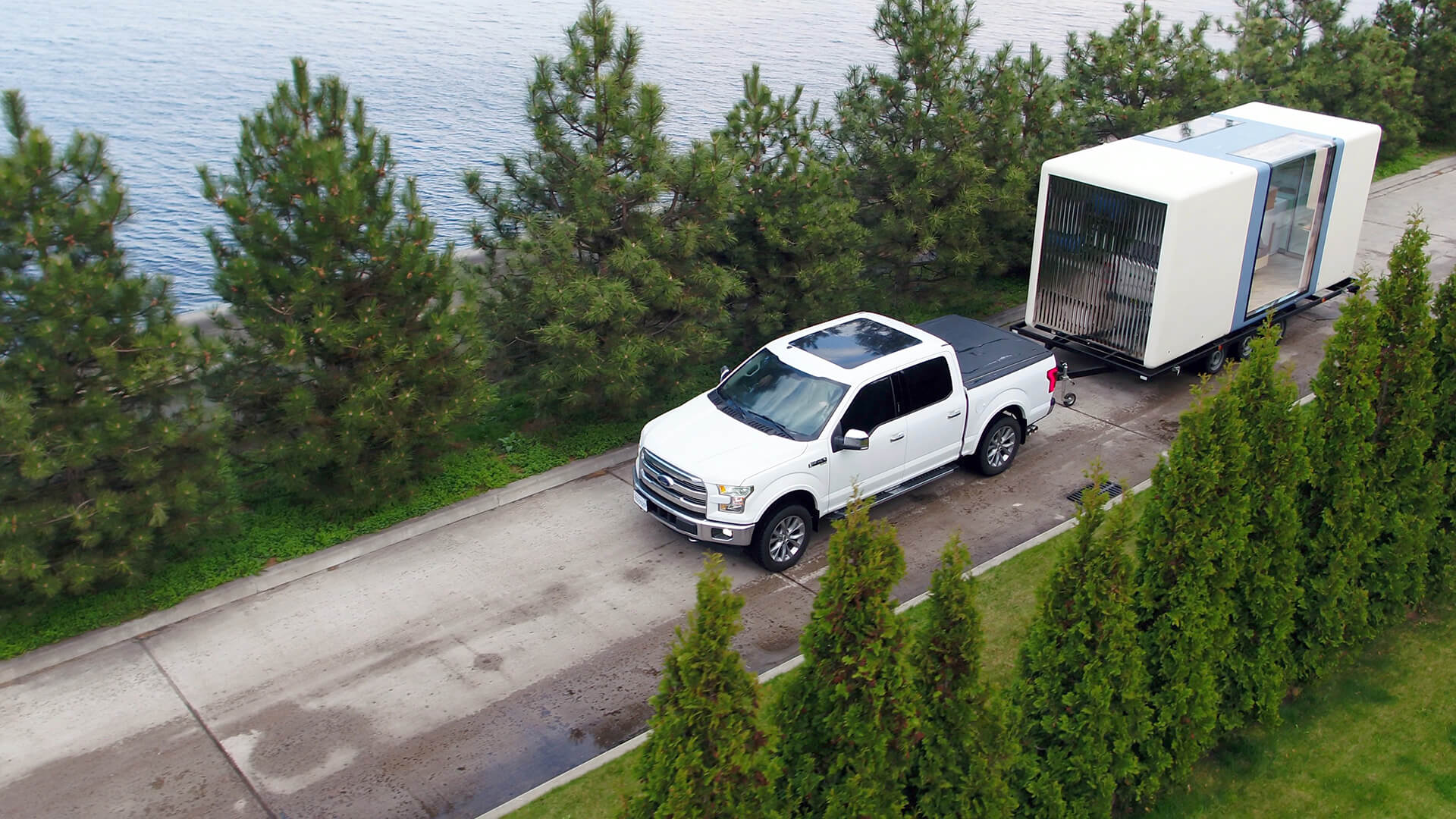

Designed to arrive fully ready at the site, the micro-house by Haus.me combines ultra-fast installation, advanced home automation, premium finish, and extreme resistance to category 5 hurricanes without prolonged construction.
According to Dwell, the Microhaus by Haus.me is 120 square feet — approximately 11 square meters — arrives completely assembled and equipped with everything needed for living, including high-quality appliances, HVAC system, built-in furniture, and accessories ranging from wine glasses to towels and cutlery. Installation on the site takes less than an hour. It does not require a foundation, building permit, or ground preparation. It connects to electricity, water, and sewage with the same plug-and-play system as a camping trailer — or operates fully autonomously in larger versions with solar panels.
The price of the Pro model is $89,990 — less than many luxury cars, without depreciation. The interior was designed by Andrew Shatylo, an aerospace engineer who participated in the development of the Antonov AN-225 Mriya — the largest plane ever built, with an 88-meter wingspan and a capacity of 640 tons.
The company was founded by physicist and industrial designer Max Gerbut, elected by the Financial Times as one of the 100 most influential entrepreneurs in Eastern Europe in 2017. The product won the Red Dot Award for Innovative Design in 2023 — the same award that distinguished products from Porsche, Apple, and Pininfarina. At CES 2025, in Las Vegas, the Microhaus Pro was presented to the public alongside the world’s biggest tech launches and covered by Engadget, PCWorld, and Mashable.
-
Key Infrastructure Projects for Brazil’s Next President: Expanding Railways to Cut Transport Costs, Reduce Truck Traffic, Create Jobs, and Boost Industries Nationwide

-
While China Builds Undersea Rail and Mexico Connects Two Oceans, Brazil Struggles with Grain Transport Due to Lack of Railways

-
Students Build Kansas’ First Hemp-Insulated Social House for a Needy Family: 85% Less Concrete, Solar Roof Returns Energy to Grid, Carbon Negative in Under 20 Years

-
China to Drill 90 Kilometers Under the Sea to Connect Two Cities Currently Linked Only by Ferry


The engineer of the world’s largest plane designing the smallest apartment on the market
The combination of Andrew Shatylo and the Microhaus is the detail that makes the product more fascinating than any competitor in the micro-housing market — and explains why the 11 m² interior feels much larger than the numbers suggest. Shatylo worked on the Antonov AN-225 Mriya program, the Soviet cargo plane with an 88-meter wingspan and a load capacity of 640 tons that remained the largest plane in the world from 1988 until it was destroyed during the Russian invasion of Ukraine in 2022.


Designing the interior of a large aircraft cabin requires the same skill that the Microhaus demands: optimizing every available inch so that the space functions better than its physical dimensions would allow. In airplane cabins, aerospace engineers have learned over decades how to hide ventilation, lighting, and storage systems in minimal structures without the occupant feeling the compression of space.
Shatylo applied this principle to the Microhaus with materials that do not exist in conventional residential construction: recycled composite polymer in the main structure — the same type of material used in external aircraft components — carbon fiber and stainless steel in premium versions, teak flooring in the bathroom, washable textile panels on the walls, and floor-to-ceiling windows that replace opaque walls. The result, described by the Engadget reporter who visited the CES 2025 booth, is an interior of wood, glass, and soft neutrals that feels like an executive jet cabin rather than a compact tiny home.
What’s included — and the level of each item
Haus.me’s policy is to deliver the Microhaus ready to be inhabited on the same day of arrival. Not “structurally ready” — ready to live in, with every everyday use item already in place.

The Pro model includes: a Murphy double bed that folds against the wall to reveal a table and two benches — the same solution used in European high-speed train cabins; kitchen with refrigerator, microwave, and hoods; bathroom with full-size shower, toilet, and teak flooring; HVAC system with automatic temperature control; mechanical ventilation; internal and external LED lighting with motion sensor; TV; high-fidelity sound system; backup battery for power failures; keyless entry with resettable password via app; and the complete list of Villeroy & Boch tableware — a German company founded in 1748 that supplies porcelain to five-star hotels worldwide — plus towels, bed linen, and wine glasses.
Voice control works via integrated Apple HomePod. The internal security camera streams to the owner’s mobile phone in real-time — a feature specifically developed for those who use the Microhaus as a vacation rental unit and want to monitor the property remotely without needing to be present.
Structural resistance that surpasses most conventional houses
One of the most counterintuitive claims by Haus.me about the Microhaus is that its structural resistance surpasses conventional residential construction standards — and verified technical data supports this argument. The Microhaus Pro is certified for seismic resistance according to the Californian code — one of the most stringent in the world, designed to protect buildings during earthquakes of magnitude above 7 on the Richter scale.

It is certified for category 5 hurricane resistance, with winds above 252 km/h. The recycled composite polymer structure is fire-resistant, while stainless steel and carbon fiber in premium versions add protection against impact deformation. For comparison: most American wooden houses are not certified for hurricane resistance above category 2, and conventional masonry houses rarely have explicit seismic certification in Brazil.
Max Gerbut described the principle that guided this design decision: “The composite structure is extraordinarily durable. Its yacht-inspired exterior is made from fiberglass, stainless steel, and teak.” The reference to the nautical industry is accurate — the materials that Microhaus uses have been tested in much harsher environments than any residential construction: salt, intense humidity, water pressure, extreme thermal variation, and wave impact. A house that withstands the conditions of a yacht hull can withstand any residential climate.
No permission, no foundation, no construction — how is it possible
The aspect of Microhaus that most surprises those accustomed to the Brazilian residential construction process — municipal licensing, project approved by CREA, foundation, structure, sealing, installations, finishing — is the total absence of construction at the final destination.
The Microhaus does not require a foundation because its weight is evenly distributed over a sufficient surface area to not need a permanent support structure. It does not require construction permission because it is classified as a removable accessory dwelling unit — similar to a trailer or a container — in most American jurisdictions where it operates. It does not require soil preparation because the installation consists of positioning the unit on leveled ground and connecting three points: electricity, water, and sewage.

The complete installation process takes less than an hour according to the company — time that includes positioning by the delivery truck, leveling, and service connections. The first documented customer by Haus.me was a resident of Portland, Oregon, who installed the Microhaus as an Airbnb unit on land adjacent to his house. The financial return was enough for the customer to become an investor in the company — a fact that Haus.me uses as a demonstration of ROI in its sales materials.
Versions, prices, and the model that includes autonomous solar energy
The Microhaus line has five distinct configurations that cover everything from basic residential use to completely autonomous off-grid operation. The Microhaus Shell costs $35,000 and includes only the structure with HVAC, lighting, wiring, bathroom with fixtures and plumbing — no furniture, no appliances, no accessories.
It is the entry point for those who want the structure and prefer to customize the interior. The Microhaus Lite costs $59,990 and includes everything from the Shell plus the fixed double bed, equipped kitchen, and dishware and textile accessories. The Microhaus Pro costs $89,990 — the CES 2025 model — and adds the convertible Murphy bed, hi-fi sound system, backup battery, and Villeroy & Boch items.
The 400 and 800 square foot versions cost $199,000 and $299,000 respectively and add what the 120 square foot Microhaus does not have: integrated solar panels that make the unit completely autonomous, with no need for connection to the power grid. None of the prices include the delivery cost — calculated based on location.
What the Microhaus Represents for the Alternative Housing Market
The launch of the Microhaus Pro at CES 2025 — the world’s largest consumer technology event — was no accident. Max Gerbut deliberately placed his product alongside OLED TVs, electric cars, and artificial intelligence gadgets because the central thesis of Haus.me is not about construction.
It’s about what happens when housing is treated as a technological product rather than a construction process. An iPhone doesn’t require construction to function. An electric car doesn’t require a foundation to be parked. The Microhaus applies the same logic to a housing unit: manufactured in a factory with industrial quality control, delivered assembled with all systems tested, installed in less than an hour, operated with a mobile app.

The global tiny homes market was valued at $13.17 billion in 2025 with a projection to reach $17.73 billion by 2030 with a CAGR of 6.1%, according to a March 2026 report. The ADU segment — accessory dwelling units, secondary housing units on already occupied land — is growing faster than any other subsegment, driven by the American housing crisis and the appreciation of properties with rental income.
The Microhaus was specifically designed for this market: a unit that generates income, remote control via mobile phone, installation without permission, and a structure that lasts decades with minimal maintenance. A financial asset that resides on the land instead of in an investment fund.