






 Portuguese
  Spanish


Hidden in deep waters for almost 300 years, an ancient merchant ship turned into a submerged time capsule, revealing clues about global trade, luxury consumption, and an interrupted journey that still challenges researchers.
An 18th-century ship lay hidden for almost 300 years at the bottom of the sea, at a depth where ordinary divers would never reach, until it was found in the Skagerrak strait, off the southern coast of Norway. The shipwreck revealed a scene that seems straight out of a movie: stacked Chinese porcelains, European goblets, fabrics, grains, and parts of chandeliers preserved at about 600 meters deep.
According to information released by Reuters, Norwegian archaeologists recovered an impressive collection of objects from a merchant ship that is believed to have sunk around the mid-1700s. The vessel has not yet been identified, and the most intriguing point is precisely this: no one knows where it came from, where it was going, or what its exact commercial mission was.
The find is already considered one of the most extraordinary cases of underwater archaeology in northern Europe, not only because of the age of the ship but because of how the cargo was preserved at the bottom of the sea. Instead of objects completely destroyed by time, researchers found pieces still recognizable, organized, and capable of telling a story interrupted almost three centuries ago.
-
Meet the Fascinating Cassowary: The Bird That Resembles a Dinosaur, Runs Like an Athlete, Crosses Rivers with Ease, and Plays a Crucial Role in Tropical Forests

-
Brazil Deploys Water-Landing Ambulance Planes in the Amazon, Cutting Travel Time from 3 Hours to 12 Minutes to Reach Isolated Communities

-
Early Commercial Flights Used Wicker Chairs Without Seatbelts to Save Weight Before Modern Safety Standards Transformed Air Travel

-
Brazil Converts Urban Tree Trimmings into Biochar and Pyrolytic Oil in Pioneering Environmental Project


A shipwreck at 600 meters that turned into a time capsule at the bottom of the sea
The ship was located in the Skagerrak, a maritime area between Norway, Denmark, and Sweden, a region historically important for European trade routes. The vessel rests at about 600 meters deep, equivalent to approximately 2,000 feet, in a dark, cold, and hard-to-reach zone.
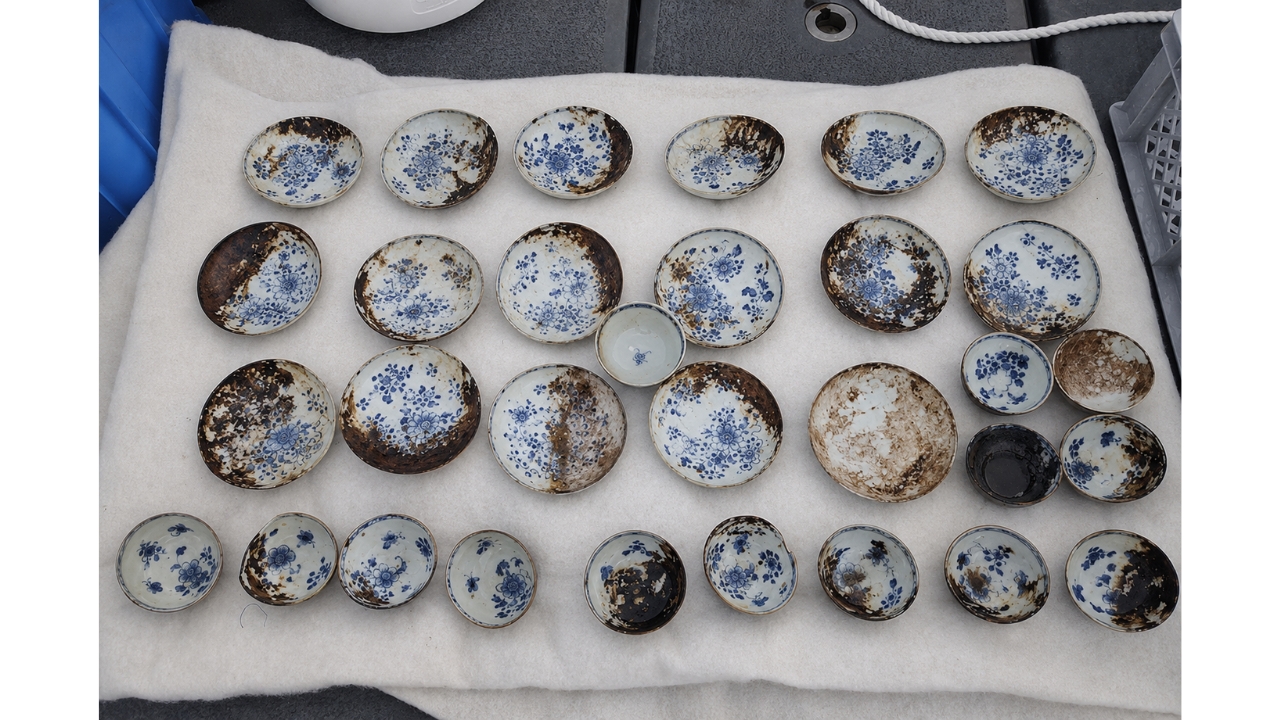
This absurd depth helped transform the shipwreck into a kind of submerged time capsule. Fragile objects, which would normally disappear in shallower waters, have endured for centuries. Among the materials found are fabrics, grains, containers, glass pieces, chandelier fragments, and an impressive amount of porcelain.
The deep environment reduces human interference and better protects some materials against rapid destruction. That’s why the case attracted so much attention from archaeologists: it’s not just an ancient ship, but a cargo practically frozen in time, preserving clues about trade, luxury, and consumption habits of the 18th century.
Chinese porcelain and European luxury: the cargo that surprised archaeologists
Blue and white bowls were stacked on the seabed
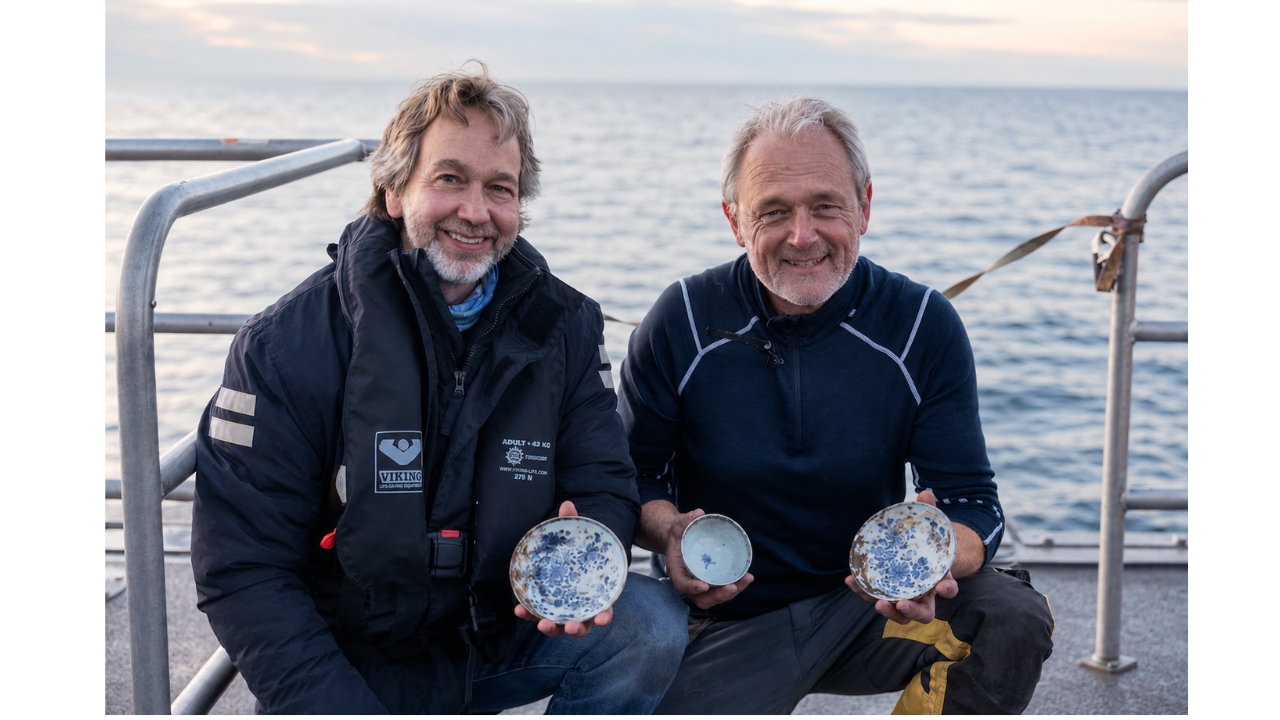
The most striking item from the shipwreck is the large quantity of blue and white Chinese porcelain, an extremely valued product in 18th-century Europe. The pieces were found in stacks, many of them still intact, creating a rare and powerful image: plates and bowls that crossed oceans and trade routes before disappearing at the bottom of the sea.
The presence of this porcelain indicates that the ship was part of a much broader trade network than a simple regional trip. Even if the vessel may not have come directly from China, its cargo reveals the strength of global trade at the time, when Asian products circulated through European ports and reached the hands of wealthy consumers.
In addition to the porcelain, archaeologists found European cups, parts of chandeliers, fabrics, and grains. This combination suggests that the ship was carrying both luxury items and common goods, mixing prestigious objects with supply products.
The mystery that still intrigues Norway
Origin and destination of the ship remain unknown
Despite the progress of the investigations, the ship remains unnamed. Researchers have not yet been able to determine its origin, its destination, or the route it was following when it sank. This uncertainty increases the impact of the find because each recovered piece can serve as a clue to reconstruct the ship’s last voyage.
The strongest hypothesis is that the ship was a merchant vessel from Northern Europe, possibly used to redistribute goods coming from major commercial centers. The Chinese porcelain may have first arrived at important ports like Amsterdam, Copenhagen, Gothenburg, or Lübeck, before being shipped again on a smaller route.
This possibility turns the shipwreck into a rare window into 18th-century European trade. The ship was not just carrying objects; it carried signs of a world already connected by maritime routes, luxury consumption, and commercial disputes.
Modern technology revealed an invisible archaeological treasure
ROVs allowed exploration of an area inaccessible to divers
The exploration of the shipwreck was only possible thanks to the use of advanced technology. Since the ship is at a 600-meter depth, archaeologists used a ROV, a remotely operated underwater vehicle, equipped with cameras, a robotic arm, and delicate collection systems.
With this equipment, specialists were able to film the site, map the structure of the ship, and retrieve objects without destroying them. The operation also allows for the creation of detailed models of the shipwreck, helping researchers understand how the cargo was distributed and how the ship may have sunk.
This point gives the case even greater strength: an 18th-century shipwreck only began to reveal its secrets because 21st-century technology managed to reach a place where humans could not work directly.
Why the find is so important for history
More than a “treasure” in the popular sense of the word, the shipwreck is a scientific and archaeological treasure. It can help explain how Chinese goods reached the European market, how they were transported between ports, and which products circulated among merchants, elites, and consumers of the time.
The presence of Chinese porcelain, European glass, fabrics, grains, and chandelier pieces creates a rare portrait of a sophisticated maritime economy. Each object can reveal information about origin, dating, trade, naval technology, and consumption habits.
The great fascination lies in the contrast: a ship that disappeared in the 18th century, lost in silence at the bottom of the sea, now returns to the surface as a story of luxury, mystery, and science. And, as archaeologists continue investigating, the question remains open: what ship was this, where did it come from, and what destination did it never manage to reach?


