






 Portuguese
  Spanish


Report from Xataka shows that airplane seats started with wicker chairs bolted to the floor, still without seatbelts, before aluminum, leather, foam, Boeing 747 systems, and 16g tests transformed comfort, weight, and safety inside modern commercial cabins throughout world passenger aviation.
The modern airplane seat may seem cramped to many passengers, but the first commercial flights had much simpler solutions. According to a report by Xataka, the first cabins even used wicker chairs bolted to the floor, at a time when lightness mattered more than comfort and safety.
The article, signed by Eva R. de Luis and published on July 5, 2026, reconstructs the evolution of commercial seats from historical records, British Airways archives, and information cited from Air Charter Service USA. The trajectory shows how the cabin stopped looking like an improvised room and began to follow strict engineering criteria.
Wicker chairs appeared in the first commercial flights
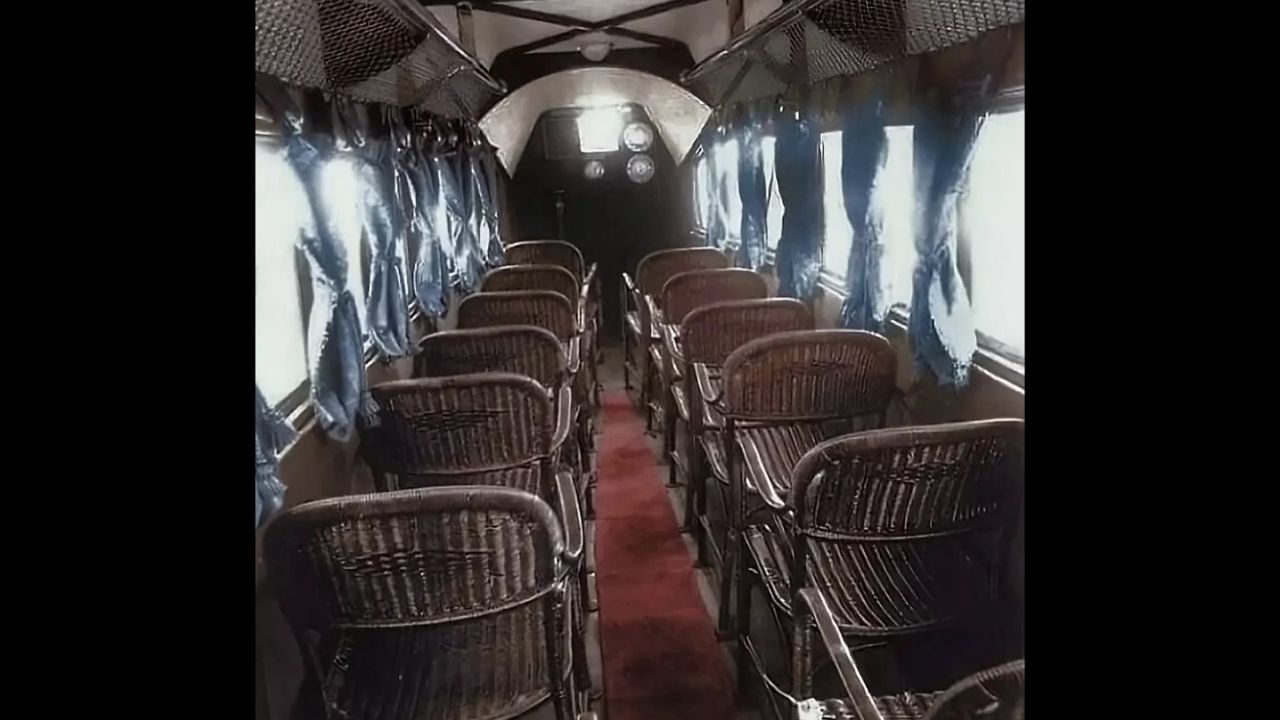
The image that went viral on social media showed an old cabin with carpet, wicker chairs, and no visible seatbelt. The publication attributed the scene to an Imperial Airways plane in 1936, but verification cited by Xataka confirmed the photo without confirming the exact date.
-
Brazil Converts Urban Tree Trimmings into Biochar and Pyrolytic Oil in Pioneering Environmental Project

-
Giant Machines at Brazil’s Porto Sudeste Convert Iron Ore Trains into Continuous Ocean Shipments
-
Land Rover Discovery Gets Stuck in Sand and Submerged by Rising Tide in Brazil

-
LG Unveils 635-Liter InstaView Fridge with Touch-Activated Door, Craft Ice, UVnano Purification, and Smart Features


The report itself states that the same cabin appears in British Airways archives associated with the 1920s. Even with the specific date open, the image well represents the look of the first interiors of commercial aviation, when the flying experience was still far from the standard known today.
Weight was a priority before comfort and impact
In the early years of passenger aviation, the main criterion for an airplane seat was to be lightweight. Engines had limited thrust, and reducing weight helped increase the aircraft’s payload, something crucial for companies still testing commercial air transport.
Therefore, the choice of wicker made sense within that technical context. It was a lightweight material, relatively comfortable by the standards of the time, and easy to install. Concern for impact resistance and energy absorption did not yet have the same importance it would gain in the following decades.
Lawson Airliner carried 26 wicker chairs
According to Xataka, Air Charter Service USA points out that the Lawson Airliner, in 1919, used 26 wicker chairs as passenger seats. That period also marked the emergence of historic airlines, such as KLM in the Netherlands and Avianca in the Americas.
PJ Wilcynski, a historical researcher at Boeing cited by Travel+Leisure in the report, stated that these wicker chairs bolted to the floor initiated the logic of passenger seats. The cabin was still rudimentary, but it already indicated the attempt to transform the airplane into a regular means of transport.
Leather and padding were introduced in the 1920s
The wicker chairs did not remain a pure solution for long. By the late 1920s, padded and leather-covered versions emerged, an adaptation that sought to improve the onboard experience without completely abandoning lightness.
Leather had a practical function. According to PJ Wilcynski, it was popular because it made seat cleaning easier in a period marked by soot at airports and dusty runways. Comfort began to enter the cabin, but still linked to very basic operational needs.
Aluminum changed seat structure in the 1930s
The big breakthrough came in the 1930s when the Aluminium Company of America created a passenger seat made with lightweight metal. From then on, tubular aluminum structures began to spread across airline aircraft.
This advancement was crucial because aluminum combined lightness and strength more appropriately than wicker. The airplane seat began to resemble a piece of engineering, paving the way for cushions, better coverings, and safety elements that were not previously part of the cabin.
Foam and seatbelt arrived with a new cabin standard
Even in the 1930s, the seats began to incorporate more comfort elements. The report mentions the arrival of velvet covers, thick seat belts, and in 1936, foam seats covered with rubber associated with the Douglas DC-3.
This process transformed the cabin into a more recognizable environment for the modern passenger. The improvised chair gave way to a structure designed to withstand repeated use, offer some comfort, and better respond to safety demands.
Boeing 747 brought electrical functions and entertainment to the seat
In 1952, the first commercial reclining seats arrived. But, according to PJ Wilcynski, the big leap to the current experience came with the Boeing 747, around 1970, when the seat began to integrate more complex cabin functions.
The multiplex system introduced call for the operator, reading light, and audio for movies, transmitted through pneumatic tubes connected to the armrest. From then on, the airplane seat ceased to be just a place to sit and began to concentrate services, comfort, and communication within the cabin.
Safety went from 6g to much stricter requirements
The most important evolution was not just aesthetic or ergonomic. In the early years, according to Xataka, the seats needed to withstand a force of 6g. In the 1950s, this requirement rose to 9g, following the maturity of the aeronautical industry.
Today, the criteria are much broader. The source cites fire resistance for 12 seconds, the ability to withstand a force of 16g, lightness, foam suitable as a floatation device, and resistance for different types of passengers. The modern airplane seat is the result of decades of accidents, regulations, and technical learning.
Modern cabin was born from the combination of lightness, comfort, and regulation
The history of the seats shows that commercial aviation did not evolve linearly just to offer more comfort. Many changes arose from technical limitations, dirt on the runways, the need to reduce weight, new materials, and stricter safety rules.
Therefore, comparing wicker chairs with current seats helps to understand a greater change. The airplane ceased to be an experimental machine adapted for passengers and became a regulated, calculated, and standardized environment to transport millions of people.
What the first seats say about flying today
The current airplane seat can be the target of criticism for reduced space, little recline, and discomfort on long flights. Still, when compared to the wicker chairs without seatbelts of the early days, it shows how much the cabin has changed in terms of safety, materials, and technology.
The question remains whether modern aviation has advanced more in safety than in comfort for the average passenger. Do you think current seats can still improve a lot, or have the space and weight limits already turned the cabin into an inevitable compromise? Leave your opinion in the comments.


