






 Portuguese
  Spanish


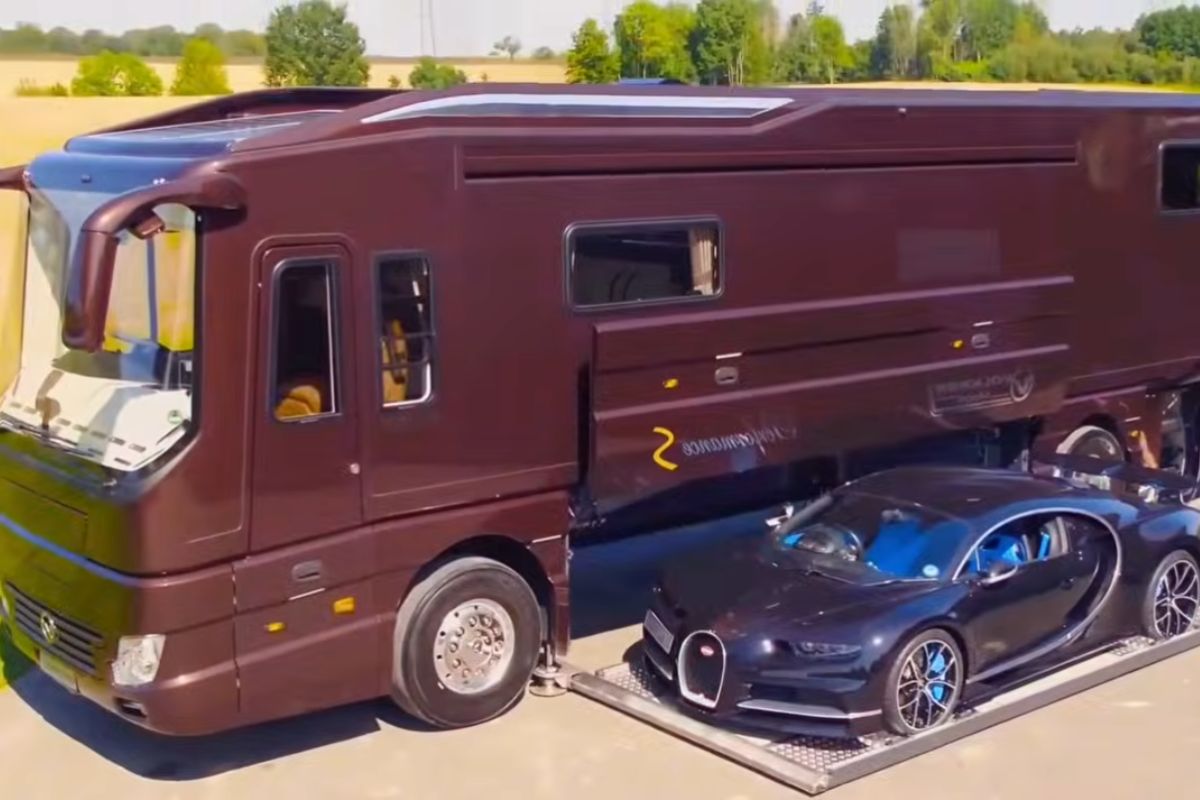


The New RV From China Combines Solutions That Seem Incompatible in Any Motor Home: Internal Glass Elevator, Second Floor That Rises at the Push of a Button, Hidden Hydraulic Garage for Supercar, High-Autonomy Solar System, Rooftop Jacuzzi, and Even a Functional Retractable Helipad Integrated Into the Design.
The new RV from China was not designed to follow the traditional logic of a motorhome. Instead of accepting the physical limits of a compact vehicle, it attempts to stack luxury, technology, and spectacle within a structure that grows upwards, closes up to drive, and expands again when parked. The result is a machine that transforms the act of stopping into a mechanical event, with a glass elevator and second floor emerging where before there seemed to be only a sophisticated van.
In the overall design, the ambition goes beyond mobile housing. The new RV from China incorporates a hydraulic garage, a high-autonomy solar system, a rooftop jacuzzi, and even a functional helipad, as if the road ceased to be a route and became temporary property. The goal is not to travel in comfort, but to take a kind of private territory on wheels, capable of combining circulation, permanence, and exhibition in a single body.
A Second Floor That Changes the Scale of the Vehicle

The element that most breaks the immediate perception of this machine is the second floor. While moving, the structure maintains the appearance of a modern and relatively contained van.
-
The mansion in Flamengo, built in 1865 for the Baron of São Clemente and closed for 20 years, has become a spa, event hall, and gym for “Symphony,” a luxury condominium that sold 70% of its gross development value in the first month on the R$ 60 million land of the former Bennett College.

-
The Ipiranga convent, a 1924 building adjacent to the Museum that remained vacant for a decade and became home to dozens of cats, is reborn as “Alma Mater,” a luxury development worth R$ 130 million with a pool in the courtyard and a clubhouse in the former nuns’ chapel.

-
An empty pool of almost 3 meters turned into tilapia farming in the backyard after a family transformed the dangerous space for children into an urban greenhouse with eggs and organic food.

-
Danger of Technological Hyperstimulation: USP specialists warn that intense use of multiple screens and digital stimuli can gradually reduce essential cognitive abilities, while scientists analyze how technological overload affects memory, concentration, and intellectual performance over the years.



However, when it parks, the roof rises mechanically and creates a complete upper floor, with a glass-walled balcony and a space designed for contemplative use, like a zen tea room.
It is not an improvised rooftop tent, but a rigid expansion integrated into the vehicle.
This vertical growth changes what is expected from a house on wheels. Instead of merely stretching sides or pushing modules outward, the new RV from China bets on usable height.
The second floor clearly shows that the design aims to escape the feeling of confinement that defines most motorhomes.
The central idea is simple: if the base is already occupied by a living room, circulation, and a kitchen, the answer is not to compress more but to rise.
To access this upper level, engineers installed a cylindrical glass elevator inside the vehicle. This choice is not merely a theatrical exaggeration.
It eliminates the dependency on internal stairs, frees up circulation space, and reinforces the miniature architectural character of the whole.
A functional glass elevator in an RV serves to say that the experience was designed as a compact mansion, not as temporary shelter.
The glass elevator also helps organize the staging of luxury. Ascending to the upper floor does not require physical effort nor disrupts the flow of the environment.
Everything was conceived so that the transition between the ground floor and the second floor feels like that of a high-end permanent residence, only compressed within a vehicle that, just seconds before, was simply parked at the edge of the road.
The Hydraulic Garage and Off-Grid Autonomy

If the second floor solves the height issue, the hydraulic garage addresses another classic problem of luxury buses: what to do when arriving in the city and the vehicle is not practical for all movements.
In the proposed design, between the wheel axles, there is a hidden compartment that slides out at the push of a button, revealing a platform capable of carrying a Bugatti, Ferrari, or Porsche.
It is a calculated solution to support tons without destabilizing the structure.
The hydraulic garage changes the function of the vehicle’s underbelly. Where there would normally be luggage, it creates a hangar for supercars, allowing the house to remain parked while the owner circulates in another level of exclusivity.
This reinforces the overall logic of the new RV from China: everything must serve to continue comfort and control, with no concessions to common practicality.
The road ceases to be a limit and becomes an extension of a luxury garage.
This mechanical autonomy is accompanied by a robust solar system on the roof.
The structure is covered with solar panels and supported by a 1000 amp-hour battery, sufficient to power air conditioning, espresso machine, and other equipment for weeks off the grid.
The solar system here does not appear as an ecological accessory, but as a central piece of operational independence.
When the hydraulic garage and solar system work together, the vehicle gains a logic of mobile fortress. The support car is stored underneath; the energy for comfort and permanence comes from above. This combination is what allows the new RV from China to present itself as a self-sufficient structure, capable of parking far from urban infrastructure without sacrificing consumption, climate control, and spectacle.
Rooftop Jacuzzi and Functional Helipad Push Luxury to the Extreme
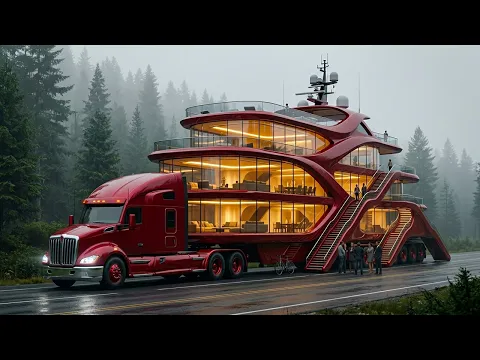

The roof serves not only to capture energy. It also houses a jacuzzi and a lounge area, transforming the rooftop into a recreational platform. This completely alters the external reading of the vehicle. An RV with a rooftop jacuzzi does not just want to transport people, but also to offer an elevated permanence scenario, where the horizon is part of the experience of use.
Beside this space is the most radical component of the project: a functional retractable helipad.
The platform hides during travel to preserve aerodynamics and, when the vehicle stops, opens to receive a light helicopter like the Robinson R22.
The effect is obvious: the new RV from China no longer competes only for road territory and also claims immediate airspace.
This functional helipad summarizes the philosophy of the machine. It is not enough to carry a house on the body; it must allow mobility to continue on another layer.
The vehicle was not designed just to reach a place but to keep all routes available after arrival.
The functional helipad is not a side detail; it is the clearest statement that the design aims to erase the boundary between vehicle, mansion, and private base.
When combining jacuzzi, upper lounge, glass elevator, and second floor, the roof ceases to be just a cover and becomes a fifth usable area.
Instead of concluding the construction, it extends it. Such choices push the new RV from China into a territory of extreme concept, where each part of the whole must do more than its basic function and also communicate excess, power, and technological self-assertion.
Why This Machine Seeks to Redefine What It Means to Live on Wheels
The strength of the project lies precisely in gathering solutions that, in common vehicles, would appear separate or would not even be considered viable.
The glass elevator transforms internal mobility into an architectural gesture; the second floor creates vertical expansion; the hydraulic garage eliminates the need to choose between bus and supercar; and the solar system sustains luxury away from the grid.
Each element isolates a classic problem of mobile living and tries to solve it with excessive engineering.
This helps explain why the new RV from China attracts so much attention even in a universe already accustomed to excesses.
It does not seem interested in adapting the house to the road but in forcing the road to accept a house that behaves like a villa, lounge, garage, and air base simultaneously.
The vehicle does not negotiate with limitation; it responds to limitation with a multiplication of functions.
There is also a clear symbolic component. Chinese engineering appears willing to miniaturize a high-end lifestyle within a mobile body.
The glass elevator and the second floor are not just functional solutions but instruments of a narrative: that the house on wheels no longer needs to resemble an adapted vehicle. It can aspire to look like a condensed private property.
In the end, the new RV from China impresses not just because it has a rooftop jacuzzi or functional helipad. It impresses because it gathers, in a single object, the ambition to control land, energy, shelter, and mobility without accepting almost any compromises.
It is the logic of absolute luxury applied to mobility, as if travel ceased to be a crossing and became a permanent installation in motion.


