






 Portuguese
  Spanish
  2 min of reading
  1 comment


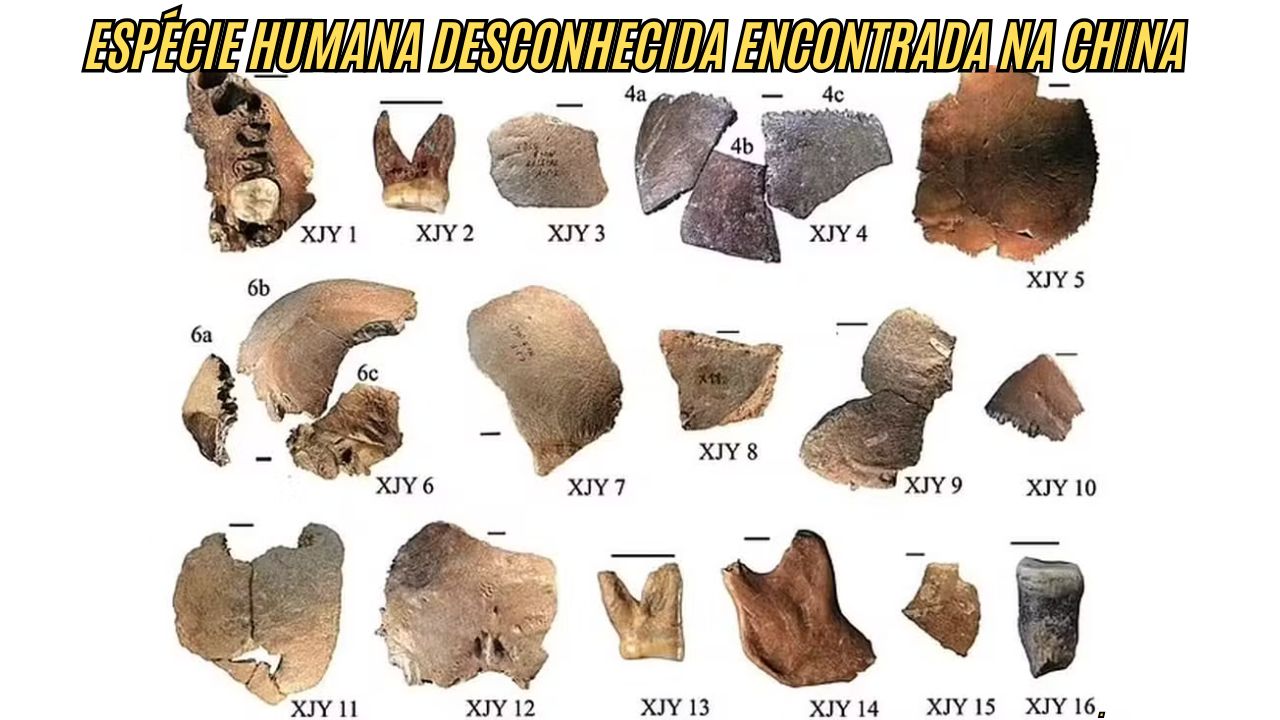


The New Discovery in China of Fossils Dated to 300,000 Years Suggests the Existence of an Unknown Human Species Called Homo Juluensis.
A new discovery in China is shaking the foundations of human evolution history. Scientists revealed that fossils found in the 1970s in the regions of Xujiayao and Xuchang, in Henan province, may belong to an unknown human species. Named Homo Juluensis, this possible new lineage of hominids was presented in a research published in the journal Nature Communications.
The fossils, dated to about 300,000 years, include bone fragments from 16 individuals. Their physical features are striking: broad skulls, large heads, and impressively large teeth. These primitive humans appear to have lived in small groups and used stone tools and animal bones for hunting. Among the foods consumed, wild horses were on the menu, and animal skins were used for protection against the extreme cold of the time.
Denisovans May Be Reclassified as Part of This New Discovery in China

The study also highlights a fascinating discovery: the teeth of Homo Juluensis exhibit surprising similarities to those of Denisovans, another extinct lineage of hominids, whose fossils were found in Siberia. For Christopher J. Bae, the research leader and professor at the University of Hawaii, this raises the possibility that Denisovans may actually be reclassified as part of this new discovery in China. However, he emphasizes that more investigations are needed to confirm this hypothesis.
-
Son finds father’s forgotten notebooks and helps scientists solve the mystery of a 55-million-year-old marine fossil that remained unanswered for almost three decades.

-
Sailor sails alone from Panama to Cuba carrying just over US$ 7,000 in food, medicine, and baby formula, spends hours at Santiago de Cuba customs, and delivers everything to Cáritas, linked to the Catholic Church, to distribute to the population.

-
In the middle of a forest in the USA, a couple transforms over 1,500 recycled tires, bottles, cans, and clay into an ecological mansion, builds 90% of the house with their own hands, and puts the nearly 7-acre self-sustaining refuge up for sale for $1.3 million.

-
Cutting board created in the Netherlands uses material made by microorganisms, measures 30 x 20 cm, and aims to eliminate microplastics that can end up in food during daily preparation.




Does Not Mean They Were More Intelligent
Despite the skulls of this unknown human species being larger than those of Neanderthals and even Homo sapiens, with volumes between 1,700 and 1,800 cubic centimeters, scientists warn that this does not mean they were more intelligent. The species likely disappeared about 50,000 years ago, possibly merging with Homo sapiens who arrived in the region.
This new discovery in China promises to rewrite important chapters of evolutionary history while opening new questions about how our ancestors interacted and survived in such a challenging world.








Monumental descoberta!!!