






 Portuguese
  Spanish
 4 min of reading
  7 comments


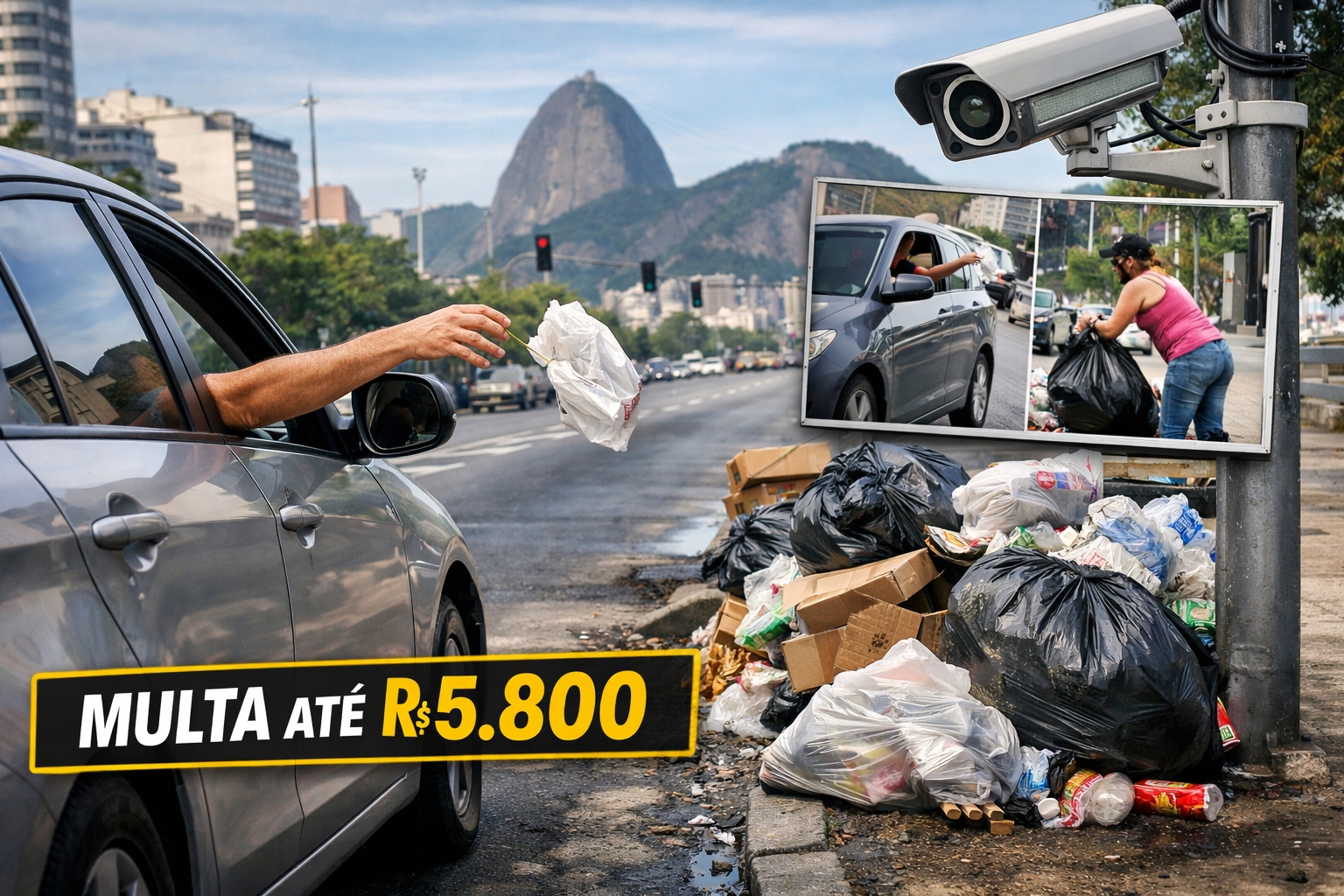


Law in Effect: Images Captured by the Cameras Can Be Used to Identify Vehicles and Fine Up to R$ 5.8 Thousand Drivers and Pedestrians Involved in the Irregular Disposal of Garbage.
The city of Rio de Janeiro has begun to allow the use of surveillance cameras to catch and fine irregular garbage disposal, after the sanctioning of Law No. 9,096, of October 13, 2025. The measure applies to drivers in vehicles and anyone who commits this type of infraction on public roads, using images from cameras already installed by the city hall.
The goal is to strengthen the fight against practices that affect public health, the environment, and the functioning of the city.
New Law No. 9,096 Is Not Limited to Drivers: Rule Applies to Anyone Caught Littering in Urban Areas
The Law No. 9,096, of October 13, 2025 authorizes the Executive Power to use cameras from CET Rio, Municipal Guard, and the Operations and Resilience Center to identify irregular garbage disposal.
-
Line of trucks on the coast of Piauí anticipates a historic operation at the Port of Luís Correia, where 120,000 tons of iron ore extracted in Piripiri are set to be shipped to China, marking the beginning of a port structure awaited for decades.

-
Better than in Brazil? Havan’s owner wants to take the chain to Paraguay and Uruguay: “I confess I had never thought about it.”

-
How much does a gas station owner earn? A business that seems like a money-making machine can generate R$ 1.5 million per month and still profit only R$ 40,000, while the real earnings come from convenience, car wash, and extra services.
-
Elderly individuals may obtain essential documents without paying fees: a project that includes CIN, CNH, CPF, and work card advances in the Chamber, eliminates issuance and renewal charges, and leaves Brazilians waiting for decisive steps to see if the benefit will actually be implemented.




The use of images is not limited to drivers, as the rule applies to anyone caught littering in urban areas.
The cameras serve as a support tool for enforcement, expanding the reach of control without creating new systems.
Irregular Garbage Disposal Represents a Threat to Public Health, Contributes to the Proliferation of Diseases, and Compromises Urban Drainage Functioning
Irregularly disposed garbage presents a direct risk to public health, facilitates the spread of diseases, and compromises environmental quality.
The accumulation of waste on public streets causes clogged drains, hindering rainwater drainage and increasing the occurrence of flooding.
The new law strengthens the municipality’s response to these problems by allowing continuous enforcement with technological support.
Who Can Be Fined and How Identification Occurs
Anyone who engages in irregular garbage disposal in urban areas can be fined when the infraction is recorded by the cameras.
In cases involving vehicles, the procedure requires recording the license plate, which allows for the accountability of the vehicle owner.
The rule does not create distinctions between pedestrians, vehicle occupants, or drivers, as long as the act takes place in a public space.
Who Enforces and Applies Penalties
The Municipal Urban Cleaning Company Comlurb is responsible for enforcement activities and applying fines.
The actions follow the criteria of Article 5 of Law No. 3,273, of September 6, 2001, which already regulates infractions related to urban cleanliness.
The cameras merely reinforce the ability to identify infractions, without altering the authority of the responsible agencies.
Fines Can Reach R$ 5.8 Thousand: How the Fining Process Works
The punishment for irregular garbage disposal does not originate in Law No. 9,096. It allows the use of cameras as a tool for catching offenders, while the fines and penalties follow Municipal Law No. 3,273/2001, which defines who enforces and applies the fines.
The amounts are periodically updated by order of Comlurb. In the update of August 12, 2024, the official table shows fines ranging from R$ 183.65 to R$ 5,878.05, varying according to the applicable article and the severity of the infraction.
In practice, the image captured by the camera serves to characterize the irregular act and support the identification of the responsible party. In cases involving vehicles, the identification may include the license plate to enable the accountability of the owner within the urban cleaning enforcement process.
After the infraction, the collection process follows the administrative flow. The non-payment of the fine may link the debt to credit restrictions, and the system records the clearance after payment within the operational timeframe informed by the official municipal services.
What Can Happen from the Application of the Law
The use of public cameras tends to enhance the efficiency of urban enforcement, reducing practices that degrade public spaces.
The regulation also reinforces the accountability of individual behaviors that impact the entire community.
Consequently, the municipality gains an additional legal tool to address recurring problems related to litter on the streets.
The new law No. 9,096 consolidates the use of technology as an ally of urban cleanliness and makes it clear that anyone, whether in a vehicle or not, can be fined for improperly disposing of garbage in urban areas.
The use of public cameras to prevent illegal garbage disposal divides opinions. What do you think about this measure? Does it help improve urban cleanliness? Leave your comment.








Esse Rj só faz **** mesmo estado cheio de **** e perdi tempo com lixo
Fantástico! Tem que multar mesmo esses miseráveis que poluem a cidade. Em Guarabira, PB tem alguns moradores queimando lixo dentro da cidade, uma poluição do **** e a prefeitura não faz **** nenhuma. **** de **** sem noção que só sabe fazer ****.
Eles deveriam criar uma lei para utilizar as câmeras na proteção da população ao invés de multar…