Portuguese
  Spanish


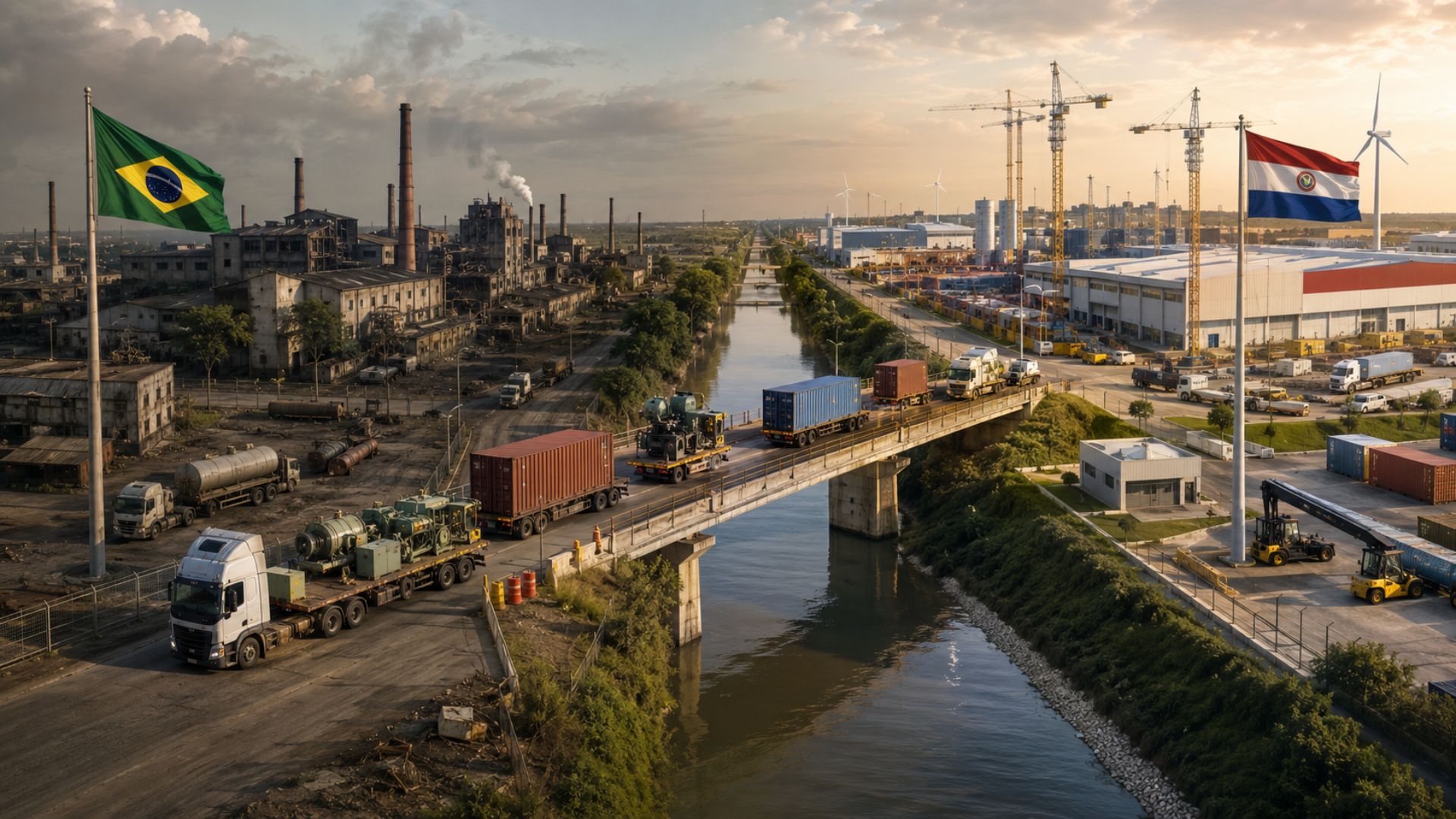

Of the 332 industries registered under the maquila regime in Paraguay in 2024, 223 are Brazilian industries, which represents 69% of the total. Paraguay grew 6.6% in 2025, compared to 2.3% for Brazil, and achieved investment grade by Moody’s and Standard and Poor’s. Income taxes in Paraguay are 10%, compared to 34% in Brazil, and industrial electricity costs three times less. Lupo, a century-old sock manufacturer, opened a factory in Ciudad del Este and already operates with costs 28% lower than in Brazil.
Brazilian industries are opening factories in Paraguay at a pace that should concern any economic policy maker in Brasília. Of the 332 industrial enterprises registered under the Paraguayan Maquila Law in 2024, 223 are of Brazilian origin, representing 69% of the entire foreign industrial base in the country. The movement is not new: the Maquila Law has existed since 1997, but the accelerated growth of migration in recent years coincides with the increase in Brazilian taxes and the growing perception that producing in Brazil is too expensive to compete globally.
The most emblematic case is that of Lupo, a sock manufacturer with 104 years of history founded in Araraquara, São Paulo. The company opened a factory in Ciudad del Este, Paraguay, in 2025, with an investment of R$ 30 million and 110 employees, with the capacity to produce 20 million pairs of socks per year. CEO Liliana Aufiero declared that the Paraguayan operation costs 28% less than the Brazilian one and that the socks produced in Paraguay are already competitive with those manufactured in China. Lupo has not closed its five factories in Brazil, where it maintains about 9,000 employees, but the decision to expand to Paraguay instead of increasing national production sends a clear signal about the Brazilian business environment.
Why Paraguay attracts Brazilian industries
The answer lies in the numbers. Paraguay charges 10% income tax on legal entities and 10% VAT, compared to 34% corporate tax burden in Brazil plus consumption taxes that raise the total burden to almost 40% of GDP. Under the maquila regime, Brazilian industries import inputs without paying import taxes and when exporting pay only 1% on the added value.
-
Brazil’s BNDES Funded Metro and Steel Plant Projects in Venezuela with Brazilian Support

-
Abandoned Building in Brazil to Become Biotechnology Unit with $10 Million Investment, Bridging Science, Industry, and Public Health
-
Company Offering “Stones to Diamonds” Scheme Sells Ruined Italian Homes to Brazilians for 1 Euro, Disappears with Promised Renovations, Leaving Buyers in Debt to Italian Tax Authorities Until 2028 Without Property

-
Plastic Packaging Drives Santa Catarina Industry to 230% Growth, Aiming for R$ 500 Million by 2030 Amid Sector Crisis, with New Gearless Line Expanding in Southern Brazil to Compete in South America



Industrial electricity in Paraguay costs 5 cents per kilowatt-hour, compared to 16 cents in Brazil, a threefold difference. The country does not have mandatory unions, the workweek is 48 hours, and labor legislation allows direct negotiation between employer and employee. For Brazilian industries competing with Chinese and Asian products, the combination of low taxes, cheap energy, and labor flexibility is hard to ignore.
The growth that embarrasses the bigger neighbor
Paraguay recorded a growth of 6.6% in 2025, while Brazil was at 2.3%. In 2026, the expectation is for a growth of 4.2% for Paraguay and more modest projections for Brazil. The accumulated foreign direct investment in Paraguay amounts to 10 billion dollars, equivalent to 20% of the 50 billion GDP, a proportion that surpasses most countries in the region.
The Brazilian industries that settle in Paraguay are not just fleeing taxes: they are seeking a stable macroeconomic environment. The country achieved investment grade by Moody’s in 2024 and by Standard and Poor’s in 2025, credentials that Brazil lost during Dilma’s government and that, according to the agencies themselves, will hardly be regained without fiscal adjustment. Paraguay’s international reserves of 11.7 billion dollars represent about 23% of GDP, compared to approximately 3% in the Brazilian case.
The Maquila Law that has been working since 1997


The Maquila Law is not a recent invention nor a reaction to the Brazilian crisis. It was created in 1997 with the aim of attracting foreign industries to produce in Paraguay using imported inputs without taxation and exporting the final product with a minimal charge of 1%. The model transformed Paraguay into a manufacturing hub for companies worldwide, initially attracting Japanese and Europeans and, in recent years, a wave of Brazilian industries.
The regime allows Brazilian industries to import raw materials, components, and equipment without paying any import tax. The production is exported with a tax of only 1% on the added value. The new Law 6.090 expanded the incentives with zero VAT for internal production. The result is a production chain that operates with costs that Brazil cannot match without a tax reform that reduces the burden on the industry.
What Paraguay has that Brazil does not offer
Besides taxes and energy, Paraguay offers structural advantages that attract Brazilian industries. The average age of the population is 29 years, with 70% of Paraguayans under 40 years old, compared to a Brazilian demographic that is already negative, with 1.6 children per woman. This means a young and abundant workforce in productive age.
The Minister of Industry and Commerce, Marco Riquelme, 39 years old and from the private sector, stated in a meeting with Brazilian entrepreneurs that “in Paraguay, the government is a friend of the entrepreneur and encourages making money.” The phrase reflects a philosophy opposite to the Brazilian one, where the relationship between the state and the productive sector is often marked by distrust, bureaucracy, and punitive taxation. Paraguay’s geographical position as a central hub between Brazil, Argentina, Bolivia, and Uruguay, combined with the future bioceanic highway that will connect the country to Chile and the Pacific, adds a growing logistical advantage.
What happens with Brazil that falls behind
The departure of Brazilian industries to Paraguay is not just a loss of production: it is a loss of jobs, revenue, and competitiveness. Each factory that opens in Ciudad del Este instead of expanding operations in São Paulo, Minas Gerais, or Santa Catarina is an investment that Brazil lost not due to lack of market or workforce, but due to excessive taxes, expensive energy, and paralyzing bureaucracy.
Brazil ranks lower than Paraguay, Uruguay, and Chile in the U.S. Department of State’s business climate rankings. The tax burden close to 40% of GDP and regulatory complexity make Brazilian industrial production less competitive each year. The 223 Brazilian industries already operating in Paraguay are the most visible symptom of a problem that goes beyond economic policy: it’s a matter of the country’s model.
Do you think Brazil is losing industries to Paraguay because of taxes or are there other factors? Would it make sense for Brazil to copy the Paraguayan maquila model or does the country need its own solution? Tell us in the comments.