Portuguese
  Spanish


Two New NASA Satellites — The TRACERS Mission — Will Be Launched in Late July to Study Solar Wind, Magnetic Reconnection, and Protect Earth from Solar Storms That Threaten Networks, GPS, and Satellites.
In late July, NASA will place two identical satellites into orbit with a bold mission: to track, practically in “real-time,” how solar wind interacts with Earth’s magnetic field and triggers phenomena that can evolve into solar storms capable of affecting power grids, communications, GPS, satellites, and even astronauts.
The project is called TRACERS — Tandem Reconnection and Cusp Electrodynamics Reconnaissance Satellites — and it opens a new phase for monitoring the so-called space weather. The launch is currently scheduled for July 22, 2025, aboard a Falcon 9 rocket, departing from Vandenberg Space Force Base in California, as part of a rideshare mission that will also carry other small satellites from the agency.
Why We Need to Study Solar Wind Now
We live surrounded by technology dependent on satellites, precision timing synchronization, and interconnected power transmission networks. All of this is vulnerable to bursts of particles and electromagnetic fields that come from the Sun during periods of high activity — the so-called solar storms.
-
Spanish Startup Develops Europe’s Densest Solid-State Battery at 402 Wh/kg

-
Telescope Launched 80 Billion km from Earth Could Use the Sun as a Giant Lens to Magnify Exoplanets, Potentially Revealing Continents, Oceans, and Signs of Life

-
Australian Researcher Turns Discarded Coffee Grounds into Eco-Friendly Bricks with 80% Less Pollution and Double the Strength Required by Law

-
Scientific Tool Developed in Brazil Aims to Prevent Femicide by Identifying Risk Factors and Strengthening Women’s Protection


Intense events can induce currents in transmission lines, degrade navigation signals, force satellites into preventive shutdowns, and compromise military and civilian communications.


Improving the forecasting of these events (with more lead time and precision) has become a priority for NASA and partner agencies precisely because our modern infrastructure is much more sensitive than it was decades ago.
The “Achilles’ Heel” of the Magnetosphere: The Cusp Regions
Earth is surrounded by a magnetic bubble — the magnetosphere — that deflects much of the solar wind. However, this bubble has “funnels” near the magnetic poles, called polar cusps.
At these points, the lines of the magnetic field open up and allow solar particles to penetrate more deeply into the upper atmosphere, making the region a natural laboratory for observing how solar energy enters the Earth system.
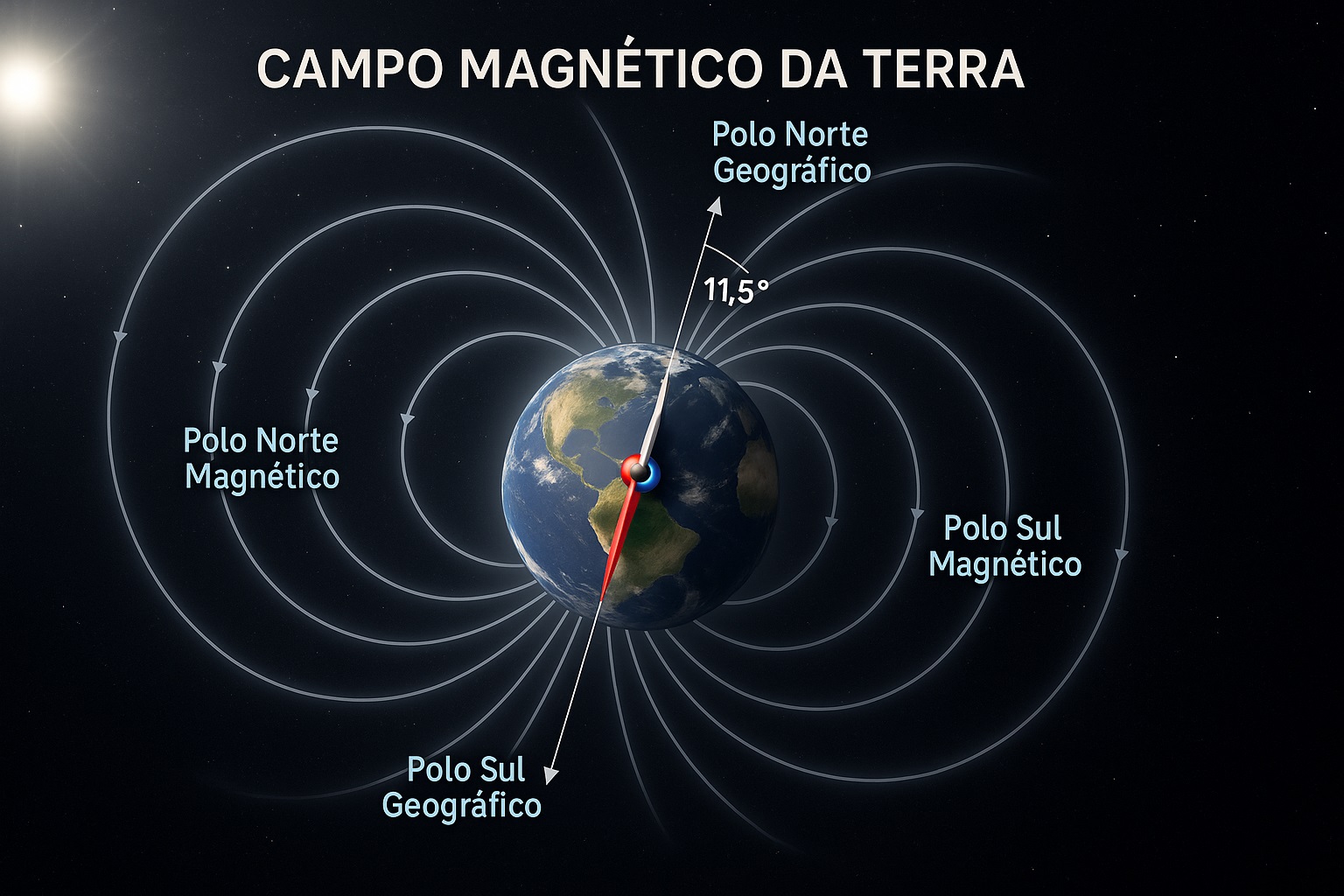
Putting the new TRACERS satellites in a synchronized orbit that repeatedly crosses the cusp of the northern hemisphere greatly increases the chances of capturing events that were previously rare occurrences.
The Key Physics: Magnetic Reconnection (When Lines Break and Explode)
The main scientific target of TRACERS is magnetic reconnection, a process in which magnetic field lines oriented in opposite directions approach, break, and reconnect in new configurations, releasing enormous amounts of energy.
This energy can accelerate charged particles, fuel spectacular auroras, and, in extreme scenarios, drive flows that affect satellites and technological systems. The problem: reconnection is dynamic, rapid, and localized; a single spacecraft captures only a “snapshot” and misses the temporal evolution.
This is why the “tandem” design of TRACERS — two satellites following the same path with a minutes-long delay — is so strategic: it will allow comparison of how the region has changed in the short interval between passings.
Two Satellites, Two Minutes: How TRACERS Observes the Evolution of an Event
In practice, the “leader-follower” configuration of TRACERS works like this: the first spacecraft crosses the cusp and records electric and magnetic fields and particle flows. About two minutes later, the second passes through the same approximate volume of space, measuring again.
Differences between the two data sets help scientists distinguish whether the observed changes are temporal variations (something evolved) or spatial variations (the probes sampled different regions). This “dynamic tomography” approach to space weather is an important evolution from past single satellite missions.
What Exactly Will the Instruments Measure
Each of the two spacecraft carries sensors for electric and magnetic fields, energetic particle detectors, and plasma instruments designed to operate in regions of variable densities and rapid transitions.
The strategy is to record everything from subtle disturbances in the solar wind flow guided by the magnetosphere to clear signatures of reconnection — such as jets of accelerated plasma, abrupt changes in field orientation, and specific energy distributions of ions and electrons.
This data will be correlated with remote observations of the Sun, ground measurements of ionospheric currents, and numerical prediction models to create an integrated picture of the event.
From the Laboratory to Decision-Making: Better Forecasts for Solar Storms
Why does all this matter outside academia? Because predicting when and how much solar energy can cross Earth’s magnetic barrier is the first step in warning utility operators, airlines, space agencies, and satellite companies.
High-cadence data on reconnection and particle entry at the cusps help calibrate models that convert solar wind conditions (measured by more distant probes, such as DSCOVR) into regional impacts on the ionosphere and magnetosphere.
With better forecasts, it is possible to reschedule orbits, reduce loads on high-voltage transformers, or place satellites in safe mode before the storm peak, reducing damages.
Earth Protection: Impact on Networks, Satellites, GPS, and Astronauts
Extreme solar events have a history of causing damage: geomagnetically induced currents can overload transformers; ionospheric disturbances degrade GPS signals; energetic particles can damage electronic components in orbit; crewed missions outside atmospheric protection become vulnerable to high doses of radiation.
NASA emphasizes that understanding the chain “Sun → solar wind → reconnection → magnetosphere → ionosphere” is essential to protect both ground infrastructure and space assets. The TRACERS mission was specifically designed to fill gaps in this chain.
Working in Formation with NASA’s Heliophysics Fleet
TRACERS will not be alone. It joins a constellation of heliophysics missions that look at space weather from complementary angles — among them, the Magnetospheric Multiscale (MMS), which studies reconnection microphysics on smaller scales, and the PUNCH mission, focused on how solar wind emerges and structures as it leaves the solar corona.
By combining data from these platforms, scientists will be able to trace the journey of solar energy from the Sun to the region near Earth, piecing together what historically came from disconnected experiments.
From TRICE-2 to TRACERS: Evolving the Method
Part of the motivation for the mission design came from previous experiments, such as TRICE-2, a campaign with sounding rockets launched over the Norwegian Sea in 2018 to sample reconnection at the polar cusp.
Although successful, TRICE-2 provided only snapshot windows of data. TRACERS expands on this idea, offering repeated and systematic sampling, orbiting Earth for a primary mission period of twelve months (with potential extension) and producing a robust statistical set of events, an essential condition for improving prediction models.
Where and How TRACERS Will Fly
The satellites will be placed in a near-polar, sun-synchronous orbit, ensuring they regularly pass through the diurnal cusp of the northern hemisphere — the funnel through which solar particles have the most direct path to the atmosphere.
The planned altitude is in the range of hundreds of kilometers (low Earth orbit satellite class), sufficient for high-resolution measurements without losing repetitive coverage. The orbit geometry has been optimized to capture thousands of passes throughout the mission, increasing the likelihood of crossing multiple solar activity regimes — from quiet periods to storm events.
Scientific Leadership and University Partnership
The TRACERS mission is led by researcher David Miles from the University of Iowa, an institution with a long tradition in space physics dating back to James Van Allen’s time.
The program management is handled by the Heliophysics Explorers Program Office at the Goddard Space Flight Center, with support from partners such as the Southwest Research Institute.
This academic-industrial ecosystem is typical of the Explorers line: missions with contained costs, well-defined scientific focus, and great potential return in critical data for space weather models.
How Soon Will We See Results?
After the launch and initial orbital commissioning phase, the instruments will be calibrated, and the first passes over the cusp will begin producing data almost immediately.
As the mission will repeat sampling under different solar wind conditions, the first statistical insights may emerge within months, while deeper analyses — relating reconnection patterns to impacts detected on the ground or in other missions — are expected to evolve over the 12 months of the primary phase and potential mission extensions.
What’s at Stake: Protecting Earth in an Active Solar Cycle
We are advancing through the peak of Solar Cycle 25, a period in which explosions, coronal mass ejections, and intensified solar wind flows become more frequent.
Launching TRACERS during this window increases the likelihood of capturing events and accelerating scientific learning — learning that, transformed into operational models, can translate into more precise alerts for energy providers, navigation services, communications, and space agencies.
In summary: two small satellites can have a disproportionate impact on protecting Earth from solar storms.