






 Portuguese
  Spanish
  6 min of reading
  0 comments


From Galileo to Einstein: Science Explains the Constant C and Why Nothing Can Be Faster in the Universe.
The human experience is intrinsically linked to a fundamental paradox of the cosmos: we are always trapped in the past. The video we watch, the light that travels through space to our eyes, or even the image of a distant nebula, all took time to travel. This need for time is due to the speed of light, a physical barrier that determines that we can never see things as they actually happen, turning the universe into a movie where we are just delayed observers. It is this fact, as detailed by the analysis of Science Every Day, that makes light crucial for astronomy, giving rise to the unit Light-Year, a measure of distance, not time.
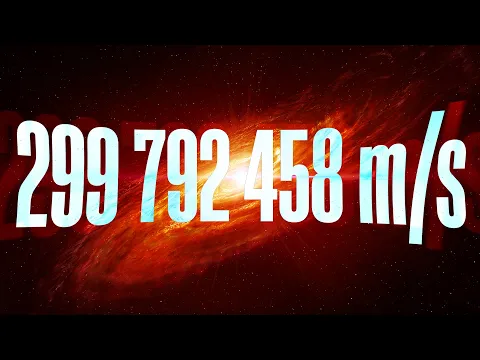
The exact speed of 299,792,458 meters per second (or approximately 300,000 km/s) is what allows a beam of light to circle the Earth almost eight times in just one second. However, on cosmic scales, this speed is “extremely slow”, a concept widely explored by Science Every Day. If we observe the Trifid Nebula, for example, the image we capture is from 5,200 years in the past. This limit is not just a curiosity: it defines the very structure of space-time and raises the central question of modern physics: why does the universe have a maximum speed and why is it exactly the speed of light?
First Steps: The Discovery of a Finite Limit
The quest to determine the speed of light began centuries ago. One of the pioneers of this investigation was Galileo Galilei. With a simple experiment involving two volunteers on distant hills, using lanterns to time the arrival of light, Galileo concluded that the speed of light was, in practice, infinite or, at the very least, so fast that no human experiment of the time could measure it. His result, although incorrect, demonstrated the difficulty in testing something that is fundamentally too fast for earthly scale.
-
In the Atacama Desert, a Tropical Oasis with Pool and Palm Trees Hosts Astronomers Studying the Universe

-
São Paulo Unveils 500 Electric Buses with $1.3 Billion Investment, Aiming to Cut 20 Million Liters of Diesel Annually and Showcase Clean Mobility

-
Robot Works 900 Hours to Build World’s Tallest 3D-Printed Concrete Tower, 30 Meters High, in Swiss Village of 12 Residents
-
Brazilian Nuclear Science Uses Advanced Techniques to Combat Microplastics in Waterways and Food, Paving the Way for Innovative Environmental Solutions





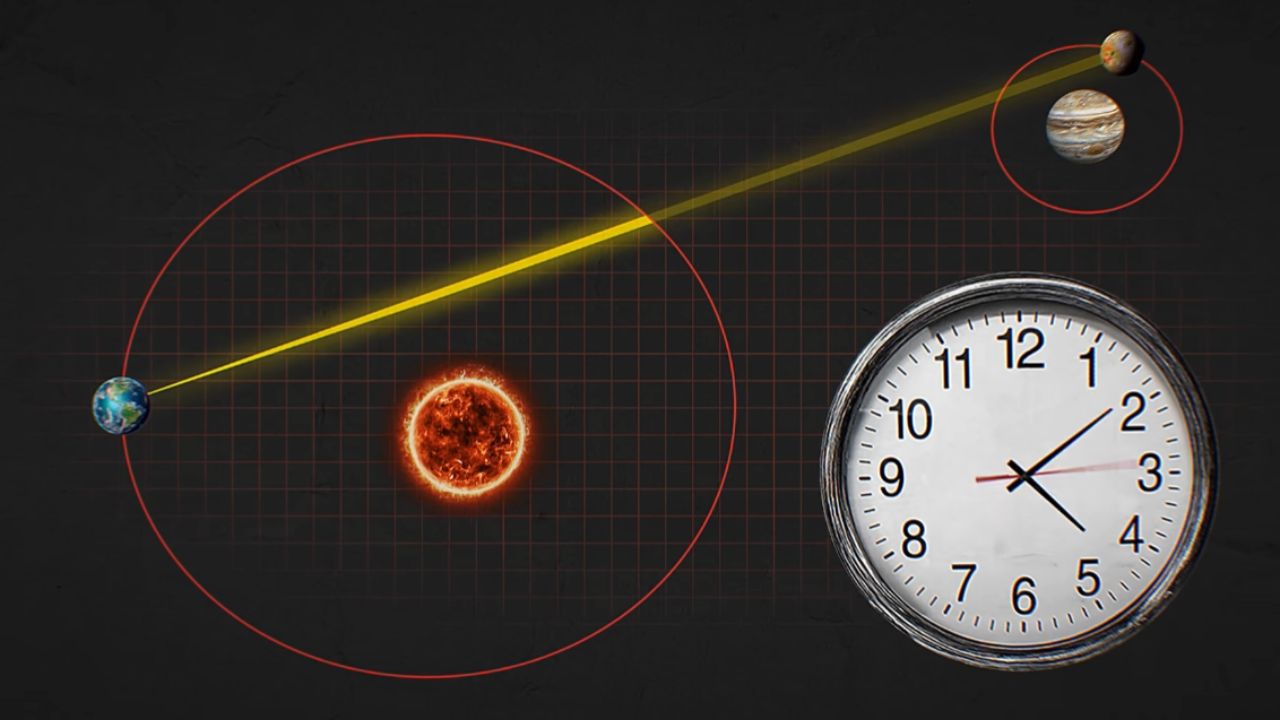
This conclusion of infinite speed was challenged by the Danish astronomer Olaf Rømer. Observing the moons of Jupiter, Rømer noticed that the time the moon Io remained hidden behind the planet depended on the Earth’s motion relative to Jupiter. When the Earth moved away, the eclipse lasted 22 minutes longer. Rømer realized that this difference could only be explained by the fact that light took additional time to travel the extra distance. Although his calculation of 210,000 kilometers per second was lower than the correct value, Rømer was the first to prove that light had a finite and relevant speed. Later on, nearly 100 years later, the English astronomer James Bradley managed to obtain a much more accurate value, close to 300,000 kilometers per second.
Maxwell and the Nature of the Electromagnetic Limit
For centuries, the behavior of light was studied through optics, but its true nature remained a mystery. In the early 19th century, the popular theory of “luminous ether” suggested that the universe was filled with an invisible and superlight matter, whose vibrations were perceived as light, analogous to ripples in a lake. However, no experiment was able to prove the existence of this ether or the exact nature of light.
The true revelation came in an unexpected way: at the tip of the pen of physicist James Clerk Maxwell. By combining the four equations that describe electric and magnetic fields, Maxwell derived a fifth equation. This equation predicted the existence of an electromagnetic wave that traveled at a constant speed, which he called C. The value of this constant was determined by two other fundamental values of electromagnetism: the electric permittivity and the magnetic permeability of vacuum. By calculating the value of C, Maxwell discovered that it was exactly equal to the speed of light that had been measured. Thus, he not only discovered the nature of light (a specific combination of electromagnetic fields), but also established that its speed is a direct result of the fundamental laws of electromagnetism that govern the universe.
Relativity and the Postulate of Absolute Speed
To understand why the constant C is the maximum limit, one must look to Einstein’s Theory of Relativity. The second postulate of relativity is key: it states that the speed of light in a vacuum is always the same for all observers, regardless of the speed of the light source or the observer.
This idea is notoriously counterintuitive. If you throw a ball from a car at 100 km/h, the speed of the ball is the sum of the two (120 km/h) for someone on the sidewalk. But, if you turn on a flashlight in a car going 100 km/h, the light will still travel at C for the stationary observer. For this absolute speed to always hold true, all the laws of Newtonian physics had to be altered, resulting in distortions in space and time. A direct and inescapable consequence of these new laws is that accelerating an object with mass to the speed of light would require infinite energy. Since infinite energy does not exist, the speed of light becomes, by the necessity of relativity, the speed limit of the universe.
The Constant C as a Fundamental Element of the Universe

The statement that “nothing can be faster than light” blends two facts. The first: the universe has a maximum speed, the constant C. The second: light moves at this maximum speed. The deeper question is not, therefore, why light is the limit, but rather what is the true origin of the constant C, a theme that still intrigues modern physics, as emphasized by Science Every Day.
The most notable clue lies in the famous equation E = mc². This formula describes the equivalence between mass (m) and energy (E), where c² acts as the exchange rate of conversion. The curious thing is that this is a conversion equation, not a speed equation; the constant C here is a fundamental element of the relationship between mass and energy, and not just the speed of light. This suggests that C is a more fundamental property of the universe than merely the speed of propagation of a wave. However, why the permittivity and permeability of vacuum have the values they do and consequently define C is an open mystery, dependent on constants that physics still cannot fully explain.
Quantum Vacuum and the Origin of the Constant C
Some researchers, in a process of unification between Relativity and Quantum Physics, have attempted to calculate the value of C from more fundamental principles. The most promising idea involves what is called quantum vacuum. Contrary to what one might think, the vacuum is not perfectly empty. It is filled with quantum fields that, even in the absence of matter, are always subject to small ripples.
These ripples are interpreted as ephemeral particles (or virtual particles), which suddenly appear and annihilate. The 2013 article mentioned by Science Every Day proposed a bold hypothesis: if we assume that light, in its essence, could have an infinite speed, but that it constantly collides with these ephemeral particles that appear in the vacuum, this interaction would slow it down. By calculating the effect of this quantum friction, researchers were able to deduce that the speed of light would be exactly equal to the constant C. This connects the speed of light with the intrinsic and fluctuating properties of the very fabric of space-time.
Thus, the constant C is the absolute limit of the cosmos because it is a requirement of Einstein’s relativity and, perhaps, because it is the result of the friction of light with the fluctuations of the quantum vacuum. As science advances to unify these theories, the universe continues to present mysteries that, in turn, generate new questions. The fluctuations of the vacuum connect with the constant C of E = mc² at a level that we do not yet fully understand.
Do you believe that the constant C has its origin in the quantum fluctuations of the vacuum or that Einstein’s relativity is the final and sufficient explanation? Which mystery of the universe do you find most fascinating and would like to see answered by science? Leave your opinion in the comments, we want to hear from those who live and are fascinated by the practice of science.


Be the first to react!