






 Portuguese
  Spanish


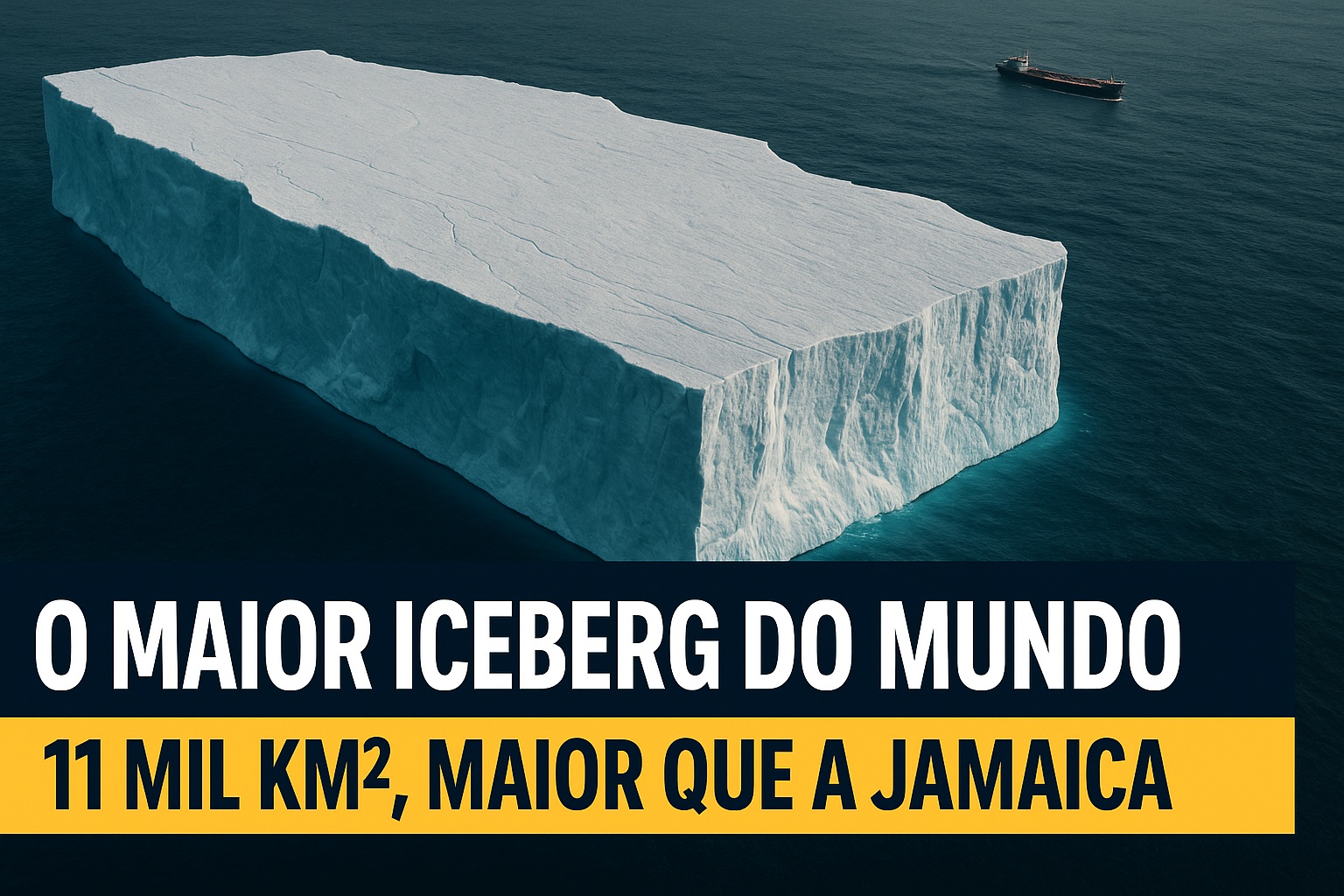


The B-15 Iceberg, With 11,000 km² — Larger Than Jamaica — Drifted for Almost 20 Years Across the Oceans. The Largest Iceberg Ever Recorded Became a Wake-Up Call About Climate Change.
In 2000, the world witnessed one of the most impressive events ever recorded by climate science: the breaking away of the B-15 iceberg from the Ross Ice Shelf in Antarctica. With an impressive 295 km long and 37 km wide, it reached an area of 11,000 km² — larger than the entire territory of Jamaica and almost the size of the state of Sergipe. It was undoubtedly the largest iceberg ever observed since satellite monitoring began.
The break occurred in March of that year and was detected by NASA images. For scientists, the event represented more than just a grand statistic: it opened a window to understanding the fragility of ice shelves in the face of global climate change.
The Impressive Size of the B-15 Iceberg
When compared to known structures, the B-15 becomes even more impressive:
-
Rare Case of Neurocysticercosis in Spain: 60-Year-Old Man’s Suspected Brain Cancer Turns Out to Be Tapeworm Cysts, Avoiding Invasive Cancer Treatments

-
Horse Trailer from 2000 Transformed into Mobile Home with Bed, Kitchen, Bathroom, and Workspace in Upcycling Project
-
Life in the Arctic: Surviving Months of Darkness, Frozen Seas, and Isolation Until the Thaw

-
Few realize Brazil’s longest internal border stretches 1,652 km




- 11,000 km² of area: larger than entire countries like Jamaica or Qatar.
- Average thickness of 200 to 250 meters: almost the height of the Altino Arantes Building in São Paulo.
- More than 3 billion tons of ice: weight equivalent to 8 million Airbus A380 airplanes.

These proportions transformed the B-15 into a living laboratory for science, as such a colossal block had rarely been studied in motion for so long.
The Two-Decade Journey Across the Oceans
Unlike smaller icebergs that melt within a few months, the B-15 survived for almost 20 years drifting through the Southern Hemisphere. Soon after its break, it fragmented into smaller blocks — the largest of them, called B-15A, still measured hundreds of square kilometers.
During the 2000s, the iceberg’s fragments were observed as they approached critical regions, such as South Georgia, where they temporarily disrupted navigation routes and even the feeding cycles of king penguins and seals, which had to adapt their hunting paths.
In 2018, NASA was still monitoring the B-15Z block, measuring about 150 km², confirming that pieces of that giant still existed nearly two decades after its formation.
Scientific and Environmental Impacts of the Largest Iceberg in the World
The B-15 did not significantly raise sea levels, as it was already part of a floating ice shelf. But this does not mean that its story has been harmless. On the contrary, it became a symbol of climate instability:
- Studies on Ocean Currents: the movement of giant blocks like the B-15 affects marine circulation, impacting ecosystems far from Antarctica.
- Changes in Wildlife: penguin colonies were forced to travel up to 70 km extra to find food when the iceberg blocked natural routes.
- International Attention: the break drew scientists’ and politicians’ attention to the risks of global warming in the polar region.
The iceberg served as a visual alarm: if events of this magnitude began to occur more frequently, the impacts would be devastating for the global climate stability.
The Importance of Satellite Monitoring
The case of the B-15 also demonstrated the crucial role of space observation technologies. Satellites from NASA and ESA tracked every fragment of the iceberg for years, allowing climatologists to compare the gradual melting with global warming models.
Without these records, the epic trajectory of nearly two decades would likely have been forgotten in the middle of the ocean. However, with them, the B-15 entered history as one of the most documented examples of the planet’s natural power.
Timeline of the B-15 Iceberg
- March 2000 – Formation of the iceberg, with 11,000 km², largest ever recorded.
- 2000–2002 – Initial fragmentation into smaller blocks, such as B-15A.
- 2005 – Fragments reach areas near penguin colonies, altering breeding cycles.
- 2010 – Large pieces of the iceberg are still visible in the South Atlantic.
- 2018 – NASA records the B-15Z fragment, with 150 km², still drifting alone.
- Post-2018 – Last remnants of the iceberg disappear into the sea, ending the nearly two-decade journey.
The Legacy of a Giant That Became a Wake-Up Call
The B-15 no longer exists, but its story remains a milestone in climate science. It showed that nature can create colossal structures capable of enduring for years and modifying entire ecosystems.
At the same time, it left a clear message: the stability of Antarctic ice depends directly on how humanity deals with global warming.
More than just a curiosity, the B-15 iceberg became a symbol of warning. Its colossal size, resilience, and 20-year journey through the seas remind us that the planet is alive, dynamic, and vulnerable, and that science must remain vigilant to understand and prepare for the next colossi that Antarctica may unleash.


