Portuguese
  Spanish




With 26 Meters Deep and 58 Million Liters of Capacity, the Piscinão at Praça Niterói Is the Largest Underground Reservoir in Rio and a Symbol of Flood Combat.
Inaugurated in 2015, the underground reservoir at Praça Niterói, in the North Zone of Rio de Janeiro, is one of the largest urban drainage works ever built in the country. The monumental structure, designed to hold up to 58 million liters of water — the equivalent of 23 Olympic-sized swimming pools — was conceived after decades of devastating floods that hit neighborhoods like Tijuca, Maracanã, Vila Isabel, and Andaraí. The so-called “piscinão at Praça Niterói” is part of a set of interventions that transformed the city’s macro-drainage and became a landmark of Brazilian urban engineering.
How the Piscinão Works and Why It Is Essential
The construction of the reservoir began in 2013 and was completed two years later, as part of a program by the City Hall of Rio to combat flooding in the basins of the Joana and Maracanã rivers. The structure has three large chambers interconnected by tunnels and a high-power pumping system.
During storms, excess water that flows down the slopes and streets is diverted to the inside of the piscinão, where it remains stored until the river levels fall. Then, the pumping system releases the volume in a controlled manner, preventing overflow and flooding in critical areas.
-
Mother discovers she may have won £12 million in the lottery but faces an agonizing wait after the shopkeeper threw the ticket in the trash.

-
A couple bought a house in Sheffield and, when removing the carpet from the hallway, found a trapdoor leading to a secret 23 m² basement with a 2-meter ceiling height, a discovery that eliminated the need for an expensive extension and, according to them, added £70,000 to the property’s value.

-
A nurse bought for 20,000 a 1955 house abandoned by a hoarder in Texas, and months later, rain revealed a buried pool in the backyard valued at $160,000, which he restored himself for about $10,000, a fraction of the cost of building a new one.
-
The United Kingdom is transforming dog feces left on trails into gas to light a streetlamp through an unlikely and surprising project that shows how even one of the most rejected wastes in cities can generate energy.




Each chamber is about 26 meters deep, equivalent to an eight-story underground building, and was excavated in a densely urbanized area, which required advanced containment and waterproofing technology.
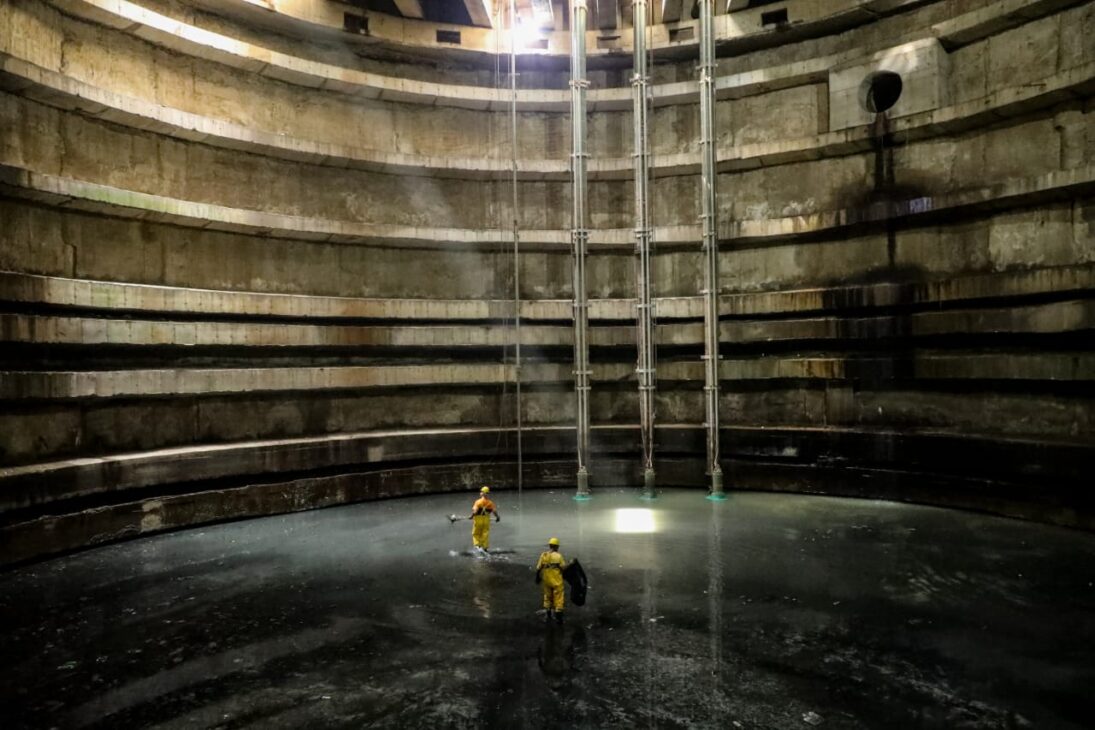
Engineers from the Rio-Águas Foundation and the Municipal Infrastructure Secretariat report that the work utilized techniques similar to those applied in subways, with the use of ring excavations and shotcrete.
The Transformation of a Region Marked by Floods
For decades, residents of the Praça Niterói region lived with scenes that repeated every summer: cars floating, destroyed businesses, and streets flooded within minutes.
The piscinão changed this scenario. Since it began operations, the frequency and intensity of floods have plummeted, especially on Radial Oeste and Paula Souza avenues, two of the historically most affected.
Merchant Sérgio Duarte, who has lived in the region for over 30 years, described the impact: “Before, the water rose to the store’s counter. Today, even with heavy rain, the level drops quickly. It’s the difference between chaos and normality.”
The project also had urbanistic effects: it increased property values, reduced annual losses from flooding, and began to integrate into the municipality’s meteorological monitoring system.
A Legacy of Brazilian Urban Engineering
The piscinão at Praça Niterói is part of the same hydraulic complex that includes the reservatory at Praça da Bandeira, inaugurated in 2013, with an additional capacity of 18 million liters.
Together, these systems represent one of the largest underground interventions in Rio de Janeiro’s recent history and were designed to withstand rainfall of an intensity equivalent to 50 years of recurrence.


The engineering employed in the project has become a reference in technical courses and civil engineering colleges. The complexity of the excavations, carried out beneath busy avenues, required 24 hours of continuous operation and real-time electronic monitoring to prevent soil subsidence.
Maintenance and Future Challenges
Despite its efficiency, the system requires constant maintenance. The cleaning of wells and ducts is done periodically by the Rio-Águas Foundation to prevent the accumulation of waste and sediments, which can compromise storage capacity.
Technicians warn that, although the piscinão drastically reduces the effects of rain, it does not eliminate the need for broader drainage policies, such as controlling soil impermeabilization and combating irregular settlements on the slopes.
Another challenge is operational cost. The pumping system consumes large volumes of energy, especially during prolonged rainy periods. Nevertheless, technicians advocate for the investment as essential for urban safety and the prevention of environmental disasters.
An Example for the Country
Today, the piscinão at Praça Niterói is cited in conferences and infrastructure reports as a model of efficient public work, associating high engineering, social impact, and urban sustainability. It shows how the combination of planning, technology, and political will can transform entire regions.
In a city historically vulnerable to water, the giant underground concrete structure has become a symbol of resilience, a reservoir that holds, beneath the earth, the hope for a Rio less at the mercy of rain.