






 Portuguese
  Spanish


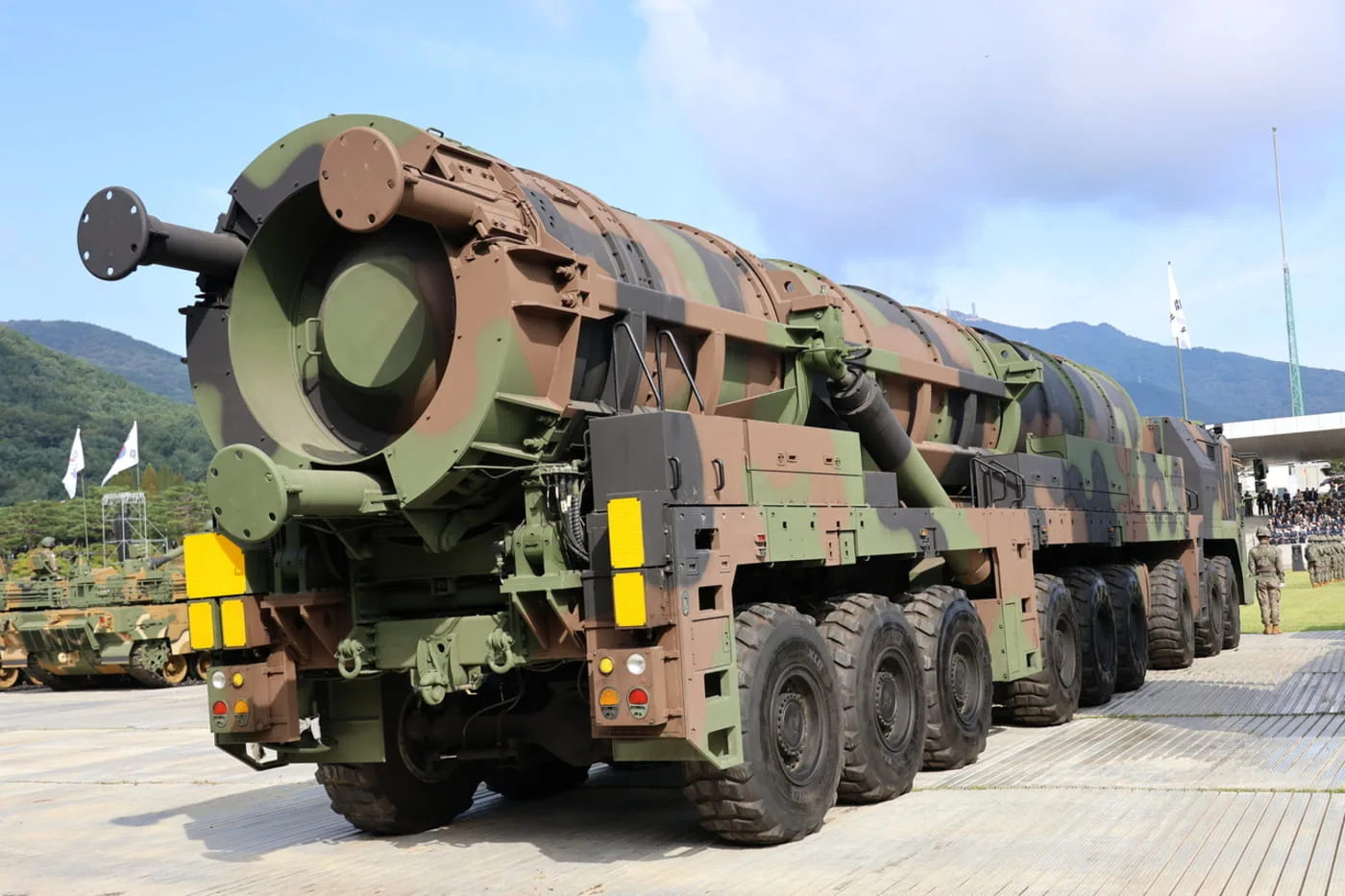


South Korea Incorporates the Hyunmoo-5 Missile, High-Speed Conventional Weapon with Penetration Designed to Destroy Bunkers and Fortified Underground Targets.
South Korea took a rare and highly symbolic step in the evolution of its conventional military capabilities by starting the operational incorporation of the Hyunmoo-5, a ballistic missile specifically designed to destroy fortified underground targets. In a regional scenario marked by tunnels, deep bunkers, and buried strategic installations, the new system emerges not as a nuclear weapon, but as a high-impact conventional response, based on mass, speed, and penetration.
What sets the Hyunmoo-5 apart from virtually any other conventional ballistic missile in operation today is the scale of the warhead. With an estimated weight between 8 and 9 tons, it is several times heavier than typical conventional warheads used by other countries, completely changing the concept of destruction through kinetic impact combined with explosion.
A Missile Designed for a Specific Type of War
The doctrine behind the Hyunmoo-5 is clear. North Korea has built, over decades, an extensive network of buried military facilities, including command centers, silos, leadership bunkers, and reinforced tunnels under mountains. Many of these targets were specifically designed to withstand conventional air strikes.
-
U.S. Military Intervention Risk in Brazil Raises Alarm, Highlights National Sovereignty Amid Tensions Over Washington’s Terrorist Designation of PCC and Comando Vermelho

-
Brazilian Air Force’s Sole KC-30 Aircraft Completes Strategic Mission to Spain for 105mm Anti-Tank Ammunition for Leopard 1A5 Tanks

-
Brazilian Air Force Seeks to Acquire More Gripen Fighter Jets
-
U.S. Air Force Launches Air-to-Air Missile Project with Range of Up to 1,850 km for Indo-Pacific Operations




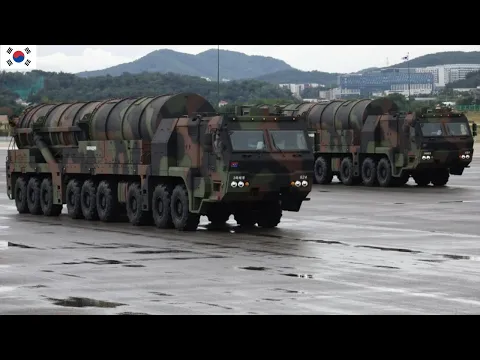

The Hyunmoo-5 was developed to handle this specific scenario. Instead of prioritizing intercontinental range, it focuses on:
- extremely heavy warhead
- high-speed ballistic trajectory
- deep penetration into the ground before detonation
This combination allows the impact energy to be transferred directly to buried structures, something aircraft-delivered bombs often cannot do with the same efficiency or rapid response.
Dimensions of the Hyunmoo-5 Ballistic Missile and Mass Stand Out
Although many details remain classified, widely publicized estimates indicate that the Hyunmoo-5 is between 16 and 20 meters long, has a diameter close to 1.6 meters, and a total launch weight that can exceed 35 tons.
This is a large missile even by ballistic standards, requiring robust launch vehicles and dedicated infrastructure.
This scale is not a technical exaggeration. It is a direct consequence of the choice to carry an extremely heavy conventional warhead, something uncommon in a world where most missiles prioritize range or multiple smaller warheads.
Range Calculated for the Regional Theater

With the maximum warhead installed, the estimated operational range of the Hyunmoo-5 is between 300 and 600 kilometers. This number is not random. It covers virtually all of North Korean territory from positions in the south, without the need for intermediate or intercontinental range systems.
Analysts point out that, with a lighter warhead, the missile could reach much greater distances, but that is not the function for which it was designed.
The Hyunmoo-5 is, above all, a regional deterrence instrument, optimized for real and immediate scenarios.
The Logic of the Ballistic “Bunker-Buster” Warhead
Traditionally, “bunker-buster” weapons are aerial bombs, like those dropped by strategic bombers. The Hyunmoo-5 adopts a different logic. By using a ballistic missile, it combines:
- extreme speed in the terminal phase
- large mass concentrated in a single point
- predictable trajectory, yet difficult to intercept
The result is an initial impact that already causes deep structural damage, followed by the detonation of the warhead underground. On buried targets, this effect can be more devastating than much more powerful surface explosions.
Why This Missile Changes the Regional Balance
The operational rollout of the Hyunmoo-5 does not merely mean another missile in South Korea’s arsenal. It sends a clear strategic message: deep underground facilities are no longer a safe sanctuary.
This alters the risk assessment of any opposing military planning. Even without resorting to nuclear weapons, South Korea now has a tool capable of:
- neutralizing buried command centers
- threatening leadership bunkers
- reducing the strategic advantage of underground fortification
All of this is within a logic of conventional deterrence, something politically less escalatory than the use of nuclear weapons.
Gradual Integration into Operational Forces
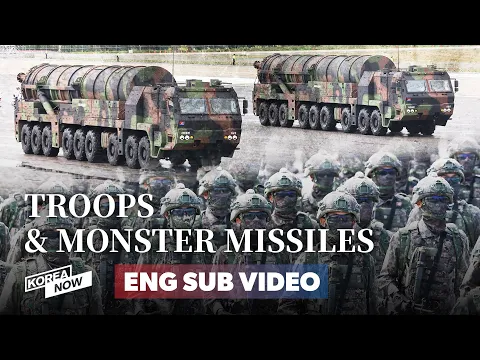
The incorporation of the Hyunmoo-5 is being made progressively, with specific units receiving the system and conducting operational training. The missile has already been publicly displayed at recent military events, signaling that it has left the purely experimental phase.
The expectation is that, by the end of the decade, the Hyunmoo-5 will be fully integrated into the South Korean deterrence structure, operating alongside:
- cruise missiles
- air attack systems
- real-time intelligence and surveillance capabilities
A Message That Goes Beyond the Peninsula
Although the immediate focus is North Korea, the Hyunmoo-5 also attracts global attention for another reason: it shows that extremely heavy conventional weapons still have a place in a world dominated by precision, miniaturization, and drones.
Few countries have invested in anything similar. This makes the Hyunmoo-5 an almost unique case, a missile that relies not only on sophisticated technology but also on carefully applied brute force.
Deterrence Without Nuclearization
Perhaps the most important aspect of the Hyunmoo-5 is political. It allows South Korea to strengthen its strategic deterrence without developing its own nuclear weapons, something sensitive from a diplomatic standpoint.
By providing a conventional alternative capable of reaching targets that would previously only be threatened by nuclear weapons, the missile creates a new layer of balance, reducing the pressure for more dangerous escalations.
A New Level of Conventional Power
The Hyunmoo-5 is not just “another missile.” It represents a change in philosophy: the idea that massive conventional warheads, launched ballistically, can fulfill missions strategically reserved for the nuclear domain.
In a world where underground warfare has become a central part of military strategy, South Korea opted for a direct, heavy, and hard-to-ignore response. And with this, it has significantly raised the level of its regional deterrence.








A Coreia do Sul tinha que ter uma arma como essa ja que a Coreia do Norte tem a bomba atomico. Mas o importante nao e ter uma arma eficiente,e sim,saber uzala.
Só não comentou como esse monstro chegaria no destino sem ser notado e interceptado….
Corea del norte, si es que las tiene, mostrara sus defensas.