Portuguese
  Spanish


Get To Know The Installation Vessels With 120-Meter Cranes, Capable Of Lifting 800 Ton Offshore Turbines.
Offshore wind energy is advancing globally. Larger and more powerful turbines are emerging. Installation vessels specialized are essential for this new era. These vessels face the challenge of installing gigantic components offshore.
What Defines Monumental Scale In Offshore Wind Energy?
The quest for clean energy drives offshore wind. The “Monumental Scale Wind Energy“ emerges. Turbines exceed 10 MW, reaching 15 MW and 18 MW. Even larger prototypes are under development. Components such as nacelles, blades, and towers are significantly larger and heavier. This demands a new generation of installation vessels (WTIVs). Their cranes have impressive lifting capacities and reach. The goal is greater efficiency and reduction of Levelized Cost of Energy (LCOE). The “monumental scale” reflects the current technological and economic limit, constantly expanding.
Installation Vessel: The Giant Behind The Turbines
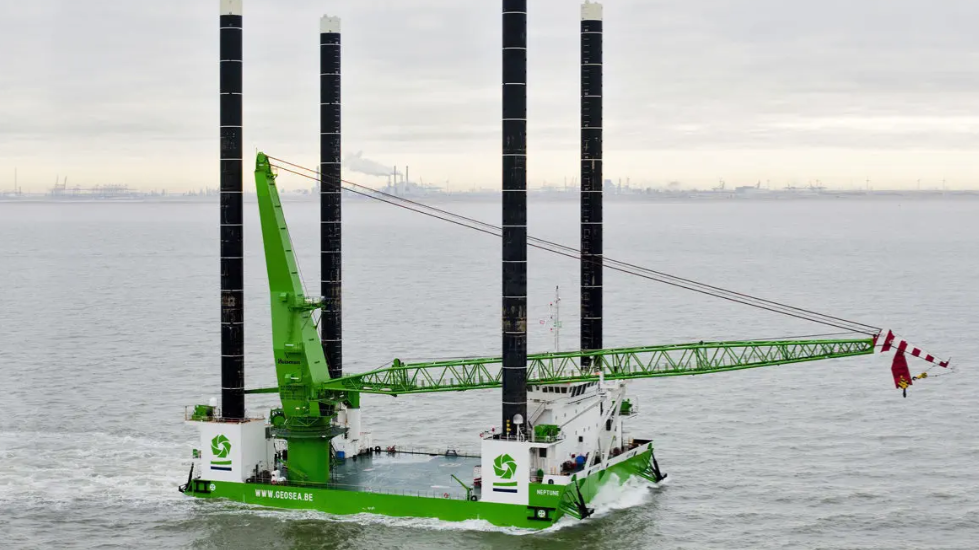
The installation vessel is crucial in this endeavor. These are vessels designed to operate in challenging seas. They transport and lift components weighing hundreds of tons. Stability is essential for precise lifting operations. Jack-up vessels, for example, elevate above the water. This creates a stable platform, immune to waves and currents. These vessels are the backbone for installing turbines with fixed foundations.
-
The U.S. Navy Conducts Submarine Tests in Idaho Lake to Detect Underwater Noises Hidden by the Ocean

-
Nuclear Submarine USS Alexandria Retired After 35 Years, Having Completed Over 1 Million Miles in Missions

-
MODEC Introduces New Hull Design for FPSO Gato do Mato to Produce Up to 120,000 Barrels of Oil Per Day in Brazil’s Pre-Salt Region
-
This Massive 12-Meter, 21-Ton Underwater Drone Can Operate Autonomously for Up to Five Days


120-Meter Cranes: Decisive Height And Reach
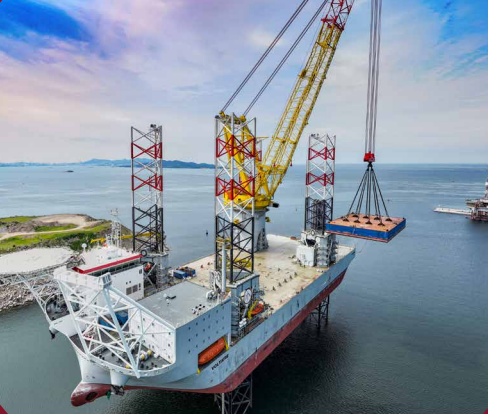
A 120-meter crane is a striking feature on an installation vessel. This measurement can refer to lifting height or boom length. Both are vital. The lifting height determines the capacity to install taller towers. The boom length, along with the operational radius, defines the reach to maneuver heavy loads. Vessels like the Voltaire by Jan De Nul have a lifting height of 162.5 meters above the deck and a boom of 140 meters. The Boreas by Van Oord has a boom height of 155 meters. These examples demonstrate that the 120-meter specification is met and often exceeded.
The Feat Of Lifting 800 Tons Offshore
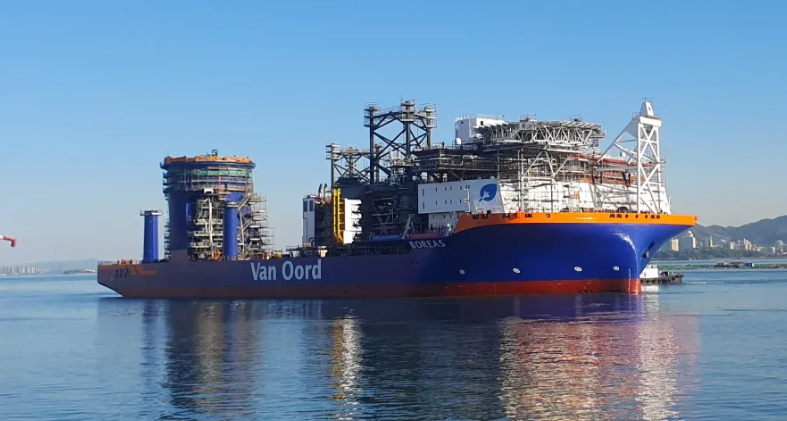
An 800-ton load is monumental for a single turbine component. It may correspond to a large nacelle. It can also be a pre-assembled set of nacelle and rotor (RNA). The nacelles of current 14-15 MW turbines, such as the SG 14-222 DD, weigh about 500 tons. The nacelle of the GE Haliade-X 12 MW reaches 685 tons (727 tons with lifting structure). Therefore, an 800-ton load sits at the forefront, possibly referring to an RNA for turbines of 10-12 MW or the nacelle of future turbines above 18-20 MW. Modern installation vessels, such as the Voltaire (3,200t crane) or the Boreas (>3,000t crane), are technically capable of lifting 800 tons, with considerable safety margin.
The Reality Of Monumental Installation
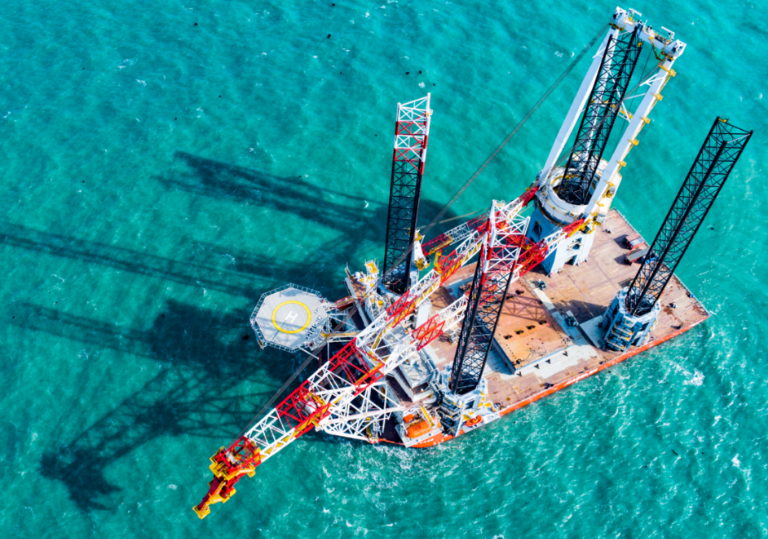
The combination of a 120-meter reach crane and the capacity for 800 tons is technically feasible. Many next-generation installation vessels, like those from the P class of Cadeler (hook height of 180m, capacity >2,600t), meet or exceed these requirements. Practical examples, such as the installation of nacelles weighing approximately 727 tons (GE Haliade-X), are already occurring. The WTIV industry designs and builds vessels anticipating components in the range of 800 tons and beyond. The installation vessel is, therefore, a key piece to realize wind energy on a monumental scale.