






 Portuguese
  Spanish


Giant of the seas and symbol of the new green race, the Höegh Aurora impresses with its size and technology: capable of carrying thousands of cars at once, the ship aims to make history by sailing without fossil fuels in the coming years.
According to Höegh Autoliners, the Höegh Aurora — delivered by China Merchants Heavy Industry shipyard in Jiangsu, China, in July 2024, and put into commercial operation in August of the same year — is the world’s largest Pure Car and Truck Carrier by capacity: 9,100 CEU, a unit of measurement equivalent to a standard mid-size car. The previous record holder was also from Höegh Autoliners, of the Horizon class, with a capacity for 8,500 vehicles.
The difference of 600 cars seems small in percentage, but what makes the Aurora exceptional is not just its size — it’s the combination of size with new-generation propulsion and a decarbonization trajectory that Höegh describes as the most aggressive ever implemented in the vehicle shipping segment. The Aurora operates with MAN Energy Solutions multifuel engines capable of running on LNG, biofuels, and low-sulfur oil. It has 1,500 square meters of solar panels on the upper deck, reducing electricity production from generators by 30 to 35%. It emits 58% less carbon per car transported than the average conventional carrier industry.
From 2027, the last four of the twelve Aurora class vessels will be delivered directly from the shipyard with engines capable of running on green ammonia — a zero-carbon fuel that will eliminate almost 100% of emissions. “The Aurora Class is the crown jewel of our green fleet renewal program,” said Sebjørn Dahl, COO of Höegh Autoliners. “These vessels meet the demands of our increasingly carbon-conscious customers.”
-
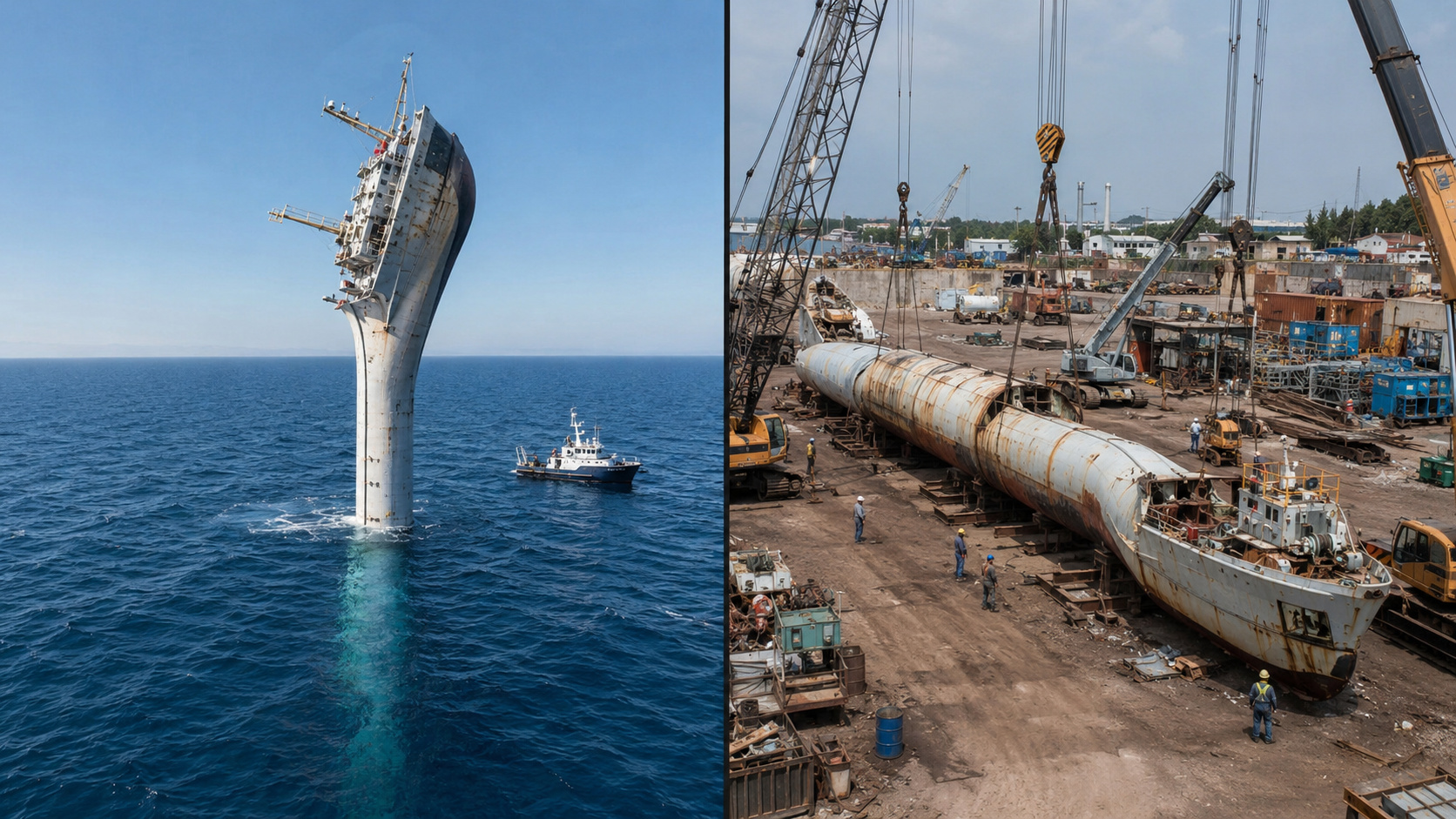
The FLIP: A 108-Meter Ocean Laboratory That Stood Vertically for 60 Years, Dismantled in 2023

-
North Korean Fiasco: Launch of the Largest Warship Ends in Sinking

-
While giant ships still burn heavy fuel and the maritime sector races against climate targets, Maersk and Vale are starting to bet on ethanol as a new route to reduce emissions at sea.

-
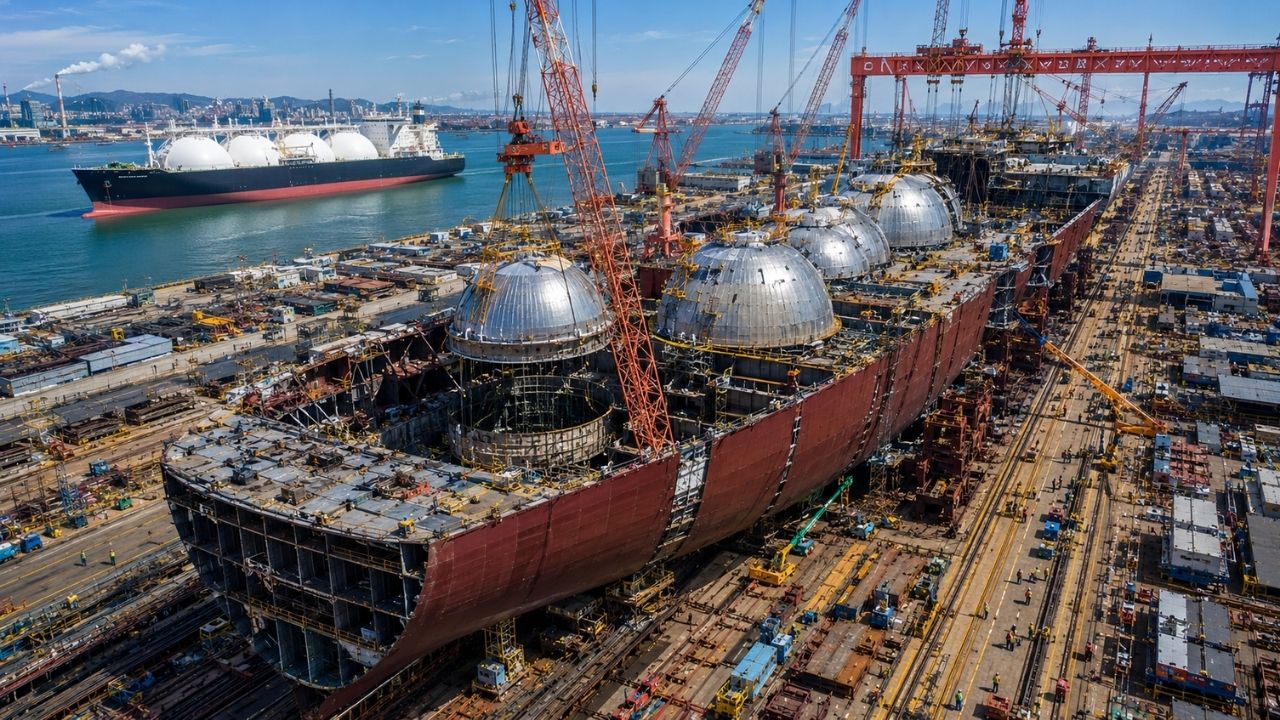
China begins construction of the world’s largest LNG ship, a 344-meter giant capable of supplying 4.7 million homes for a month, carrying 271,000 m³ of gas, and placing QatarEnergy in the largest naval order ever recorded in world history.


What is a Pure Car and Truck Carrier and why size matters
To understand what the Höegh Aurora represents, it is necessary to understand the segment in which it operates — one of the most invisible in global logistics, despite moving tens of millions of vehicles per year. A Pure Car and Truck Carrier — PCTC — is a specialized vessel for transporting vehicles. Unlike container ships, which stack metal boxes with cranes, PCTCs are essentially floating garages: vehicles drive in via ramps, are parked on the decks, and exit the same way at the destination port.
Most automakers worldwide use PCTCs to export vehicles from their factories to markets on other continents. Every Toyota produced in Japan that arrives at a dealership in Brazil, every Volkswagen manufactured in Germany that is sold in China, every Tesla built in the United States that is delivered in Europe likely passed inside a ship of this type.

The Höegh Aurora is 199.92 meters long and 37.62 meters wide — dimensions that place it on the same scale as an average container ship, but with a radically different internal organization. It has 14 internal decks, five of which are liftable — they can be raised or lowered to accommodate vehicles of different heights, from compact cars to large SUVs, trucks, tractors, mining equipment, and even heavy construction machinery. The maximum ramp capacity is 375 tons — sufficient for the largest cargo vehicles.
The detail that makes the Aurora particularly relevant for the future of the sector is the structural reinforcement of the decks to support electric vehicles on all 14 bridges. Electric vehicles are significantly heavier than their combustion equivalents due to batteries — a Tesla Model 3 weighs approximately 1,800 kg compared to about 1,400 kg for an equivalent Toyota Corolla. The increase in weight per vehicle completely changes the load calculation per deck, and older ships designed for combustion fleets needed to be recertified or had their capacity reduced when they started transporting EVs. The Aurora was designed from the outset for the electric era.
The solar panels nobody expected to see on a cargo ship
The upper deck of the Höegh Aurora is a flat surface almost 200 meters long by 37 meters wide — a total area exceeding 7,000 square meters which, on a conventional vessel, would only be ventilation and maintenance space. Höegh Autoliners decided to install 1,500 square meters of solar panels there.
A solar installation on a vehicle carrier is unusual for obvious practical reasons: solar panels are fragile, the marine environment is corrosive, and the ship’s inclination and movement reduce generation efficiency. Höegh overcame these challenges with hardened shipbuilding panels, fixed to structures that resist hull vibration and salt spray. The result is a 30 to 35% reduction in electricity production by conventional generators during daylight hours.


In absolute numbers: the Aurora consumes electrical energy for lighting, ventilation, navigation systems, safety equipment, and deck air conditioning throughout the entire voyage. A significant portion of this consumption now comes directly from the sun. On the sunniest routes — Asia-Europe via the Suez Canal, North America-Europe via the North Atlantic under favorable conditions — the fuel savings from the panels can be measured in tons of LNG not consumed per trip.
The shore power system complements solar generation: when the Aurora is docked in an equipped port, it can completely shut down its diesel generators and use electricity from the land grid, eliminating port emissions that increasingly strict regulations in European and American ports are penalizing with rising fees. The combination of solar + shore power + LNG is what allows the Aurora to operate with 58% less carbon per vehicle transported than the industry average — without any experimental or unprecedented technology, just with the efficient integration of already available systems.
The ammonia problem — and why Höegh bet on it
The Höegh Aurora’s transition to green ammonia by 2027 is the most ambitious and riskiest part of the Aurora Class program — and understanding why Höegh chose ammonia instead of methanol, hydrogen, or other alternative fuels is to understand the logic that will shape the debate on maritime transport decarbonization in the next decade.
Ammonia — NH₃ — has two properties that make it attractive as a marine fuel. First: it contains no carbon. When burned, it produces nitrogen and water — not CO₂. Second: it has a much higher energy density by volume than pure hydrogen, meaning a ship can store more energy in the same tank space, making long-range routes viable without needing enormous tanks.
The problem is that ammonia also has problematic properties for use on crewed ships. It is highly toxic — concentrations of 300 parts per million in the air are dangerous for humans in short exposure, and 2,500 ppm are lethal in minutes. It is corrosive to certain materials, requiring modifications to fuel systems. And it burns with a low-temperature flame that requires auxiliary ignition, complicating engine design.

MAN Energy Solutions — manufacturer of the Aurora ships’ engines — developed two-stroke engines specifically designed for ammonia that solve ignition and combustion problems. Höegh Autoliners has already contracted green ammonia supply — produced from renewable energy without carbon emissions in the production process — with partners including Yara Clean Ammonia, Norwegian North Ammonia, and Sumitomo Corporation. DNV — the world’s leading maritime certifier — granted the Aurora vessels “ammonia ready” and “methanol ready” notations, certifying that the systems were designed for the transition.
The last four ships in the series of 12 will be delivered directly from the shipyard already equipped with ammonia engines — scheduled for 2027, with a slight delay compared to the original plan due to a delay in MAN engine supply. The first eight ships, including the Aurora and Borealis, were delivered with LNG engines but with all systems designed for future conversion — what Höegh calls “ammonia ready”: they don’t need to be replaced, they need to be converted.
The route a PCTC travels — and what changes when it doesn’t emit carbon
The Höegh Aurora, after being delivered in Jiangsu in July 2024, made its first commercial voyage carrying vehicles in Japan and South Korea and heading to Europe, passing through ports in Belgium, France, the United Kingdom, Sweden, and the Netherlands before arriving in Hamburg for a major event with Höegh clients. In February 2025, it made its first call in the Caribbean, docking in Kingston, Jamaica.
This trajectory illustrates what a large PCTC does in practice: long-range transoceanic routes, multiple ports per voyage, cargo combinations that mix consumer vehicles with high-value machinery. The Asia-Europe route is the busiest in the segment — Japanese, Korean, and Chinese automakers export to the European market in a flow that, on return, carries European vehicles to Asia. The Asia-North America route is also intense, with Toyota, Hyundai, and increasingly BYD sending vehicles to the United States and Canada.

What changes when the ship traversing these routes emits 58% less carbon than the average — and eventually zero carbon with ammonia — is the carbon footprint incorporated into the vehicle’s price. Each Toyota sold in Europe has a share of carbon emissions that includes manufacturing at the factory and sea transport to the European port. When sea transport switches from conventional fuel to green ammonia, this share decreases. For automakers operating under increasing lifecycle emission regulations — such as those the European Union is progressively implementing — this reduction has direct economic value.
The chairman of Höegh Autoliners, Leif O. Høegh, articulated the significance of the Aurora class in a statement that went beyond marketing: “Together with our partners, we are removing carbon from one of the hardest-to-decarbonize sectors. Changing the perception of long-distance transport. Together, we are making sustainable shipping feasible, accelerating the green transition in our industry and setting a new standard for more sustainable solutions and services in shipping.”
The twelve ships that will change the sector
The Aurora is not a singular experiment. It is the first in a series of 12 identical ships — all built to the same specification, all registered under the Norwegian flag, all certified by DNV. Höegh receives two Auroras every six months since 2024, with the twelfth expected in the first half of 2027.
The scale of the order is what distinguishes the Aurora program from other alternative propulsion projects in the shipping industry. Many companies have prototypes or pilot ships with alternative fuels. Höegh has twelve ships, all identical, all being delivered over a three-year period. This creates an operational precedent at scale that the industry can study and replicate: issues with LNG supply logistics in different ports, maintenance patterns of solar panels in different weather conditions, actual engine efficiency with different types of cargo and speed.

CEO Andreas Enger was direct in describing Höegh’s position in the industry: “As the largest and most environmentally friendly PCTCs ever built, the Höegh Aurora embodies the change our industry needs.” The phrase is both a factual description and a declaration of competitive position. In an industry that moves tens of millions of vehicles per year and accounts for a significant portion of global transport sector emissions, being the first to operate zero carbon is not just environmentalism — it’s a competitive advantage in a market where customers are automakers increasingly pressured by lifecycle emission regulations in the markets where they sell their cars.
The world’s largest vehicle transporter is, at the same time, the most concrete bet the shipping industry has made so far that the future of long-distance sea transport does not need to be powered by fossil fuels.


