Portuguese
  Spanish


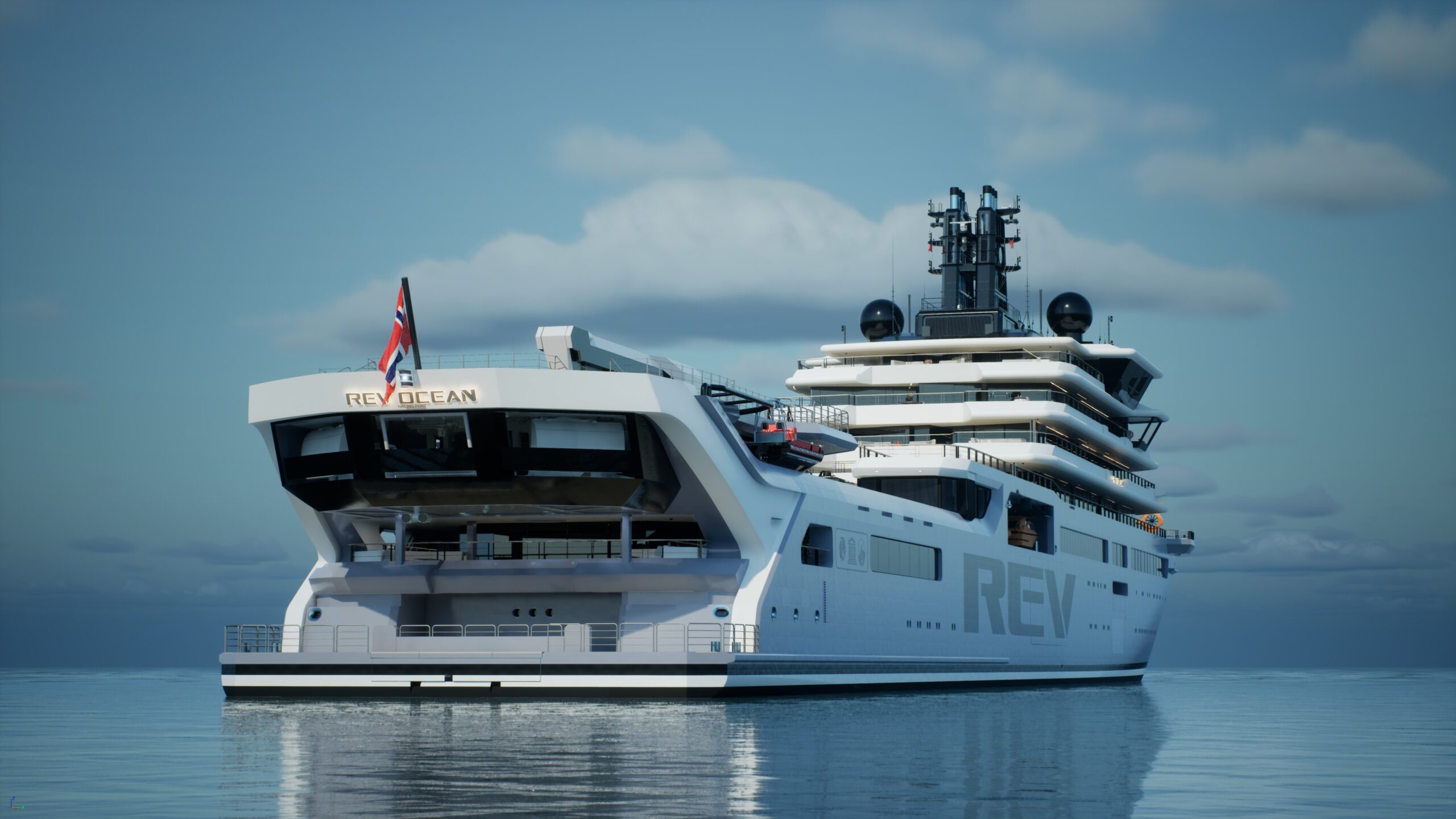

REV Ocean, world’s largest yacht at 194.9 meters, combines extreme luxury, nine laboratories, a manned submarine, and a scientific mission to study the oceans.
With 194.9 meters in length, 19,235 gross tons, and a structure designed to operate as a deep-sea oceanographic laboratory, the REV Ocean arrived at the Damen Shiprepair shipyard in Vlissingen, Netherlands, in March 2025, for the final stage of outfitting and finishing before its scheduled delivery in the fourth quarter of 2026. The vessel is already officially the world’s largest yacht, surpassing the Azzam, a 180-meter vessel belonging to the royal family of the United Arab Emirates.
Its size, however, is only the most visible part of the project. The vessel brings together nine scientific laboratories, a manned submarine capable of descending to over 7,000 feet, an autonomous underwater vehicle, an ROV rated for 19,600 feet deep, sonar for mapping the seabed up to 26,200 feet, and an artificial intelligence system for identifying marine species.
The REV Ocean belongs to Norwegian billionaire Kjell Inge Røkke, who grew up fishing cod, built an empire in the fishing and offshore energy sectors, and decided to finance one of the most ambitious oceanographic platforms ever designed. The result is a hybrid vessel: a high-seas research laboratory, a luxury superyacht, and a scientific tool created to investigate the oceans on an unprecedented scale.
-
Nuclear Submarine USS Alexandria Retired After 35 Years, Having Completed Over 1 Million Miles in Missions

-
MODEC Introduces New Hull Design for FPSO Gato do Mato to Produce Up to 120,000 Barrels of Oil Per Day in Brazil’s Pre-Salt Region
-
This Massive 12-Meter, 21-Ton Underwater Drone Can Operate Autonomously for Up to Five Days

-
Global Shipping Faces Shortage of Certified Maritime Officers, Salaries in the U.S. Can Exceed $100,000 Annually


Kjell Inge Røkke went from fishing in Alaska to building a maritime empire before funding the REV Ocean
Kjell Inge Røkke’s trajectory is one of the most improbable in Norwegian capitalism and helps explain why the REV Ocean exists. Røkke was born in 1958 in Molde, the son of a carpenter and an accountant. At 18, he embarked on a fishing vessel and went to work in Alaska, where he spent the next decade learning the American fishing industry inside out.
First, he worked as a crew member. Later, he became an operator and began buying second-hand vessels, reselling them for profit. By the 1990s, he already controlled American Seafoods, one of the largest fishing companies in the United States, with a fleet operating from Argentina to Russia.
American Seafoods was accused over the years of overfishing practices in multiple regions. Røkke never directly denied it but made a statement that became central to understanding the motivation behind the REV Ocean: “I haven’t invested in any infrastructure, I haven’t built roads. Basically, I am a harvester.” A harvester. Someone who extracts value from natural resources without leaving equivalent infrastructure behind.
Giving Pledge, REV Ocean foundation, and the attempt to transform fortune into ocean research
In 2017, at 59 years old, Røkke signed the Giving Pledge, an initiative created by Bill Gates, committing 50% of his estimated US$ 4.8 billion fortune to ocean education and research.
In the same year, he created the REV Ocean foundation, a non-profit organization, and commissioned the ship that would take almost a decade to complete.


“I want to be remembered not as someone who only took, but as someone who gave back,” he said when presenting the project. The phrase encapsulates the entrepreneur’s symbolic turning point: from someone who built a fortune by exploiting marine resources to someone who began funding one of the greatest tools ever created to study and protect the oceans.
The ship is, at the same time, an instrument of this attempt at restitution and a concrete symbol of one of the most dramatic conversions in recent corporate environmentalism. The man who made a fortune extracting from the ocean now funds the most expensive, complex, and ambitious vessel ever designed to investigate it.
REV Ocean was designed as two ships in one, combining ocean science and extreme luxury
Project director George Gill described the REV Ocean to Robb Report as “the Swiss Army knife of ships.” The comparison makes sense because the vessel was planned to combine functions that would normally be separated across different platforms: charter yacht, research vessel, expedition base, floating laboratory, and submarine exploration platform.
The internal design itself confirms this division. The REV Ocean is practically two ships in one, divided between science and luxury, with both worlds coexisting without compromising each other. The aft half concentrates the scientific heart. The forward half houses the charter, accommodation, and leisure areas.
This architecture is key to the project. The ship does not use science as a prop to justify luxury, nor luxury as an obstacle to research. It attempts to transform the high-end charter market into a funding source for scientific expeditions.
Nine laboratories, moonpool, and underwater vehicles make REV Ocean an unprecedented scientific platform
The aft half of REV Ocean houses nine scientific laboratories, occupying space equivalent to approximately 15 tennis courts, according to foundation data. Each laboratory has a specific function, including chemical analysis of water samples, marine biology, ocean floor geology, genomic analysis, and physical oceanography.

One of the most important elements is the moonpool, a 7.7 by 5-meter opening in the hull, which connects the interior of the ship directly to the sea. This system allows launching and retrieving underwater equipment without relying solely on external cranes and without drastically altering the vessel’s operation.
This structure gives REV Ocean a rare capability for long expeditions. Equipment can be deployed in the water under more controlled conditions, samples can be retrieved quickly, and underwater vehicles can operate in remote regions with greater operational safety.
Manned submarine, 19,600-foot ROV, and 26,200-foot sonar extend the reach of deep-sea research
Underwater vehicles are among the most extraordinary equipment on board. The Triton 7500 is a manned submarine capable of taking three passengers to depths of over 7,000 feet, enough to access more than 70% of the world’s ocean floor.
The ROV, a remotely operated vehicle, is rated for 19,600 feet of depth, capable of reaching deep points in almost all ocean trenches. The AUV, an autonomous underwater vehicle, can navigate without direct human operator, mapping areas and collecting data during prolonged missions.
Furthermore, the seafloor mapping sonar system operates continuously while the ship sails, creating high-resolution bathymetric charts of still little-known regions. Less than 25% of the global ocean floor has been mapped with resolution comparable to terrestrial maps, and REV Ocean was built to address precisely this scientific gap.
Machine shop, 3D printing, and autonomy reduce reliance on ports during remote expeditions
REV Ocean was also designed to operate far from ports for long periods. A complete machine shop allows for equipment repair, component adjustment, and maintenance during expeditions in remote regions.
The 3D printing facility extends this autonomy, allowing for the fabrication of spare parts and equipment adaptations on board. On a long-distance oceanic expedition, this detail can prevent an entire mission from being interrupted by a small mechanical failure.
This level of operational independence is crucial for research in areas such as the Arctic, South Pacific, ocean trenches, and hard-to-reach regions. Instead of returning to port for every adjustment, the ship can continue collecting data where other projects would have to stop.
Luxury area will feature suites, pools, spa, tennis court, library, and two helipads
The forward half of REV Ocean houses the world of luxury charter. The master suite, described by Robb Report as one of the largest on any charter yacht, includes two separate VIP bedrooms for Røkke’s children, a living area, dining room, open kitchen, and a private glass-bottom pool over the sea.

For charter guests, 15 en-suite cabins accommodate up to 30 people, all with sea views. The structure also includes a TV room, library, game room, and a five-story atrium with an elevator.
The ship will also feature a tennis court, three swimming pools, a spa, a gym, and two helipads – one for guest access and another operational for transferring scientific staff at sea. This configuration confirms that REV Ocean is not just a laboratory, but also one of the most extreme luxury projects ever delivered by the shipbuilding industry.
REV Ocean Foundation wants to bring billionaires and influencers into ocean science
The CEO of the REV Ocean Foundation, Nina Jensen, former Secretary-General of WWF Norway, explained that the proposal goes beyond funding. According to her, having a functional platform to invite the richest and most powerful 10% of the planet can help find solutions to the ocean’s problems.
The idea is that someone capable of paying US$4 million per week and actively participating in a scientific expedition, seeing samples, data, and instruments in real-time, will leave with a different understanding of the ocean crisis. It wouldn’t just be luxury tourism, but an attempt to transform financial influence into environmental engagement.
Director James Cameron and Tom Cruise’s Mission Impossible production team have already shown interest in the vessel. Netflix was also mentioned as a potential partner. The maiden voyage is scheduled for January 2027.
Seafloor mapping, biodiversity, and response to environmental crises are among the possible missions
The onboard sonar can produce high-resolution bathymetric maps of areas that have never been mapped in similar detail. This information is essential for understanding deep habitats, ocean circulation, geological risks, and still unknown ecosystems.
The artificial intelligence system for identifying marine species can accelerate the processing of biological data, helping scientists recognize patterns, classify organisms, and monitor biodiversity in real-time during expeditions.
The ship can also act in unexpected environmental events. In the event of an oil spill, marine mortality, localized acidification, or extreme algal bloom, its displacement and rapid collection capabilities can transform REV Ocean into a high-level scientific response platform.
The world’s largest yacht attempts to transform guilt, fortune, and engineering into ocean knowledge
Røkke described the ship’s mission with the precision of someone who spent decades sailing before understanding the scale of what he was sailing upon: “REV will be a platform for knowledge gathering. I want to welcome researchers, environmental groups, and other institutions on board, to acquire new skills and develop innovative solutions for the challenges and opportunities connected to the seas.”
REV Ocean departs for its first expedition in January 2027. After eight years of construction, delays, design changes, increased length, and stability adjustments, the vessel should finally leave the shipyard as the world’s largest yacht and, at the same time, one of the most advanced scientific ships ever designed.
The fisherman who became a billionaire and then an environmentalist built a vessel difficult to classify. It is a yacht, a laboratory, a symbol of compensation, and a scientific tool. The question remains whether the largest private ship ever built to study the oceans will be able to produce knowledge proportional to the size of the fortune that put it to sea.