





 Portuguese
  English
  Spanish
  7 min of reading
  0 comments


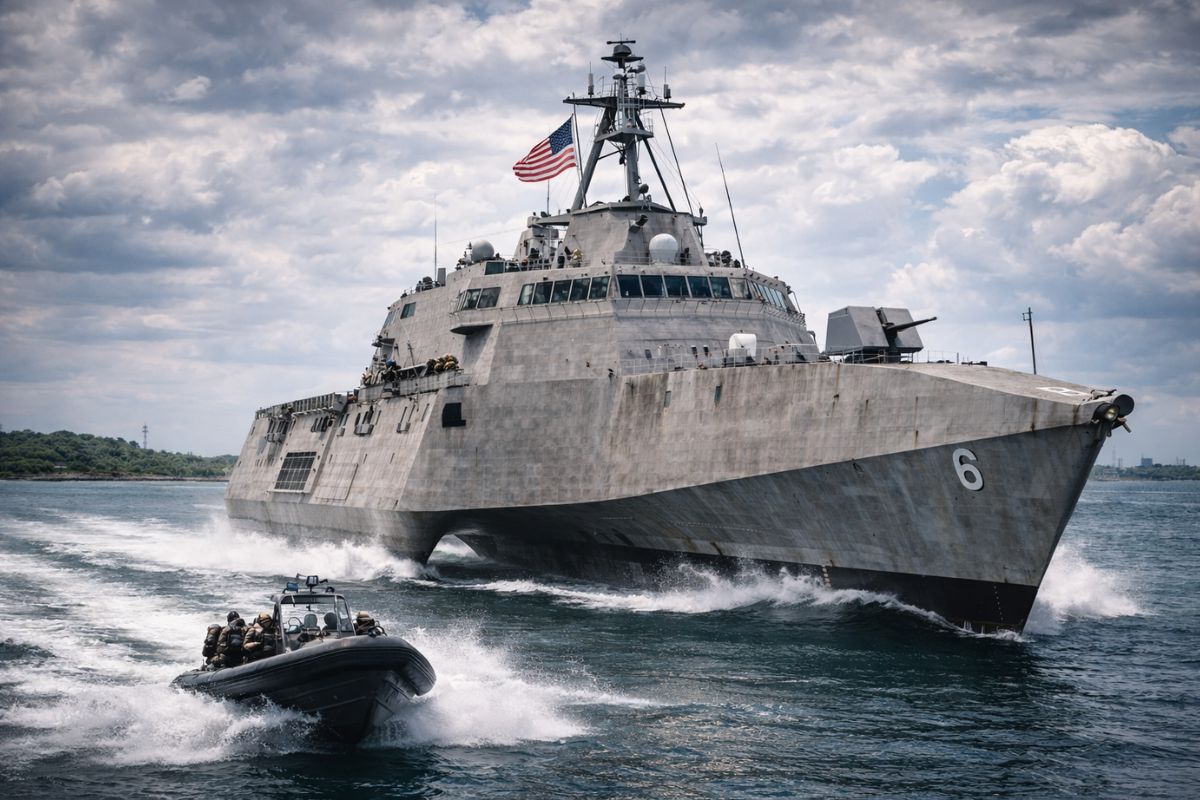
Reformulated After Galvanic Corrosion, Structural Fatigue, and Delayed Mission Modules, The U.S. Navy Trimaran Gave Up the Ambition to Change Roles in a Few Days, Gained Reinforcements, New Operational Logic, and More Useful Armament, Becoming a Relevant Asset in High-Risk Shallow Waters and Current Complex Missions
The U.S. Navy trimaran has regained attention amid American naval movements in the Middle East, especially when appearing alongside much larger ships with a different function. The Independence class, a variant of the LCS program, reappears in an environment where shallow waters, congested traffic, and rapid response weigh more than size and impressiveness.
What makes this case relevant is not only the unusual triple hull design but the trajectory. A project sold as a modular solution for multiple naval wars accumulated serious failures, consuming time, money, and credibility, and yet was repurposed with another operational role, more limited but more coherent with its real characteristics.
From Ambitious Promise to Controversial Program

To understand the controversy, one must return to the context that shaped the LCS. After the end of the Soviet Union, the United States Navy stopped prioritizing only classic confrontations on the open sea against an equivalent fleet and began to look more closely at coastal, narrow, and shallow water threats. In this scenario, the idea of a fast, agile, stealthy, and modular coastal combat ship emerged.
-
Train of up to 111 tons leaves China for Brazil, crosses almost 20,000 km in up to 70 days by ship, and arrives in São Paulo in such a tight operation that a truck even had to deflate its tires to pass under a viaduct.

-
A small town with 800 inhabitants in the interior of the United States is giving away free land, with water, electricity, and paved streets, and even offers a cash allowance for families with children, all to attract residents and escape the depopulation threatening rural villages.

-
At about 9 meters deep in the sea of Sicily, divers recovered a 2,500-year-old marble horse attributed to the colossal Temple of Zeus in Agrigento, a piece that, if confirmed, would be the largest archaeological discovery in the region in a century.
-
22-carat gold may be hidden in household items treated as scrap, while Swiss scientists use whey to recover the precious metal and pave the way for new sustainable urban mining.




The proposal was ambitious. The ship was supposed to operate in surface warfare, anti-submarine warfare, and mine countermeasures, swapping mission modules in a few days according to tactical needs. On paper, the U.S. Navy trimaran seemed like a shortcut to maximum flexibility, with speeds exceeding 40 knots, a shallow draft, and a wide flight deck for a ship of this size.
The Independence class was one of the responses offered to the program, with participation from companies like Austal and General Dynamics and the choice of an aluminum trimaran hull. The concept promised high performance in areas close to the coast and a platform capable of quickly adapting to different scenarios, something that seemed ideal for a navy looking to replace older frigates and minehunters.
But what was innovative in design and doctrine also became a source of vulnerability. The same package that delivered speed and a shallow draft concentrated material and operational risks, especially when the ship transitioned from technical presentation to the real cycle of use, maintenance, and system integration.
Corrosion, Cracks, and the Shock of Reality
The first major problem cited was galvanic corrosion. The aluminum hull, in contact with steel components in the water jet propulsion system, created an aggressive chemical environment in saltwater. In practice, the combination began to attack the very structure around the propulsion, generating a serious crisis of reliability and maintenance.
This point was decisive because it affected the core of the vessel, not a peripheral detail. When the U.S. Navy trimaran began to suffer from corrosion at this level, the image of a revolutionary platform was replaced by a perception of an expensive fragility, precisely in a program that already carried high expectations and billion-dollar costs.
At the same time, structural cracks emerged associated with aluminum fatigue, especially in rough sea conditions. The material offers weight and performance advantages but comes at a cost when subjected to continuous stress in demanding operations. The issue was not only repairing spot damages but also adjusting operational limits and reviewing reinforcements in critical areas.
The crisis became even greater because modularity, sold as the backbone of the project, also failed. Anti-submarine warfare and mine countermeasure modules were delayed by years due to software, integration, and cost issues. Without the modules functioning as promised, the U.S. Navy trimaran ran the risk of becoming a fast hull without a clear function, the worst scenario for a program born to be versatile.
How the Reformulation Saved the Ship Without Saving the Original Idea
The response came in stages and with a change of posture. To contain corrosion, engineering adopted impressed current cathodic protection, with sacrificial anodes and continuous application of electric current to neutralize the reaction that was degrading the assembly. It was a necessary technical correction to prevent the problem from continuing to undermine the viability of the class.
In parallel, structural reinforcements and design adjustments were made while still on the assembly line, focusing on the areas of highest stress on the hull. Operational restrictions were also adopted in extremely rough seas to reduce the risk of new cracks. The solution was not magical; it was a combination of engineering correction and acceptance of limits, something common in military programs that are born too ambitious.
The most important change, however, was doctrinal. The Pentagon abandoned the idea of quickly swapping modules in a few days and began to specialize each ship with a defined mission package at the shipyard. In practical terms, the logic of the naval Swiss Army knife was replaced by a platform with a more stable function.
This shift explains why the U.S. Navy trimaran did not disappear after the most critical phase. It did not return as the universal solution promised at the beginning but as a vessel adapted to tasks where its advantages still outweigh the limitations, especially speed, shallow draft, and operation in congested coastal areas.
The New Operational Role in Shallow Waters and Risk Missions
With the perception that the vessel was under-armed, the Navy integrated new attack means, including the NSM anti-ship missile, in addition to the existing armament. This step altered the employment profile of the Independence class, which began to be seen as more useful in surface warfare and specific mine countermeasure and patrol missions.
Today, the operational reading presented points to the U.S. Navy trimaran as a kind of light corvette, very fast and better armed for naval choke points, straits, and complex coastal areas. Its value appears less in major fleet duels and more in presence tasks, rapid response, and containment of asymmetric threats.
This point helps to understand the presence of this type of vessel in the Persian Gulf and around the Strait of Hormuz. The local geography favors platforms with shallow drafts and high mobility, while large cruisers and destroyers feel less comfortable in congested spaces. In shallow waters, the question is not just who has more firepower, but who can maneuver, persist, and react first.
The base also relates this employment to swarm tactics associated with Iran, with small fast boats armed to saturate the defenses of larger ships. In this context, the U.S. Navy trimaran was redesigned for a clearer tactical role, dealing with surface threats in a tight environment, supporting mine countermeasures, and freeing larger ships for missile defense and broader coverage tasks.
What This Case Reveals About Military Innovation and Project Limits
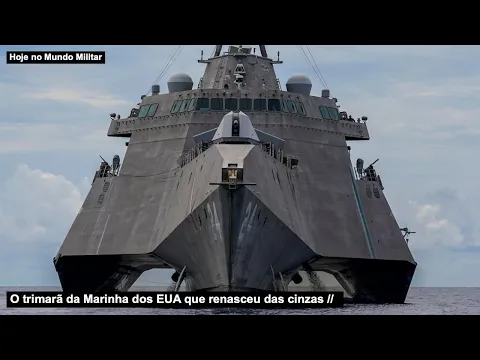

The history of the Independence class exposes a recurring pattern in complex military programs. Overly ambitious projects often promise speed, modularity, cost savings, and superiority at the same time, but the operational phase reveals that each technical gain comes with costs of integration, maintenance, and usage restrictions.
In the case of the U.S. Navy trimaran, the correction did not come from confirming the original proposal but from scaling it down. The ship became more useful when it stopped trying to do everything and focused on doing a smaller set of missions better. This does not erase the history of failures but helps explain why it is still employed in high-risk scenarios.
There is also a lesson about time and money. The base describes long delays, software and integration issues, and a real threat of early cancellation. In programs of this scale, the later operational reality contradicts the theory, the higher the cost to recover performance and trust.
Even so, the class did not just become a symbol of waste. The technical reformulation, mission specialization, and armament reinforcement gave the U.S. Navy trimaran a practical role in an operational range where larger ships are not necessarily the best tactical response.
The case of the Independence class shows how a naval project can nearly collapse due to corrosion, cracks, and poorly executed modularity, yet still return with real utility after technical corrections and doctrinal changes. The U.S. Navy trimaran did not reborn as the original promise, but as a specialized asset for shallow waters, mine countermeasures, and surface warfare in high-risk environments.
If you had to choose the main error of this program, would you bet on the ambition of modularity, the combination of materials, the initial limited armament, or the attempt to demand too much from a single platform? And in the current version, do you see the U.S. Navy trimaran as a smart recovery or just an adaptation to reduce losses?





-

2 people reacted to this.