Portuguese
  Spanish


From Oceans Where Least Expected to Imminent Cosmic Collisions, The American Space Agency Reveals Findings That Rewrite What We Know About Space.
NASA, the American space agency, remains at the forefront of space exploration, revealing secrets of the cosmos that challenge our imagination. Recently, a series of remarkable discoveries, from the composition of distant moons to the study of massive black holes, has altered our perception of the universe. These research efforts, conducted with cutting-edge technology, not only answer ancient questions but also open new fields of inquiry about life and the formation of everything we know.
Liquid Water Ocean on Mimas, Moon of Saturn
One of NASA’s most surprising revelations was the discovery of a liquid water ocean beneath the icy crust of Mimas, one of Saturn’s moons. Previously, Mimas was thought to be just a frozen celestial body. Simulations indicate that this “young” ocean, aged between 2 and 25 million years, is still evolving, offering a unique natural laboratory for the study of conditions that could harbor life.
NASA’s James Webb Telescope and the Oldest Galaxy
The powerful James Webb Space Telescope, one of NASA’s main tools, has identified the oldest galaxy ever observed, JADES-GS-z14-0. The light from this galaxy has traveled for over 13.4 billion years to reach us, allowing scientists to observe the universe in its early stages. This discovery is fundamental to understanding how the first stars and galaxies formed.
-
At 77 years old, a retired woman who never tires of learning completes her second degree in design in Ceará and moves people by revealing the help of her 98-year-old mother in the final project.

-
China’s masterstroke: a plant capable of regrowing even when buried by sand helps to recover more than 7,300 hectares of desert with 5 million seedlings, roots over 10 meters deep, and rainfall below 150 mm per year.
-
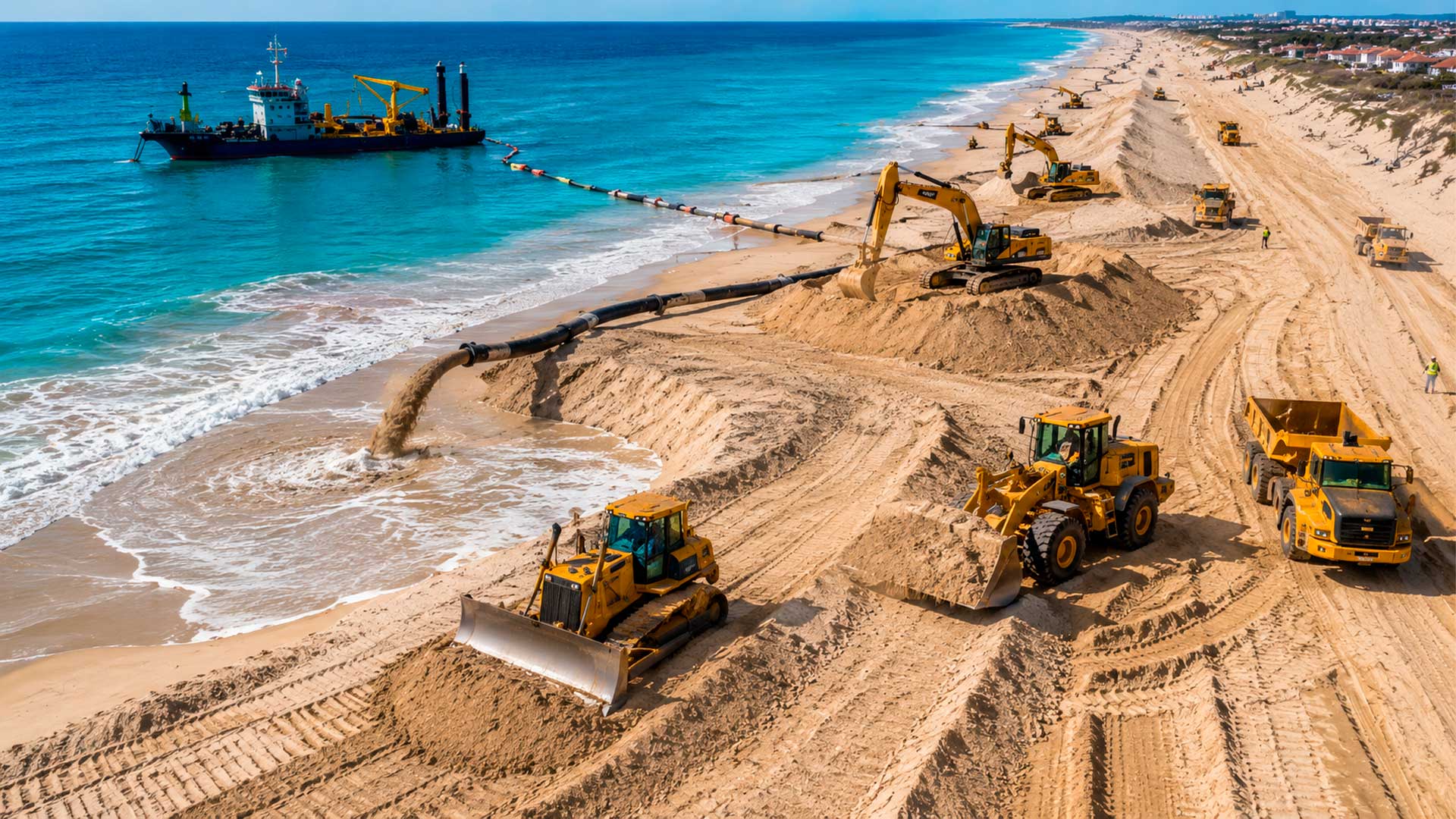
Portugal placed 1.4 million m³ of sand in the Algarve, spent 14.9 million euros to recover 6.7 km of beaches between Quarteira and Garrão, and is now trying to gain 37.5 meters of shoreline before the sea advances again.
-
The blacksmith’s son dropped out of school at 15, became a mechanic, lost his factory in the war, and built Honda, the Japanese giant that today sells millions of motorcycles and cars worldwide.




NASA Reveals a Supermassive Black Hole on a Collision Course
NASA observations using data from various telescopes have revealed a system with two supermassive black holes destined to collide. This extreme phenomenon will release a colossal amount of energy, generating gravitational waves that could be detected on Earth. The study of these events helps scientists understand the evolution and growth of black holes at the center of galaxies.
NASA’s Psyche Mission and the Precious Metal Asteroid
The space agency launched the Psyche mission, aimed at a homonymous asteroid located between Mars and Jupiter. This celestial body is believed to be the remaining core of an ancient planet and is composed primarily of metals like iron, nickel, and gold. NASA’s mission aims to study planetary formation and the composition of planetary cores, something that cannot be directly observed on Earth.
New Clues About the Origin of Water on Earth Thanks to NASA
The analysis of samples from the asteroid Bennu, brought back by NASA’s OSIRIS-REx mission, revealed the presence of molecules of water and carbon. This evidence reinforces the theory that asteroids may have been responsible for bringing essential ingredients for life, including water, to our planet billions of years ago.
In addition to these, NASA has also made significant advances by discovering an exoplanet that may have a boiling water ocean and detecting water vapor in a protoplanetary disk, providing further insights into how solar systems and habitable planets can form in other parts of the universe. Each of these discoveries represents a crucial step in humanity’s ongoing quest for knowledge beyond the borders of Earth.