Portuguese
  Spanish


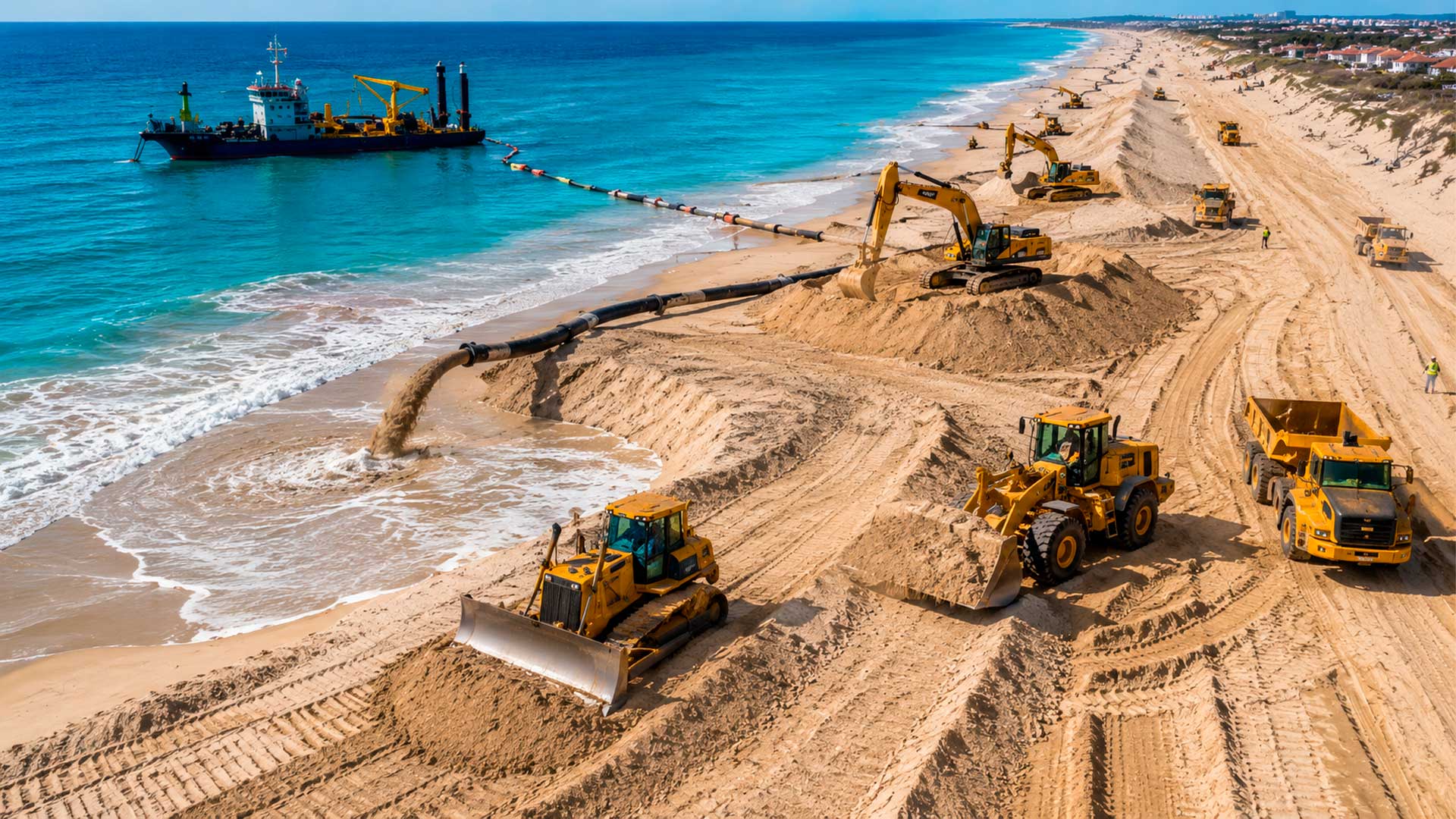

A 14.9 million euro project between Quarteira and Garrão uses dredging in the Atlantic to restore tourist beaches in the Algarve, reduce cliff erosion, and expand the sand strip before the bathing season in Portugal
Portugal began a major coastal intervention in the Algarve in 2026 to try to contain the loss of sand in one of the most pressured stretches of the country’s coastline.
The project involves the deposition of 1.4 million cubic meters of sediments between Quarteira and Garrão, in the municipality of Loulé, with the aim of widening the beach by an average of 37.5 meters.
According to the Government of Portugal, the intervention covers 6.7 kilometers of seafront, is part of the Coastal Zone Management Plan Vilamoura–Vila Real de Santo António, and received an investment of 14.9 million euros, an amount close to R$ 88 million at the recent exchange rate.
-
In the city that the market called “road cockroach,” between Balneário Camboriú and Florianópolis, he launched a planned neighborhood worth R$ 1 billion with a marina for 90 boats and sold 80% of the lots in the first phase in 1 week.

-
At a depth of 5,000 meters, where there is no sunlight, researchers found ancient DNA preserved in the mud of the South Atlantic and discovered signs of organisms that did not match known records.

-
At 77 years old, a retired woman who never tires of learning completes her second degree in design in Ceará and moves people by revealing the help of her 98-year-old mother in the final project.
-
China’s masterstroke: a plant capable of regrowing even when buried by sand helps to recover more than 7,300 hectares of desert with 5 million seedlings, roots over 10 meters deep, and rainfall below 150 mm per year.



The project was planned to be completed before the European bathing season, when the Algarve receives a strong influx of tourists.
The number circulating as “2.2 million tons” comes from the approximate conversion of the official volume of sand. The Portuguese technical source works with cubic meters, not tons, and public documents indicate that the material comes from a nearby underwater area, not from the United States.
The sand did not come from the USA and was taken from an underwater patch off the coast itself


The phrase “Portugal withdraws sand in the USA” does not appear in the official documents consulted. What exists in international texts is the expression “2.2 million U.S. tons,” a unit of mass used in the United States, which probably led to the incorrect translation to “in the USA.”
The English text itself states that the project uses sand dredged from an offshore area, that is, in the sea, near the coastal stretch.
In the descriptive memory of the project application, the material is described as sand accumulated in a “borrow pit” deposited along the Quarteira-Garrão section. The document also points out that the intervention occurs on a seafront of about 6,600 meters, between the Quarteira Fishing Port and Garrão.
The technique used is known as artificial beach nourishment. In practice, dredgers remove sediments from the seabed, transport the material, and pump it through pipelines to the beach. Then, machines spread the sand to form a new coastal profile.
The Algarve lost sand for decades and the work tries to buy time against erosion
The pressure on this stretch of the Algarve did not start now. The technical document cites the construction of the Vilamoura marina and the Quarteira groynes as works that altered the coastal drift, interrupting part of the natural transport of sand from west to east.
With less sediment arriving, the beaches became more vulnerable to wave attack.
The same report points out that the coastal stretch of Loulé is one of the most striking examples of erosion on the Portuguese coast. During storm periods, the lack of sand reduces the beach’s ability to absorb the sea’s energy, leaving cliffs, access points, roads, properties, and tourist structures more exposed.
The current intervention attempts to restore this natural protection. The goal is not just to create an artificial beach for tourism, but to keep the direct impact of the waves away from the base of the sandy cliffs and reduce the risk of coastline retreat.
A million-dollar project that protects tourism, residents, and coastal infrastructure
The Algarve heavily depends on its beaches. In the European summer, the region receives tourists from various countries, boosting hotels, restaurants, transportation, property rentals, local commerce, and services linked to the season. When the strip of sand shrinks, the problem ceases to be just environmental.
With less beach available, the bathing capacity decreases. It also increases the pressure on walkways, parking lots, access points, beach bars, and nearby residential areas. In the case of Quarteira-Garrão, the project aims to improve safety and maintain the use of the beaches during the busiest months.
The regional newspaper Barlavento reported that the works entered the operational phase in April 2026, with the installation of pipelines in the sea on April 2 and 3 and beach nourishment starting on April 4. The execution was organized by sections, passing through Trafal, Vale do Lobo, Garrão, Forte Novo, and Quarteira.
The construction account also reveals the cost of coastal adaptation. By dividing the investment of 14.9 million euros by 6.7 kilometers, the average expenditure exceeds 2.2 million euros per kilometer of protected coastline. It is a high expense, but less than the potential losses of losing beaches, access, properties, and entire economic activities in tourist areas.
Sand replenishment works, but does not freeze the shoreline
Artificial beach nourishment is treated in Europe as a more flexible alternative than walls, riprap, and large rigid barriers. The Climate-ADAPT platform, maintained by the European Environment Agency and the European Commission, describes the technique as a replenishment of sediments compatible with the original beach, capable of widening the sand strip and cushioning the energy of the waves before it reaches roads, dunes, and buildings.
But the technique itself has limits. It does not eliminate erosion. It only replenishes sand in a coastal system that remains subject to currents, storms, tides, wind, and rising average sea levels. Therefore, such projects require monitoring and, in many cases, new replenishments after a few years.
The history of the Algarve itself shows this limitation. The project application cites an intervention in 2010 on the Forte Novo-Garrão stretch, with 1.25 million m³ of sandy sediments. The estimate recorded in the document is that about 45% of the volume deposited in that operation had already disappeared years later.
This does not make the work useless. It shows that it buys time. Instead of “defeating” the sea, Portugal tries to reduce damage, keep beaches usable, and protect areas where coastal retreat can affect people, businesses, and public infrastructure.
The real cost appears after the sand reaches the beach
The visible part of the operation is the wider beach. The less visible part is in the environmental monitoring, the choice of the extraction area, the compatibility of the sand, the turbidity of the water, the protection of benthic habitats, and the care with possible submerged archaeological remains.
These stages weigh on the cost and timeline. They also explain why it is not enough to just dump any sand on the coast. The sediment needs to have the appropriate grain size, similar behavior to the original material, and controlled origin to avoid causing another problem instead of solving erosion.
The case of Quarteira-Garrão sums up an account that several coastal regions will have to face in the coming decades. Maintaining a tourist beach in the face of erosion requires public money, dredgers, licensing, monitoring, and acceptance that maintenance may become routine.
Portugal bet on 1.4 million m³ of sand, 6.7 km of intervention, and 14.9 million euros to gain, on average, 37.5 meters of beach. Now, the response will come from the sea itself: the new sand strip needs to withstand storms, currents, and the coming summers.
What do you think of this type of construction to contain the advance of the sea? Leave your comment and say whether it makes sense to invest millions to restore tourist beaches or if coastal countries should seek other forms of adaptation.